1970s

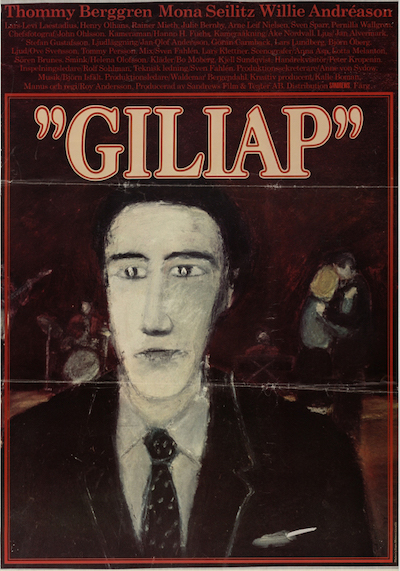
  • Roy Andersson – Giliap (1975)

    1971-1980CrimeDramaRoy AnderssonSweden

    Quote:
    Roy Andersson premiered his second feature-length film, “Giliap”, in 1975. The film is a marked departure from “A Swedish Love Story”, and that is no accident. Success brought pressure onto Andersson to make “A Swedish Love Story II”. But he didn’t want to be someone who churned out yet another film in the same spirit, and then one more… So he changed style drastically in “Giliap”. Andersson had great hopes for the film, but it found neither a public nor positive reviews. “Giliap” did, however, win a larger reception abroad, especially in France. Yet despite its meagre successes in Sweden, the film is interesting, not least aesthetically. For here one finds the first seeds of Andersson’s distinctive film style.
    In “Giliap”, actor Thommy Berggren plays a wandering day-labourer who takes employment at the fading Hotel Busarewski. The hotel is run by a wheelchair-bound misanthrope who harshly deals out orders to his staff as he reminisces about Busarewski’s former golden days.Read More »

  • Márta Mészáros – Szabad lélegzet AKA Riddance (1973)

    1971-1980ArthouseDramaHungaryMárta Mészáros

    Jutka, a young woman who works in a factory, falls in love with Andras, a university student. She pretends to be a student, to him and to his parents, and begins to live a lie. Finally she rebels against Andras and his demands and the social conventions that forced her to live a lie.Read More »

  • Kazuo Ikehiro – Mushukunin mikogami no jôkichi: Tasogare ni senko ga tonda AKA Mikogami Trilogy III: Slaughter in the Snow (1973)

    1971-1980JapanKazuo IkehiroMartial Arts


    29f7c043f76a2bde437fd0d52a185152

    SUMMARY
    In feudal Japan, women are vulnerable, in need of protection, and capable of deception. Jokichi of Mikogami, a drifter, has not yet fully revenged the death of his wife and son. He searches for Kunisada Chuji, who in turn has hired the knife-throwing Windmill Kobunji to kill him. Kobunji and Jokichi meet in the winter, near Sasago Pass, when both have rescued women: Jokichi has saved the lute-playing Oyae whose clan and whose lover want her dead; Kobunji has rescued Oharu, a well-born woman married to an innkeeper. Is this rescue a whim or something deeper? And why does Jokichi become the consumptive Kobunji’s protector? What ultimately will Jokichi do about Oyae?
    jhailey on IMDbRead More »

  • Kazuo Ikehiro – Mushukunin Mikogami no Jôkichi: Kiba wa hikisaita AKA Mikogami Trilogy I: The Trail of Blood (1972)

    1971-1980ActionAsianJapanKazuo Ikehiro


    SUMMARY
    Can a sinful man change and find peace? It’s unlikely in gang-plagued Japan. Jokichi of Mikogami, a drifter (and hired sword), goes straight after protecting a woman in distress: they marry, have a son, and Jokichi pursues his father’s craft. After three years, the gangs he embarrassed when he saved his wife find the family and leave Jokichi in grief, vowing revenge.
    jhailey on IMDbRead More »

  • Enzo G. Castellari – Il Grande Racket AKA The Big Racket (1976)

    1971-1980CrimeEnzo G. CastellariHorrorItaly

    Quote:
    Nico is a police inspector who is battling against gangsters who are terrorising an Italian town and extorting money from its locals. No one dares to speak out against them except a local restaurant owner. After telling all his daughter is swiftly raped and the inspector taken off the case. He decides, however, to go it alone and enlists support from victims of the hoodlums.”Read More »

  • Nelson Pereira dos Santos – Como Era Gostoso o Meu Frances AKA How Tasty Was My Little Frenchman [+Extras] (1971)

    Drama1971-1980BrazilNelson Pereira dos Santos

    THE BEGINNING OF THE EXPLOITATION OF BRAZIL
    In 1594 in Brazil, the Tupinambás Indians are friends of the Frenches and their enemies are the Tupiniquins, friends of the Portugueses. A Frenchman (Arduíno Colassanti) is captured by the Tupinambás, and in spite of his trial to convince them that he is French, they believe he is Portuguese. The Frenchman becomes their slave, and maritally lives with Seboipepe (Ana Maria Magalhães). *Contains Spoilers* Later, he uses powder in the cannons that the Portuguese left behind to defeat the Tupiniquins in a battle. In order to celebrate the victory, the Indians decide to eat him.Read More »

  • Ivan Cardoso – O Conde Gostou Da Coisa (1974)

    1971-1980BrazilComedyCultIvan Cardoso

    “Comedy in which three friends are on the table in a bar to drink and tell his adventures. What is exaggerating the sailor drinks while listening to a narrative of an exciting strip poker which ends in a huge orgy. The binge was so great that when you arrive home the sailor has a nightmare where he is pursued by wild women on an island … “Read More »

  • Tobe Hooper – Eaten Alive (1976)

    1971-1980CultHorrorTobe HooperUSA

    Quote:
    “Eaten Alive” is director Tobe Hooper’s 1977 follow up to “The Texas Chain Saw Massacre” (1974). While it is still a horror film that takes place in the deep South, it is a much different kind of film, and much like “Texas Chain Saw’s” first sequel, deals with a lot of humor, as well as over-the-top violence.

    The story starts with an awkward semi-rape scene involving Buck (played by a young Robert Englund) and a young prostitute. Englund has said that the Japanese version of this opening sequence inserted images of a stunt double’s genitalia, though the American version was more tame.Read More »

  • Stéphane Marti – Allegoria (1979)

    1971-1980ExperimentalFranceQueer Cinema(s)Short FilmStéphane Marti

    Quote:
    “A filmmaker and academic, Stephane Marti has pursued cinema as a visual art form, divorced from the codes of the dominant narrative cinema, since 1976. He is a passionate and militant advocate of Super-8, a filmmaking tool which he has used for 30 years.

    His work has been shown in festivals and international presentations and has elicited numerous articles and interviews. His flamboyant, baroque and sensual style focuses principally on the Body and the Sacred.Read More »

Back to top button