Quote:
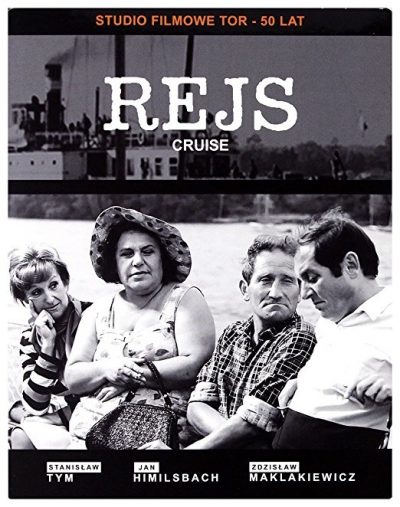
Life in Poland is satirized in this standard comedy drama about a group of people who take a short cruise together, a brief vacation along a river before the demands of life and work are faced again. The wide mix of passengers goes from one end of the personality spectrum to the other, and the close quarters make mingling, talking, and interacting all the easier. Sight gags and sharp wit keep the cruise, and the comedy, rolling along at a good pace.Read More »
1970s
-
Marek Piwowski – Rejs AKA The Cruise (1970)
1961-1970ComedyCultMarek PiwowskiPoland -
J. Lee Thompson – Battle for the Planet of the Apes (1973)
1971-1980ActionJ. Lee ThompsonSci-FiUSASynopsis:
“Battle for the Planet of the Apes” is the final chapter in the sci-fi movie series. In this chapter, a tribute of human atomic bomb mutations are out to make life miserable for the peaceful ape tribe. The story is told primarily in flashback with the opening and closing taking place in the year 2670.Read More » -
Jean-Pierre Melville – Un flic AKA A Cop (1972)
1971-1980CrimeDramaFranceJean-Pierre MelvilleQuote:
Edouard Coleman (Alain Delon) spends his days and nights chasing criminals, but doesn’t see the crook right under his nose. Simon (Richard Crenna), a smooth nightclub owner, works with a small crew to execute daring heists with big payoffs, while the beautiful Cathy (Catherine Deneuve) is torn between them. As cop and criminal do what they do best, paths converge and old scores must be settled. The 13th and final film from Gallic great Melville (Bob Le Flambeur, Army of Shadows) doubles-down the ice-blue look that had been the director’s signature in Le Samourai and Le Cercle Rouge, both starring the equally cool Delon.Read More » -
Masaru Konuma – OL kanno nikki: Ah! Watashi no naka de AKA Erotic Diary of an Office Lady (1977)
1971-1980AsianEroticaJapanMasaru Konuma

Synopsis:
Japanese pink film in Nikkatsu’s Roman Porno series starring Asami Ogawa and directed by Masaru Konuma. Ogawa’s debut film, this was the seventh and last entry in the Office Lady Journal series, which had been launched in 1972 with Office Lady Journal: Scent Of Female Cat. In their Japanese Cinema Encyclopedia: The Sex Films, the Weissers write, “This film is a perfect end to the series. Konuma is the master of free-form, rambling cinema. He manages to make ordinary life seem extraordinary with moments of kinkiness (i.e., the eroticism of a sex scene with Ms. [Aoi] Nakajima wearing a full kimono dress; or another segment where Asami is making love in a room full of baby chicks).”
— From wikipedia.Read More » -
Claude Jutra – Mon oncle Antoine AKA My Uncle Antoine (1971)
1971-1980ArthouseCanadaClaude JutraDrama

All Movie.com Plot Synopsis by Hal Erickson
With Mon Oncle Antoine, actor Jean Duceppe established himself as Canada’s principle purveyor of eccentric relatives. Playing the uncle of 15-year-old Jacques Ganon, Duceppe acts as the lad’s confidante through the difficult coming-of-age process. The Canadian backwoods and the mining-town milieu of the 1940s are displayed to excellent nostalgic advantage in this retrospective piece from writer/director Claude Jutra (who also plays a supporting role). Though relatively unknown in the states (and often dismissed as unremarkable by below-the-border critics), Mon Oncle Antoine is regarded as a classic of the Canadian Cinema. The film won an unprecedented eight statuettes at the 1972 Canadian Film Institute Awards, including best picture and best director.Read More » -
Larisa Shepitko – Voskhozhdeniye AKA The Ascent (1977)
1971-1980DramaLarisa ShepitkoUSSRWarTwo Soviet partisans on a mission to gather food contend with the winter cold, the occupying Germans, and their own psyches.
Letterboxd review by Lara Pop ★★★★½:
It rarely gets bleaker than The Ascent. Larisa Shepitko’s tale of perseverance in the face of imminent death surprised me on several counts. For the first half of the movie, I couldn’t figure out the significance of the title. If anything, Shepitko presents its exact opposite. The barren, snow-covered landscape, where death lurks in every grinding step man takes, devours the movie in its all-consuming white death. The shaky camera movement enhances every sound made in the white silence as the camera zooms in on man’s face and outlines the thin crust of ice scratching his cheek with its cold tendrils, stretching, reaching, with one goal in mind: to get to the innermost layer: the spirit; and to break it. It is a tableau of a frostbitten feast, an icy infusion of a deathly descent, straight into the vein. I couldn’t figure out why I was watching a film named its exact opposite.Read More » -
Bruno Barreto – Dona Flor e Seus Dois Maridos AKA Dona Flor and Her Two Husbands [+Extra] (1976)
1971-1980ArthouseBrazilBruno BarretoComedy

Quote:
In a small city of Brazil, a woman named Flor marries a man named Vadinho, but once married she finds that he is a good-for-nothing. She works teaching cooking and he takes all of her money to gamble. After Vadinho dies, Flor marries Tedoror, the owner of a drugstore. Flor is happy with her new husband but misses the love life with her previous husband. When one day the ghost of Vadhino comes back to peruse her.Read More » -
Andrzej Zulawski – Diabel AKA The Devil (1972)
1971-1980Andrzej ZulawskiArthouseHorrorPoland

Quote:
At the climax of Harold Pinter’s vaguely allegorical but wholly chilling play The Birthday Party, the broken hero is being taken away by strangers, no doubt to a bad place. The locals, who have no idea what sort of political act of terror is being committed, stand by helplessly, but one of them rises and says, “Stan, don’t let them tell you what to do!” Even though Pinter never makes a specific point of reference as to what deplorable regime is imposing its will, the viewer intuitively understands the message. So it is with Andrzej Zulawski’s The Devil. International audiences unfamiliar with Polish politics might not know or care that his horror film was based on actual events from the turbulent 1960s, during which communist authorities provoked a group of Warsaw students into staging anti-censorship protests. Read More » -
Govindan Aravindan – Kanchana Sita AKA Golden Sita (1977)
1971-1980ArthouseExperimentalGovindan AravindanIndiaSynopsis:
The film interprets a story from the Uttara Kanda of the epic poem Ramayana, where Rama sends his wife, Sita, to the jungle to satisfy his subjects. Sita is never actually seen in the film, but her virtual presence is compellingly evoked in the moods of the forest and the elements. The film retells the epic from a feminist perspective, and is about the tragedy of power and the sacrifices that adherence to dharma demands, including abandoning a chaste wife.Read More »


