1960s

  • Károly Makk – Elveszett paradicsom AKA Lost Paradise (1962)

    1961-1970DramaHungaryKároly Makk

    Hungarian filmmaker Károly Makk was an important figure in the development of Hungarian cinema after WWII. He made his directorial debut in 1954. Prior to that, he attended the Budapest Academy of Film Art and then was an assistant director on Geza von Radvanyi’s Somewhere in Europe. While his films of the ‘60s were well respected in Hungary, Makk’s work did not receive international recognition until 1971, when his Love won the Special Jury Prize at Cannes. Since then, he has gained an international reputation. His 1982 film Another Way was the first Eastern European film to deal directly with gay and lesbian concerns. (Mubi)Read More »

  • Marco Ferreri – Break up AKA The Man with the Balloons (Uncut) (1965)

    1961-1970ArthouseComedyItalyMarco Ferreri

    Synopsis :
    An industry that manufactures chocolates, is obsessed to the limit, to scientifically verify the exact spot where the balloons burst when they swell, but fails in its attempts, because they always end up breaking balloons, putting nerves increasingly enervated and reaching complete neurosis, while his great woman, just married, waiting on the bed, something more to him than his passion for inflating balloons.Read More »

  • Hiroshi Teshigahara – Otoshiana AKA Pitfall (1962)

    1961-1970AsianCrimeHiroshi TeshigaharaJapan

    When a miner leaves his employers and treks out with his young son to become a migrant worker, he finds himself moving from one eerie landscape to another, intermittently followed (and photographed) by an enigmatic man in a clean, white suit, and eventually coming face-to-face with his inescapable destiny. Hiroshi Teshigahara’s debut feature and first collaboration with novelist Kobo Abe, Pitfall is many things: a mysterious, unsettling ghost story, a portrait of human alienation, and a compellingly surreal critique of soulless industry, shot in elegant black and white.Read More »

  • Andrey Smirnov & Larisa Shepitko – Nachalo nevedomogo veka AKA Beginning of an Unknown Era (1967)

    1961-1970Andrey SmirnovDramaLarisa ShepitkoUSSR

    During the most liberal period of the Khrushchev regime, Grigori Chukrai, director of the classic Ballad of a Soldier, presided over an “experimental studio” dedicated to nurturing new talents. The studio was closed after it produced the three-part Beginning of an Unknown Era, conceived as a memorial for the 50th anniversary of the October Revolution. The film was shelved and to this day the negative is reported lost. However, a print of Andrei Smirnov’s episode Angel and Larissa Shepitko’s Homeland of Electricity survived – both films were premiered at the 1987 Moscow Film Festival. It is understandable that the authorities might have considered Angel and Homeland of Electricity inappropriate for trumped-up celebrations of the Revolution.Read More »

  • Glauber Rocha – Deus e o Diabo na Terra do Sol AKA Black God, White Devil [+commentaries] (1964)

    1961-1970ArthouseBrazilDramaGlauber Rocha

    Quote:
    After killing his employer when said employer tries to cheat him out of his payment, a man becomes an outlaw and starts following a self-proclaimed saint.

    Reehan Miah wrote:
    Glauber Rocha’s Aesthetics of Hunger – a 1965 essay which attempts to explicate the Cinema Novo – reads like a convoluted mass of allegations, opacities and rhetoric (none of which are necessarily without substance). Somewhere within these imbroglios however, one stumbles upon an assertion that’s especially jarring:Read More »

  • Claude Chabrol – L’avarice [Les sept péchés capitaux] (1961)

    1961-1970Claude ChabrolComedyFranceShort Film

    Quote:
    “L’Avarice” was Chabrol’s contribution to the 1962 French/Italian omnibus film LES SEPT PÉCHÉS CAPITAUX (which also featured contributions from de Broca, Jacques Demy, Sylvain Dhomme, Max Douy, Jean-Luc Godard, Eugène Ionesco, Edouard Molinaro, and Roger Vadim) in which a group of twenty-five engineering students put hold a lottery to pick who gets to spend a 50,000 franc evening with a beautiful prostitute. The film was photographed in Franscope by Jean Rabier (Henri Decae’s camera operator on LE BEAU SERGE and LES COUSINS.)
    —DVD BeaverRead More »

  • Robert Lapoujade & Jacqueline Plessis – Le Socrate [Jacqueline Plessis version] (1968)

    1961-1970ArthouseExperimentalFranceJacqueline PlessisRobert Lapoujade

    Shows the eccentricties of Le Socrate, a philosopher who has divorced himself from materialistic society and a local policeman assigned to watch him.

    scenario : Jean-Patrick ManchetteRead More »

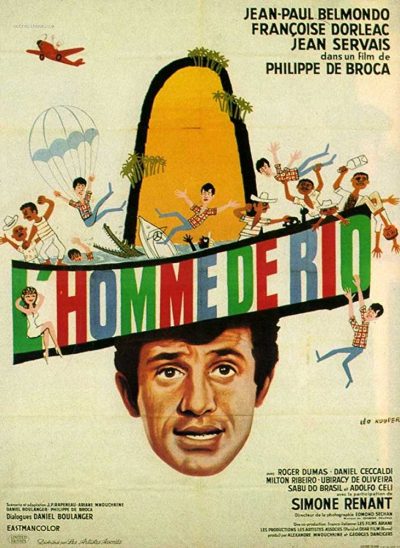
  • Philippe de Broca – L’homme de Rio AKA That Man from Rio (1964)

    1961-1970ArthouseComedyFrancePhilippe de Broca

    Synopsis:
    Farce, spy spoof, and adventure. Swarthy thieves ignore jewels to steal an Amazon figurine from the Museum of Man in Paris’ Trocadero Palace and kidnap the world’s authority on the lost Maltec civilization. Cut to Agnes, the daughter of a murdered man who possessed one of two other such figurines. Moments after her sweetheart, Adrien, an Army private with a week’s leave, arrives in Paris to see her, Agnes too is kidnapped, drugged, and loaded on a plane to Rio. Adrien is in hot pursuit, and before he can rescue her (with the help of a shoeshine boy), foil the murderous thieves, and solve the riddle of the Maltecs, he must traverse Rio, Brasília, and the Amazon heartland… all before the end of his week’s leave.Read More »

  • Robert Mulligan – Inside Daisy Clover (1965)

    1961-1970DramaRobert MulliganUSA

    Quote:
    “Inside Daisy Clover” is one of those films which divides movie buffs, beloved by some and detested by others. There’s no doubt that it’s an acquired taste, thanks largely to Wood’s bravely quirky, potentially audience-alienating performance in the title role – that of a 1930s teen starlet nurtured and then devoured by Hollywood’s monolithic studio system – one Swan Studios, run by a truly frightening Christopher Plummer (a role played the same year he did “The Sound of Music”).Read More »

Back to top button