

A man saves a woman who had been kidnapped by Comanches, then struggles to get both of them home alive.Read More »
A man saves a woman who had been kidnapped by Comanches, then struggles to get both of them home alive.Read More »

A young woman leaves a state orphanage to find her mother in this interesting examination of
how the overt repression of women in the older pattern of village life has been replaced by
the more subtle sexual and economic exploitation inherent in the apparently freer existence
of young girls in the contemporary city. A key film from Marta Meszaros.Read More »

From Amos Vogel’s Film as a Subversive Art:
This powerful, unsettling film elevates voyeurism to its central element in a series of raw sexual encounters reflected in an apartment mirror, from which a hidden camera records its images. The lustful sex turns increasingly pathetic and the mirror is finally smashed in despair. The “playing” on reality — the entire film is staged, the mirror thus reflecting a double illusion — is eminently modern and structural, as is the camera’s passive immobility, with action at times leaving the frame or the film “running out”.Read More »
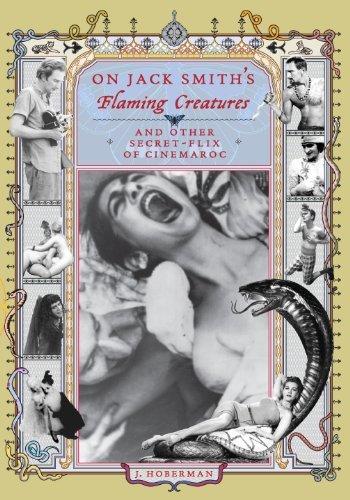
Part of the New American Cinema group in New York City during the 60s, Jack Smith’s flamboyant aesthetic can be characterized by a mix of baroque exoticism, gaudy costumes, and detritus salvaged from the city streets. Flaming Creatures is a non-narrative, Dionysian orgy, complete with wild dancing, gender bending, and a climactic earthquake. The carnivalesque madness of the film is reinforced by the chaotic density of its formal composition. Smith’s deliberate spatial disorientation creates a pansexual landscape of tangled body parts; just as the viewer is unable to situate the visual coordinates of the image, the creatures are unaware of which extremity belongs to whom.Read More »

Quote:
Eburi is a 36 year-old man. Nothing enthuses him any more. While being drunk, he promises to contribute a story to a magazine. When he sobers down, he decides to write about the life of a salaried employee like himself who is very ordinary, not particularly talented.
The following is his story:
In 1949, Eburi gets married to Natsuko. His monthly salary is 8,000 yen and hers 4,000 yen. Therefore, both have to work to support themselves. Eburi has developed a habituIl tendency to pester around when he gets drunk. One year after their marriage, son Shosuke is born. In 1959, Eburi’s mother dies in despair of her husband who has become listless due to the several ups and downs of gaining big profits and going bankrupt. His father is still alive and Eburi is enable to find a way to pay his father’s debts.Read More »

IMDB:
In 1718, on a small island off the Carolina coast, a recently freed family of indentured servants plans to settle and homestead there but they run into conflict with a group of fishermen also claiming ownership of the island.Read More »

Quote:
Yasuzo Masumura based his story on prize winning Edogawa Ranpo’s book [Hanayaka na shitai]. It’s a thriller about a Food Company’s boss being killed and the search for his murderer. Part of the movie is a trial movie.Read More »

Quote:
An aging group of outlaws look for one last big score as the “traditional” American West is disappearing around them.Read More »

Autotranslated description:
Scenes from New York in the 1960s. Four young people, friendship, jealousy, separation. Filmed in black and white, with an agile camera, without dialogue. Mark Rappaport’s early work was shot in 16mm on superimposed film material. Mark Rappaport’s instruction to the light controller in the “Movielab” copier: “Scenes are overexposed. Please try hard to get this to look good.” The camera and optical sound negative was found by Rick Prelinger. The Munich Film Museum has digitized it and redefined it. Sound disturbances at the beginning of the film and image damage at the end of the film are due to water damage.
(Stefan Drössler)Read More »