In the late 1950’s prostitution was banned in Japan and if a woman was found exercising this profession they were sent to a reformatory. This is a story of one of these brave women Kuniko who is released from the reformatory and tries to build a new life.Read More »
Synopsis: Two friends take two prostitutes for a night of pleasure. But the night turns out to be frustrating for all involved, as much bitterness is revealed in their conversation and attitudes, uncovering their anguish and deeper feelings, and the emptiness of their lives.Read More »
From Amos Vogel’s Film as a Subversive Art: Possibly the most ‘aesthetic’ and ‘experimental’ of revolutionary Cuba’s films, this outstanding work utilizes high-contrast photography, over-exposure, and solarization to create the faded chiaroscuro and poetic authenticity of the period it depicts. The film deals with an 1870 uprising against the Spanish occupation troops in Cuba, in which the machete, originally used to cut sugar cane, becomes a weapon of the people’s warfare. The portrayals of decadent upper classes and heroic peasants are sharp and incisive, and distancing devices – such as characters addressing the camera – are used to induce attitudes of analysis instead of involvement. The emergence of such a strongly poetic work within the Cuban film industry testifies to the divergent aesthetic tendencies permitted expression within the revolution.Read More »
Quote: Misumi directs an adaptation of a famous novel written by Yamasaki Toyoko, writer whose works were adapted numerous times for TV (Shiroi Kyotō is a sort of cult here in Japan) and for the big screen. Kyō Machiko, Wakao Ayako and Takada Miwa star in a story about a wealthy family and the greed and selfishness of his three daughters, and relatives, after the passing of their old father. The movie casts a dim light on family relationships and money, where the only ray of hope seems to come from the younger generations. Cinematography, music and editing are top-notch, the manner in which Misumi and his editor cut from one scene to the following in many passages of the film is really mesmerizing.Read More »
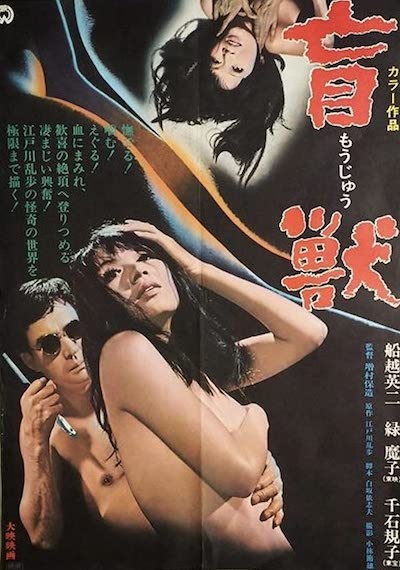
Blind Beast is a grotesque portrait of the bizarre relationship between a blind sculptor and his captive muse, adapted from a short story from Japan’s foremost master of the macabre, Edogawa Rampo (Horrors of Malformed Men, The Black Lizard, Caterpillar).Read More »
Synopsis: Two young women leave the claustrophobic existence of the big city behind and move to a small border town. They get caught up with a border guard who is involved in smuggling from both sides of the border. When the border changes as a result of a political realignment, the two young women end up living with the guard. Both fall for the man, but jealousy rears its ugly head and they move back to the city. The ever-restless women soon leave the city behind and return to the border where they continue their youthful romps with the guard and other willing participants. The guard has women on both sides of the line who help in his illegal activities.
Quote: Two adventurers and best friends, Roland and Manu, are the victims of a practical joke that costs Manu his pilot’s license. With seeming contrition, the jokesters tell Roland and Manu about a crashed plane lying on the ocean floor off the coast of Congo stuffed with riches. The adventurers set off to find the loot.Read More »
Quote: Children of the old herdsman Banaya been living in the city. However, the younger son, who had come on vacation, Bakai, wants to leave in the pasture, despite the fact that the boy had become accustomed to the city and loves school.Read More »