

PLOT:
Shohei Imamaura’s debut film follows a man who joins a troupe of traveling actors, and becomes involved with one of the married actresses and her younger sister.Read More »
PLOT:
Shohei Imamaura’s debut film follows a man who joins a troupe of traveling actors, and becomes involved with one of the married actresses and her younger sister.Read More »

THE TREASURE OF BIRD ISLAND (POKLAD PTACIHO OSTROVA) – 1952, 77 min. Dir. Karel Zeman. Inspired by a Persian fairy-tale, and told in the ornate style of illustrated Persian manuscripts, Zeman’s first feature is set on a remote island, where the inhabitants discover a legendary treasure that brings them both joy and grief. For the first time in BIRD ISLAND, Zeman combined stop-motion puppetry and traditional animation to create a timeless, glittering world of wonders.Read More »

America’s mid-20th century love affair with the Biblical epic began with Mervyn LeRoy’s Quo Vadis (1951). And a new Blu-ray by Warner Home Video goes a long way to proving why that’s the case. The saturated colors and epic setpieces that dominate the film’s mise-en-scène are reason enough to sit back and enjoy the spectacle. But Peter Ustinov’s scenery-chewing performance as the last Roman Caesar, Nero, is another great justification. This film was the template for future movies of its ilk, and should be seen for that if for no other reason. Like The Robe (1953), or Ben-Hur (1959), Quo Vadis is based on a historical novel that examines the nascent religion of Christianity through the eyes of an outsider. Here it is loyal Roman commander Marcus Vinicius (Robert Taylor), who falls in love with a Christian slave, the beautiful Lygia (Deborah Kerr), while struggling to remain loyal to the increasingly mad Emperor Nero. Lygia’s entreaties for Vinicius to join her in following Christ’s teachings are initially dismissed.Read More »

Introduction
A dark satire of a contemporary Japan still exhausted from the aftermath of war, hunger, poverty and unemployment.And just as its people are recovering, there is a threat during these Cold War years of renewed militarism and rearm…Read More »

Eccentric film about female reporter fired for writing about police corruption. To make money she hides while a weekly magazine offers a prize for her discovery. A bank embezzler and his underlings take advantage of her disappearance to pin the theft on her, as well as the murder of the weak link in their gang. Meanwhile, the cop she got fired is now a private detective and he gets involved in the investigation. Another example of Ichikawa’s mixing of farcical genre filmmaking with perspicacious visual design. Comic highlights include an intentions of murder scene in which each shot reveals the gap in knowledge between potential perpetrator and victim, and the role of unseen objects in accidentally protecting the latter from the former. Another cynical film that finds in cinema a model for the superficial image society of 1950s Japan.Read More »

Plot Synopsis: Adapted by Leon Uris from his own novel, the film follows a group of World War II marines, from Basic Training to Battlefield. Major Van Heflin knows that his men are spoiling for a real fight, but must make do with the desultory skirmishes assigned them by the Brass. All this changes with an onslaught of heavy-duty battling in the South Pacific. Aldo Ray plays a tough leatherneck who falls in love with demure Nancy Olson, while James Whitmore, Tab Hunter, Dorothy Malone and Raymond Massey costar. And watch for young Justus McQueen, cast as private L.Q. Jones; McQueen liked his character name so much that he adopted it as his professional cognomen. Composer Max Steiner’s musical score earned him an Oscar nomination. — Hal Erickson (AMG)Read More »
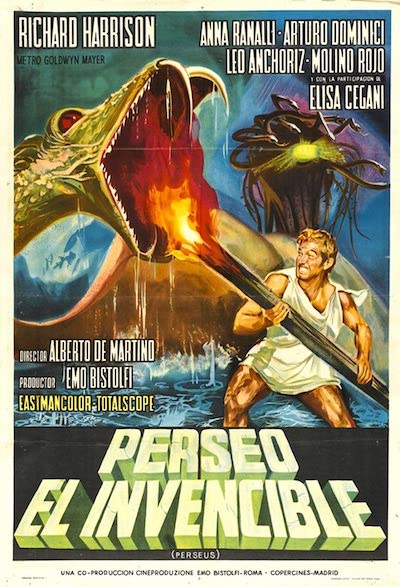
Perseus is designated by fate to save the peaceful kingdom of Serifos by defeating a sea monster and the gorgon Medusa, then by repelling the advancing army of the hostile city of Argos.
The film’s unique and terrifying version of Medusa was the early work of Carlo Rambaldi, who later gained fame in Hollywood creating creatures for King Kong, Close Encounters of the Third Kind and E.T. The sea monster was supervised by Armando de Ossorio, who later directed the Spanish “Blind Dead” quadrilogy.Read More »

Set in post war Japan, the film tells the tale of a woman (Martha Hyer) looking for her missing brother. Her brother operated a small export business and has suddenly disappeared. Strangely his business partner has also vanished. Japan is portrayed as a hotbed for smugglers and snoopers all trying to make a buck anyway they can.
Hyer soon comes in contact with the Japanese police who are somewhat sympathetic but they are also hunting for her brother because they believe he was involved in some smuggled opium. In steps an American ex-serviceman (Byron Mitchie), who works the black market and agrees to help Hyer find her brother.Read More »

In Venice, a failed and alcoholic musician attends the concert of his teenage son, a precocious conductor who has never met him. Three years after “Prélude à la gloire”, in order to confirm the aura of child star Roberto Benzi, this new film embroiders a fictional story around filial bonds and the father’s remorse. While Roberto Benzi, as impressive as a conductor as he is a poor actor, does what he can, Jean Marais, leaving for the first time his usual part of young leading man, is quite impressive. With the help of excellent supporting actors: Fernand Sardou, Edouard Belmont and Jacqueline Porel, he allows the film to rise above its condition of melodramatic and conventional work. The direction of Georges Lacombe, sober and elegant, does not fail. The film, although less successful than its predecessor, is famous for having generated a good number of musical vocations among the young people of the time.Read More »