1940s

  • Hans Steinhoff & Karl Anton & Herbert Maisch – Ohm Krüger aka Uncle Kruger (1941)

    Hans Steinhoff1941-1950DramaGermanyHerbert MaischKarl AntonPoliticsThird Reich Cinema
    Ohm Krüger (1941)
    Ohm Krüger (1941)

    The most incendiary of Nazi Germany’s anti-British films, and one of the most audaciously cynical movies ever made. Conceived by Joseph Goebbels’ Propaganda Ministry as a propagandistic blockbuster, this lavish production leaves no stone unturned in its bitter indictment of Great Britain, which at the time (early 1941) stood alone as Germany’s wartime foe. In its historical re-enactment of the Second Boer War, Ohm Krüger depicts Britain as a relentlessly aggressive power, hell-bent on world domination; the film’s remarkable set pieces feature a scotch-swilling Queen Victoria, a cruelly conniving Cecil Rhodes and a Winston Churchill look-alike who presides over a murderous concentration camp. On the Boer side stands saintly “Uncle” Krüger, portrayed as a model of simple dignity and unerring moral right by one of the world cinema’s greatest actors, Emil Jannings. Read More »

  • Luchino Visconti – La terra trema AKA The Earth Trembles (1948)

    Luchino Visconti1941-1950DramaItalian Neo-RealismItaly
    La terra trema (1948)
    La terra trema (1948)

    Quote:
    With La Terra trema, Luchino Visconti shows an extraordinary concern and sympathy with the plight of ordinary Sicilian fisher folk. Coming from a privileged aristocratic background, Visconti was so appalled by what the fascists had done to his country that he took up with left-wing politics and Marxist ideology. Whilst this political awareness does make its way into La Terra trema, what is far more striking is Visconti’s genuine compassion for the people he is filming. He conveys their sense of pride and nobility, as well as their extreme hardship and inability to make a better lot for themselves. Perhaps it is the fact that Visconti came from such a totally different world that allows him to engage so forcefully with his subject, to draw out every scintilla of poignancy, not as a complacent distant voyeur, but as someone who is profoundly moved by what he is seeing around him.Read More »

  • Douglas Sirk – Hitler’s Madman (1943)

    Douglas Sirk1941-1950DramaUSAWar
    Hitler's Madman (1943)
    Hitler’s Madman (1943)

    Synopsis:
    Somewhat fictionalized account of the destruction of the village of Lidice in Czechoslovakia and the events leading up to it. In 1942, the Allies parachuted a Czech resistance fighter into the area. He quickly reunites with his former girlfriend and many of the villagers who knew him from before the war. The Nazis are evil however and under the command of Reinhardt Heydrich rule the country with an iron fist, arbitrarily arresting innocents and charging them with fictitious crimes. When Heydrich is severely wounded in a roadside attack – he dies three days later – Henrich Himmler orders the destruction of Lidice. The men are herded into a church which is set aflame and the women are sent to concentration camps. The town itself is leveled.Read More »

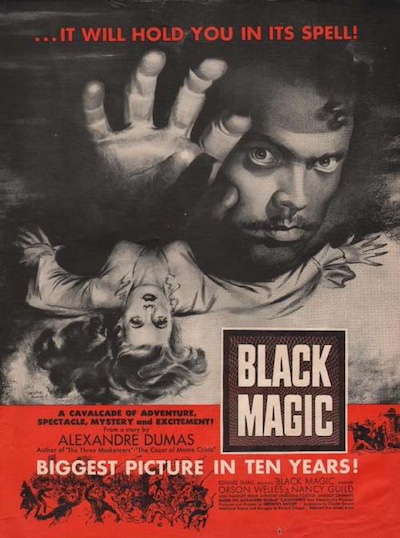
  • Gregory Ratoff & Orson Welles – Black Magic (1949)

    Gregory Ratoff1941-1950DramaMysteryOrson WellesUSA
    Black Magic (1949)
    Black Magic (1949)

    Synopsis:
    A gypsy man discovers that he is a natural hypnotist, and decides to make a fortune off of his ability. When he meets the Viscount who had ordered the execution of his parents and his own whipping and blinding (the latter from which he escaped), he uses his abilities to gain vengeance. Of help to him is a woman who has a startling resemblance to Marie Antoinette. Soon, his lust for power and his love for the woman gain control of him.Read More »

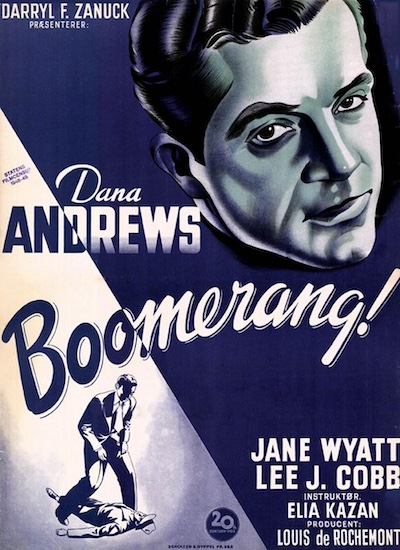
  • Elia Kazan – Boomerang! (1947)

    1941-1950CrimeElia KazanFilm NoirUSA
    Boomerang! (1947)
    Boomerang! (1947)

    Quote:
    Boomerang, directed by Elia Kazan, is a chilling film noir, the true story about the murder of a priest, the subsequent arrest and trial of a jobless drifter, and the efforts of young state’s attorney Henry Harvey (Dana Andrews) to uncover the truth. Closely based on the actual 1924 murder of Fr. Hubert Dahme in Bridgeport, Connecticut, the film was directed by the young Elia Kazan in a highly effective, semi-documentary style. Kazan shot most of the film on location, using high-contrast cinematography and an extremely mobile camera to create a palpable sense of urgency. The screenplay, expertly crafted by Richard Murphy received an Academy Award nomination.Read More »

  • Edgar Neville – El crimen de la calle de Bordadores (1946)

    Edgar Neville1941-1950CrimeMysterySpain
    El crimen de la calle de Bordadores (1946)
    El crimen de la calle de Bordadores (1946)

    On a dark night, the body of a well-known society woman is found; the investigators immediately suspect that the killer was the woman’s maid. For her part, the maid demands that the woman’s fiancé be brought in for questioning. Some journalists covering the story decide to follow up on the maid’s suggestion and gradually piece together the chain of events that led to the murder.

    Suave and good-looking, the fiancé was taking advantage of the dead woman, his attentions more focused on a much tougher young lady. Yet just as the narrative of the crime starts to come together, sudden revelations challenge all the information already discovered by the journalists. As someone renowned for his own storytelling abilities, Edgar Neville used this philosophical thriller as way of meditating on how stories are created, as well as the complex relationship between a tale and its teller.Read More »

  • Kenji Mizoguchi – Joyû Sumako no koi AKA The Love of Sumako the Actress (1947)

    Kenji Mizoguchi1941-1950DramaJapan
    Joyû Sumako no koi (1947)
    Joyû Sumako no koi (1947)

    Quote:
    The stage director Shimamura, who is bringing western theatre to Japan, falls in love with the outspoken actress Sumako Matsui, and leaves his family to be with her, while trying to keep his Art Theatre solvent.Read More »

  • Giorgio Ferroni – Tombolo, paradiso nero (1947)

    Giorgio Ferroni1941-1950DramaItalian Neo-RealismItaly
    Tombolo, paradiso nero (1947)
    Tombolo, paradiso nero (1947)

    Quote:
    Tombolo, paradiso nero is a 1947 film directed by Giorgio Ferroni. Inspired by an article by Indro Montanelli, the film depicts the undergrowth of smugglers, prostitutes and deserters from the post-war Pineta del Tombolo, when the US military was stationed in the area.Read More »

  • Ford Beebe – Enter Arsene Lupin (1944)

    Ford Beebe1941-1950CrimeFilm NoirUSA
    Enter Arsene Lupin (1944)
    Enter Arsene Lupin (1944)

    A rich but naive young woman is in possession of some priceless jewels. She doesn’t realize it, but a gang of jewel thieves does.Read More »

Back to top button