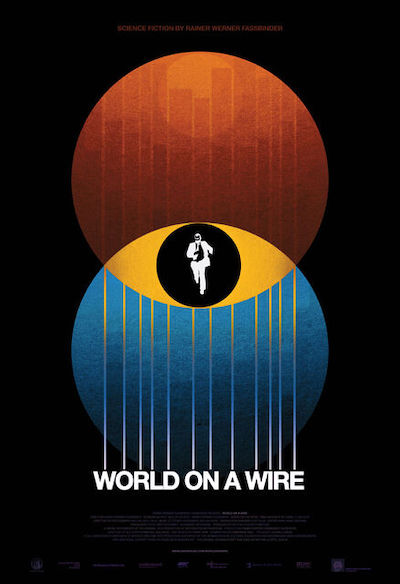
Somewhere in the future there is a computer project called Simulacron one of which is able to simulate a full featured reality, when suddenly project leader Henry Vollmer dies. His successor Dr. Fred Stiller experiences odd phenomena. A good friend, Guenther Lause, disappears in the middle of a conversation and a week later nobody has ever heard of him. And those fits of dizzyness – Stiller cannot believe himself to be fool. There has to be an explanation for all this. Could Simulacron have something to do with it?Read More »
-
Rainer Werner Fassbinder – Welt am Draht AKA World on a Wire (1973)
1971-1980GermanyRainer Werner FassbinderSci-FiTV -
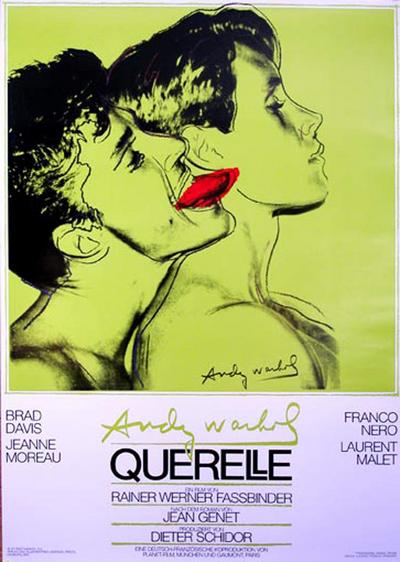
Rainer Werner Fassbinder – Querelle (1982)
1981-1990DramaGermanyRainer Werner FassbinderPlot Synopsis by Brian J. Dillard (allmovie.com)
A sailor learns to take, and give, it like a man in this surrealistic adaptation of writer and thief Jean Genet’s novel Querelle de Brest by avant-garde German director Rainer Werner Fassbinder. In a colorful brothel in the port of Brest, proprietor Nono (Gunther Kaufmann) is known for wagering with his customers. Win a throw of the dice, and they get to make love with his wife, Lysiane (Jeanne Moreau); lose, and they must take it from behind by Nono himself. One day, Lysiane reads the tarot for her lover, Robert (Hanno Poschl), and learns in the cards of his intense passion for his brother, Querelle (Brad Davis). Querelle himself soon arrives, and the brothers enact a bizarre greeting halfway between a hug and a wrestling match. Querelle, it seems, is looking for partners in a drug deal; Robert points him in the right direction. An argument about the merits of sex between men soon leads Querelle to murder his fellow smuggler, Vic (Dieter Schidor). Back at the whorehouse, Querelle loses on purpose to Nono and finds he has a taste for passive gay sex. Meanwhile, fellow sailor Gil, who looks exactly like Querelle’s brother (and is played by the same actor), murders one of his compatriots after the brute publicly impugns his manhood. Wanted by the police for both his own crime and Querelle’s, Gil goes on the lam. Querelle soon crashes his hideout, and an intense bond develops between the two murderers — a friendship that will lead Querelle to the greatest love, and the greatest treachery, of his life. Director Fassbinder was in the process of editing Querelle when he died of a drug overdose in June 1982. Gunther Kaufmann, who plays Nono, was Fassbinder’s ex-lover; the film is dedicated to another former lover, El Hedi Ben Salem, the news of whose suicide had just reached the director. Critically derided even by many of Fassbinder’s admirers, Querelle earned a Golden Raspberry award for Worst “Original” Song for “Each Man Kills the Thing He Loves,” an Oscar Wilde poem set to music by Peer Raben and sung repeatedly by Jeanne Moreau. Moreau had previously starred in Mademoiselle, a Tony Richardson effort co-scripted by Genet. Look for Frank Ripploh, another pioneering German director, in a cameo.Read More » -
Joël Le Moigné – Les poneyttes (1967)
1961-1970DramaFranceJoël Le MoignéSynopsis:
Max Thorp, 25, succeeded everything : he manages a famous magazine, a nightclub, a recording studio and a radio station. But high was the price for this success…Read More » -
Ben Rivers – Slow Action (2011)
2011-2020Ben RiversDocumentaryUnited KingdomSlow Action is a post-apocalyptic science fiction film which exists somewhere between documentary, ethnographic study and fiction. Slow Action applies the idea of island biogeography – the study of how species and eco-systems evolve differently when isolated and surrounded by unsuitable habitat – to a conception of the Earth in a few hundred years; the sea level rising to absurd heights, creating hyperbolic utopias that appear as possible future mini-societies.
Slow Action is filmed at different sites across the globe: Lanzarote – a beautiful strange island known for its beach resorts yet one of the driest places on the planet, full of dead volcanoes and strange architecture; Gunkanjima – an island off the coast of Nagasaki, Japan, a deserted city built on a rock, once home to thousands of families mining its rich coal reserves; Tuvalu – one of the smallest countries in the world, with tiny strips of land barely above sea level in the middle of the Pacific; and Somerset – an as yet to be discovered island and its various clades.Read More »
-
Rainer Werner Fassbinder – Wildwechsel AKA Jail Bait (1973)
1971-1980ArthouseDramaGermanyRainer Werner FassbinderQuote:
Tonight I saw the infamous Wildwechsel, or Jail Bait, at the Museum of Modern Art. This movie lives up to it’s reputation as one of Rainer Werner Fassbinder’s darkest and most perverse movies. And that’s really saying something.Eva Mattes, age 18, plays Hanni, age 14. Hanni willingly has a sexual relationship with Franz, age 19 (played by Harry Baer). Hanni looks older than her age–say, 4 years older–as we cannot help but notice, since Hanni is nude or hornily pulling her clothes off in scene after scene. Franz gets busted for sleeping with a minor, but Hanni still wants him, and it all goes downhill from there.Read More »
-
Rainer Werner Fassbinder – Der Stadtstreicher AKA The City Tramp (1966)
1961-1970GermanyRainer Werner FassbinderShort Film

Description: There is really nothing you could get out of this film. Not even with the weirdest mind. Even some Japanese action director would have made a more believable and satisfying 10 minutes film with this plot line. So is there anything good about it? Yes, if you would look at it as a dream. Because in a dream, nothing has to make sense. Just like this early short from Fassbinder.Read More »
-
Rainer Werner Fassbinder – Frauen in New York AKA Women in New York (1977)
1971-1980ArthouseDramaGermanyRainer Werner FassbinderA film version of a play Fassbinder directed in Hamburg, Clare Booth Luce’s “The Women”. It gave Fassbinder an opportunity to indulge his passion for working with women – there are forty women in the play and no men.
The play dates from the 1930s, and Fassbinder was accused by the critics of being anti-women (a frequent criticism of late). As usual, he chose to work “against” the text, and from this has constructed an entertaining and engaging play about love between upper-class women with nothing better to do than sneer at others when things go wrong with their lives and loves.
(the above was taken from the appendix Filmography in: Fassbinder. Edited by Tony Rayns. Revised and expanded edition. bfi, London 1980, page 115)Read More » -
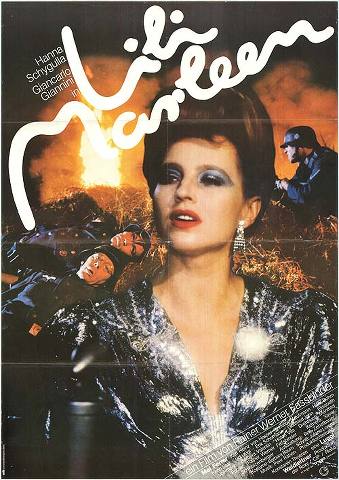
Rainer Werner Fassbinder – Lili Marleen [+Extras] (1981)
1981-1990DramaGermanyRainer Werner FassbinderRomance1938. Willie (Hanna Schygulla) and Robert (Giancarlo Giannini) are in love: She, a minor German singer who appears in a Zurich nightclub and waits for her big breakthrough. He, son of a rich Jewish family. His father (Mel Ferrer) is the head of an organization that helps Jews flee from Nazi Germany. While he is against Robert’s relationship with a German, as he feels that this could jeopardize the work of his organization, he permits Willie to accompany Robert on a secret mission to Germany. Upon their return to Switzerland the lovers find out that Robert’s father played a cruel trick on them: Willie is not allowed back into the country.Read More »
-
Ideya Garanina – Koshka, kotoraya gulyala sama po sebe AKA The Cat Who Walked by Herself (1988)
1981-1990AnimationIdeya GaraninaUSSRQuote:
Virtually unknown nowadays, even in its home country of Russia, The Cat Who Walked by Herself is an endearing children’s film directed by Ideya Garanina and produced at the Soyuzmultfilm studio. It is based upon Rudyard Kipling’s short story “The Cat that Walked by Himself,” which was first published in 1902. As far as I’ve been able to tell, the film uses a variety of animation techniques, including puppetry, stop motion and traditional animation, blending it all into an interesting tale of the origin of the civilised human and his millenia-long partnership with several species of domesticated animal. The story is narrated by a seemingly omniscient cat, who reminds a young child of an agreement struck long ago by the Cat and the Woman. The voice of the feline (whom, having absolutely no knowledge of Russian, I have been unable to identify) is a brilliant narrator, her voice at once carrying a sense of quiet arrogance, pride, dignity and everlasting knowledge.Read More »