The Castle is a philosophical novel by Franz Kafka. In it a protagonist, known only as K., strives to gain access to the mysterious authorities of a castle that governs the village where K. has arrived to work as a land surveyor. Dark and at times surreal, The Castle is about alienation, bureaucracy, and the seemingly endless frustrations of man’s attempts to stand against the system.Read More »
-
Franz Kafka – The Castle (1926)
1921-1930AustriaBooksFranz Kafka -
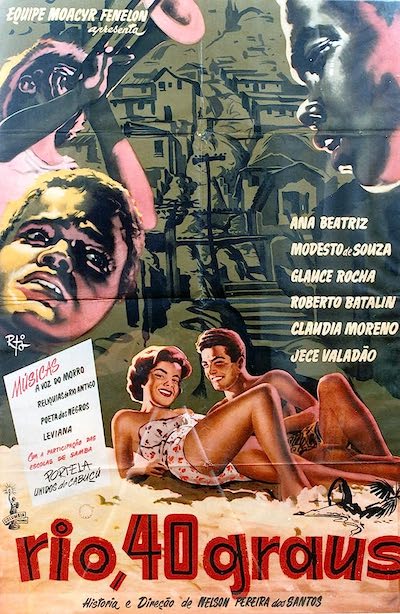
Nelson Pereira dos Santos – Rio Quarenta Graus aka Rio 40ºC (1955)
Drama1951-1960BrazilClassicsNelson Pereira dos Santos

Banned by Brazil’s Federal Department of Public Safety, “Rio, 40 Grau”s is a landmark film that ushered in the wave of Neorealist cinema in Brazil – Cinema Novo. The film chronicles a day in the life of five peanut vendors from the favelas (shanty towns) of Rio de Janeiro. Other subplots involving characters they meet along the way are interspersed. This was one of the first Brazilian films to address the issues of race, poverty, and class. These themes would continue to be examined by dos Santos throughout his career.Read More »
-
Nelson Pereira dos Santos – Como Era Gostoso o Meu Frances AKA How Tasty Was My Little Frenchman [+Extras] (1971)
Drama1971-1980BrazilNelson Pereira dos Santos

THE BEGINNING OF THE EXPLOITATION OF BRAZIL
In 1594 in Brazil, the Tupinambás Indians are friends of the Frenches and their enemies are the Tupiniquins, friends of the Portugueses. A Frenchman (Arduíno Colassanti) is captured by the Tupinambás, and in spite of his trial to convince them that he is French, they believe he is Portuguese. The Frenchman becomes their slave, and maritally lives with Seboipepe (Ana Maria Magalhães). *Contains Spoilers* Later, he uses powder in the cannons that the Portuguese left behind to defeat the Tupiniquins in a battle. In order to celebrate the victory, the Indians decide to eat him.Read More » -
Nelson Pereira dos Santos – A Terceira Margem do Rio AKA The Third Bank of the River (1994)
1991-2000BrazilDramaFantasyNelson Pereira dos SantosFrom the book “Brazilian Cinema” – Edited by Randal Johnson and Robert Stam:
“The Third Bank of the River” is a coproduction (French and Brazilian) and, like the Guerra film, it too ingeniously interweaves diverses stories by its source author. Beginning with the story that provides the title for the film – the virtually wordless drama of a man who abandons his family to live on a boat in the middle of the river – Nelson Pereira dos Santos integrates four other stories. Liojorge (Ilya São Paulo) the son (in Nelson’s re-creation) of the enigmatic boatman of the first story, follows an enchanted cow and thus becomes the protagonist of another story (“Seqüência”) in which the cow leads him to the most beautiful woman in the world (Sonja Saurin).Read More »
-
Paulo Caldas & Lírio Ferreira – Baile Perfumado AKA Perfumed Ball (1997)
Drama1991-2000BrazilPaulo Caldas and Lírio FerreiraA close friend of “Padre Cicero” (Jofre Soares), the “Lebanese”Mascate” Benjamin Abraham (Duda Mamberti) decides to film “Lampião” (Luis Carlos Vasconcelos) and all his gang, believing that the film will make them rich. After some initial contacts he talks directly with the famous “Cangaceiro” and exposes his idea, but the dreams of “Mascate” are hampered by the dictorship of the Estado Novo.Read More »
-
Lane Slate – Deadly Game (1977)
1971-1980DramaLane SlateTVUSAPlot Synopsis by Hal Erickson
Twice during the mid-1970s, Andy Griffith unsuccessfully attempted to launch a TV detective series titled Abel Marsh. The first pilot film was The Girl in the Empty Grave; the second was The Deadly Game. Griffith once again stars as resort-town sheriff Abel Marsh, this time wrestling with a sinister conspiracy involving a dangerous chemical spill. Lane Slate produced, directed and wrote the film, while Griffith’s longtime manager Richard O. Linke functioned as executive producer. Deadly Game was first telecast December 3, 1977.Read More »
-
Moacyr Góes – O Homem Que Desafiou o Diabo (2007)
2001-2010ArthouseBrazilComedyMoacyr GóesJosé Araújo, an attractive, happy traveling salesman, arrives at the little town of Jardim dos Caiacós where he meets “Turco,” owner of the grocery and Dualiba’s father, a virgin forty-year-old woman. Excited at the pretty woman, Zé Araújo does what nobody else had ever dared to do. Dualiba tell her daddy what happened, and he looks for Zé Araújo to make an irrefutable proposal: marry his daughter. Years later, apparently resigned to his fate, Zé Araújo discovers he’s the joke in town. Unexpectedly, there’s a change from an attractive traveling salesman into a fearless Ojuara, who rides into the Northeatern Brazilian backlands to fight for the unprotected along a journey full of adventures and love conquersRead More »
-
Max Nosseck – Garden of Eden (1954)
1951-1960CultExploitationMax NosseckUSASYNOPSIS: A nudist camp provides the primary setting for this exploitation film that chronicles the camps attempts to gain respectability in a community. The story centers around the daughter-in- law of a prissy magnate. After her husband dies, the woman decides that she needs a major change in her life. When she accidently finds a nudist colony, she decides that this is the change she has been looking for. Of course her late husband’s father is morally outraged by her actions until he visits the camp himself to bring her back. Soon he finds he likes the lifestyle and becomes a convert.Read More »
-
Raphael Nussbaum – Kommando Sinai AKA Sinai Commandos: A Story of the Six Day War (1968)
1961-1970CampIsraelRaphael NussbaumWar
At the start of the 1967 Six-Day War (June 5-10) between Israel and the surrounding Arab nations, a team of eight Israeli commandos, with their female boat captain in tow, are sent on a suicide mission deep into the Sinai to destroy an important Arab radar station at Sharm El Sheikh to pave way for the main invading Israeli forces.
imdb comment wrote:
This movie could be consider as one of the few movies that described the historic moment that israeli people lived in Israel during the Six-Day War, especially because they were surrounded by a great number of enemies , and their determination to remain like a Jewish State allowed to them to defeat it. I watched the movie like 20 years ago, and in that time, I Got the oportunity to record in my Betamax , and I still have it with me, and when I have time, I enjoy watching it again. The best scene could be when the commandos destroyed the radar station from Egyptian Army.Read More »