Michelangelo Antonioni’s Identification of a Woman is a body- and soul-baring voyage into one man’s artistic and erotic consciousness. After his wife leaves him, a film director finds himself drawn into affairs with two enigmatic women: at the same time, he searches for the right subject and actress for his next film. This spellbinding antiromance was a late-career coup for the legendary Italian filmmaker, and is renowned for its sexual explicitness and an extended scene on a fog-enshrouded highway that stands with the director’s greatest set pieces (-Criterion)Read More »
-
Michelangelo Antonioni – Identificazione di una donna AKA Identification of a Woman (1982)
1981-1990ArthouseDramaItalyMichelangelo Antonioni -
Viktor Kosakovsky – Sreda AKA Wednesday (1997)
1991-2000ArthouseDocumentaryRussiaViktor KosakovskyQuote:
Wednesday, July 19, 1961: it’s summertime and the newspapers are full of the usual articles. The world is comfortably embedded in the Cold War. An average day in Leningrad. 51 girls and 50 boys are born in Leningrad on this day.
One of them is Victor Kossakovsky. Why here and not somewhere else? Why then and not another time? These questions are the starting point for his film. Could it be that this child was mistaken for another in hospital? Who are all the people who began their lives on that same day? Do they somehow share the same fate or are they merely contemporaries?Read More » -
Chia-Liang Liu – Wu guan aka Martial Club (1981)
1981-1990AsianChia-Liang LiuHong KongMartial Arts
Quote:
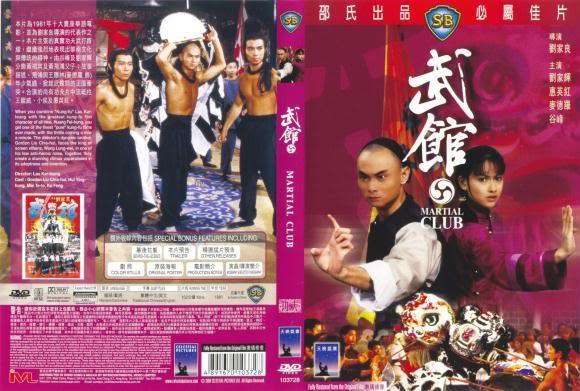
Martial Club can be loosely seen as a sequel to Challenge of the Masters as Gordon Liu revives the legendary character Wong Fei Hung. Once again we are given the ‘rival kung fu school’ storyline and the evil school bringing in an outside fighter to aid their treachery. He is also aided by his lady-friend, the consistently excellent, Kara Hui Ying-hung. The film is a blend of the schools feuding and trying to save face with Gordon Liu doing the slapstick routine with playing chum Robert Mak before the final showdown.Read More » -
Mario Soldati – Tragica notte aka Tragic night (1942)
1941-1950DramaItalian Cinema under FascismItalyMario SoldatiReleased from jail, Nanni (Checchi) punches prison guard Stefano (Ninchi) who has
denounced him. In order to take revenge, Stefano suggests the suspicion that, during his
absence, his wife has had business with the Count Paolo (Rimoldi). A few days later, at
night, a deadly ambush will be prepared.Read More » -
Fernando Di Leo – Avere Vent’anni aka To Be Twenty (1978)
1971-1980CrimeExploitationFernando Di LeoItalyAvere vent’anni (To Be Twenty) – (the title refers to the famous phrase at the beginning of Paul Nizan’s book, Aden Arabia: I was twenty years old. I will never allow anyone to say that these are the best years of my life.), was shot by Fernando di Leo in 1978. He also wrote the script which dates back to some years earlier and came from the desire to portray new female characters who had established a revolutionary psychology, and attitudes in society after 1968.
The intermediaries for this story are two young travelers, Tina and Lia – played by Lilli Carati and Gloria Guida, both very popular actresses at that time, who leave the Italian provinces and go to Rome to join a “community” and are under the illusion of being able to live in complete freedom, especially sexual freedom, without restraints or limits.
Read More » -
Alfred Hitchcock – Young and Innocent (1937)
United Kingdom1931-1940Alfred HitchcockClassicsThriller
Young and Innocent (1937) 
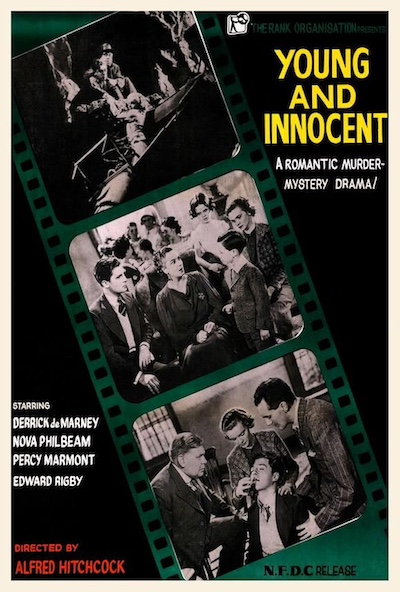
Synopsis: As early as 1937’s Young and Innocent, Alfred Hitchcock was beginning to repeat himself, but audiences didn’t mind so long as they were thoroughly entertaining-which they were, without fail. Derrick De Marney finds himself in a 39 Steps situation when he is wrongly accused of murder. While a fugitive from the law, De Marney is helped by heroine Nova Pilbeam, who three years earlier had played the adolescent kidnap victim in Hitchcock’s The Man Who Knew Too Much. The obligatory “fish out of water” scene, in which the principals are briefly slowed down by a banal everyday event, occurs during a child’s birthday party. The actual villain, whose identity is never in doubt (Hitchcock made thrillers, not mysteries) is played by George Curzon, who suffers from a twitching eye. Curzon’s revelation during an elaborate nightclub sequence is a Hitchcockian tour de force, the sort of virtuoso sequence taken for granted in these days of flexible cameras and computer enhancement, but which in 1937 took a great deal of time, patience and talent to pull off. — Hal EricksonRead More »
-
Jacques Becker – Le Trou AKA The Hole (1960)
1951-1960ClassicsCrimeFranceJacques BeckerReviewed by Glenn Erickson
Le Trou (literally, The Hole) is a harrowing experience in claustrophobia, pressure and hope among inmates in a French prison. The hopes and aspirations of the overcrowded members of one prison cell are put to the test as they commit their trust to luck and each other, to effect a difficult escape. Jacques Becker’s final film is the most realistic prison break movie Savant’s seen – as we all know how these stories usually turn out, the tension and suspense grow, every desperate step of the way.
Synopsis:
The La Santé is overcrowded because of construction, and five men are put into each cell instead of four. But in one cell, the inmates are secretly delighted. Claude Gaspard (Marc Michel), faces a long sentence and therefore can be trusted. He’ll be the extra man needed for a daring, complicated escape the men have planned, that requires nerve, deception, and a lot of digging. The scheme is such a beautifully executed communal effort, that when the first diggers break through to the outside world, they dutifully go back so that their comrades can escape too.Read More » -
Abbas Kiarostami – Be Tartib ya Bedoun-e Tartib AKA Orderly or Unorderly (1981)
1981-1990Abbas KiarostamiIranShort Film

SYNOPSIS:
This film’s first shot shows students descending a staircase in a calm, orderly fashion. Its second portrays the same action as a chaotic rush. Separated by slates and Kiarostami’s voice intoning, “sound, camera,” subsequent sequences describe the same dichotomous behavior in a schoolyard, on a school bus, and in the haphazard traffic of Tehran. Kiarostami described this as “a truly educational film,” but it plays more like a quirky philosophic aside.Read More » -
Noboru Tanaka – Jitsuroku Abe Sada aka A Woman Called Abe Sada (1975)
1971-1980ArthouseEroticaJapanNoboru TanakaCritical Appraisal (From Wiki)
Midnight Eye’s review of A Woman Called Sada Abe compares it to In the Realm of the Senses, notes, “Aside from being less sexually explicit, it is also smaller scale, more intimate, more cinematically stylised and arguably more erotic.”[5]A Woman Called Sada Abe is generally considered one of Nikkatsu’s five best Roman porno films.[1] Many Japanese critics consider it to be superior to Oshima’s internationally better-known In the Realm of the Senses, and Junko Miyashita is called a more realistic Sada Abe than Eiko Matsuda.[2] Miyashita’s performance in the film has been judged one of the best of her career, and the film has been called director Tanaka’s masterpiece.[1]Read More »