Quote:
At a New York City restaurant, the patrons are men, nude but for a G-string, waited on by one woman, also clad in a G-string (played by Viva) and a G-bestringed (bestrung?) waiter. Some of the “nude” patrons leave the establishment, their places taken by new customers, also nearly in the buff. There are numerous in-camera jump cuts (known as ‘strobe cuts’) and the camera weaves around a bit. The waiter and waitress move from table to table, talking to the customers. Taylor Mead sits smirking at the fountain, where eventually he partakes in a long conversation with Viva about her Catholic childhood. Viva, the waitress if not the actual person, seemingly is obsessed with the subject of lascivious priests. There is more strobe cutting and at one point, Viva turns to the camera and asks that it be turned off. The camera is turned off and, after an interlude, is turned back on again, after which Viva continues with her monologue. More patrons arrive while others go, perhaps thinking — if not speaking — of Michelangelo. Written by Tummy AuGratinRead More »
-
Andy Warhol – The Nude Restaurant (1967)
USA1961-1970Andy WarholExperimentalQueer Cinema(s) -
Menahem Golan – Mivtsa Yonatan aka Entebbe: Operation Thunderbolt (1977)
1971-1980ActionDramaIsraelMenahem GolanThe Cannon GroupPlot Outline :
In July 1976, an Air France flight from Tel-Aviv to Paris via Athens was hijacked and forced to land in Entebbe, Uganda. The Jewish passengers were separated and held hostage in demand to release many terrorists held in Israeli prisons. After much debate, the Israeli government sent an elite commando unit to raid the airfield and release the hostages. The film is based on the true facts and follows the events since the flight’s takeoff and until the hostages’ return to Israel.Read More » -
Georgi Daneliya – Osenniy marafon AKA Autumn Marathon (1979)
Drama1971-1980ComedyGeorgi DaneliyaUSSRSynopsis:
A gentle, bittersweet tragicomedy, Autumn Marathon is about a middle-aged translator, Andrei Buzykin (Oleg Basilashvili), whose almost pathological niceness has trapped him in a seemingly endless series of awkward situations: his inability to turn anyone down has left him juggling a wife and mistress, on top of vast amounts of additional work usually done as unpaid favours for friends and students that’s constantly interfering with his own projects to the point where his career is put at risk.
And because he can’t bear to hurt anyone, he’s always taking the easy way out – which invariably means constructing a vast edifice of lies that he can’t possibly keep track of, which has the equally inevitable side-effect of turning a fundamentally decent if weak-willed man into what looks like the epitome of a philandering boor. Half the time, his excuses are entirely genuine – he really did help his Danish friend Bill Hansen (Norbert Kuchinke) at a drying-out clinic, and stayed up all night with his less talented colleague Varvara (Galina Volchek) to help her on a difficult translation, but this counts for little when he’s so widely disbelieved. The title refers to his regular early morning jogging sessions with Bill – again, he’d much rather be doing something else, like staying in bed, but how can he possibly say no?Read More »
-
Andy Warhol – Lonesome Cowboys (1968)
1961-1970Andy WarholCultQueer Cinema(s)USAWesternAn outrageously funny spoof on the Western film, Lonesome Cowboys is a synthesis of Warhol’s sorties into the New York underworld, but much more humorous and with closer adherence to a nonsensical plot. The film was photographed in Arizona, in a ghost town where (somehow) two of Warhol’s superstars are discovered. The incongruous montebanks happen to be Viva, as chic and sarcastic as she was in Bike Boy and resembling a displaced model for Hound and Horn, and Taylor Mead. Mr. Mead is the zany of our time, and when five mysterious cowhands saunter into town, the hilarity commences. The cowboys are an odd assortment, a bit androgynous and city-wise, and they interact with the two in varying attitudes of lust and indifference in set-pieces of inspired film comedy. Often, Lonesome Cowboys reaches the ultimate in surrealist imagery: cowboy-deputy Mead performing the Lupe Velez Twist, his own choreographic distortion; or one of the cowboys performing ballet exercises at the hitching post. Viva’s langorous seduction of the most innocent-looking among the cowboys is actually a satirical comment on sexual artifice. This erotic, sagebrush comedy has its cruel edge, and one feels that Andy Warhol attempts to make some statement about the nature of brotherly love and the impossibility of virtue rewarded in these times of fallen idols. Select just about any Warhol film from the mid-sixties and you’ll find a scandal tucked away. Lonesome Cowboys’s most notable run-in with the law was in Atlanta where it was seized after replacing Gone with the Wind in a mall theater.Read More »
-
Mikhail Romm – Obyknovennyy fashizm AKA A Night of Thoughts AKA Triumph Over Violence (1965)
Documentary1961-1970Amos Vogel: Film as a Subversive ArtMikhail RommPoliticsUSSRSynopsis:
A collage of documentary and chronicle footage from various German and Soviet archives, attempting to reconstruct the experience of the citizens of the Third Reich and to grasp the essence of totalitarian regime. The footage is accompanied by director’s commentary, analyzing the imagery.Romm’s “Ordinary Fascism” pulls out all the stops in its selection of documentary material to draw the viewer not only into absolute horror about fascism and nazism in the 1920s-1940s Europe, but also to a firmest of convictions that nothing of the sort should be allowed to happen again anywhere in the world. The film was released in 1965, in the Soviet Union’s heyday at the height of the great societal and intellectual “thaw” that followed the Stalin’s death and the denunciation of Stalin’s totalitarianism by Nikita Khruschev. Never explicitly mentioning any of them explicitly, the film targets tyranny and despotism no matter what form they may take.Read More »
-
Gillian Robespierre – Obvious Child (2014)
2011-2020ComedyDramaGillian RobespierreUSAquote:
Gillian Robespierre’s Obvious Child managed two great feats in one film: it announced Jenny Slate as a strong actor to watch and, more importantly, turned in a great romantic dramedy surrounding the topic of abortion. The film wasn’t a polemic or political diatribe, nor did it toss off the subject matter flippantly. Instead, Obvious Child addressed various aspects of love, modern adulthood, and the implications of parenthood and abortions with aplomb. As written by Robespierre, the film was as light and hilarious as could be expected while doing an impressive balancing act by being sensitive to the realistic decisions women face. It helped too that the cast turned in performances perfectly in keeping with the tone of the film: they were sad without being soul-wrenchingly sad and funny without being glib or quirky about it. But above all else, Slate’s performance and Robespierre’s film were pleasingly human.
-TinyMixTapes (#20 on their “Favorite 30 Films of 2014” list)Read More » -
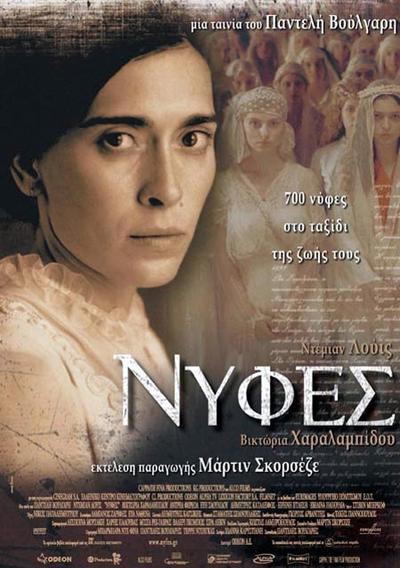
Pantelis Voulgaris – Nyfes AKA Brides (2004)
Drama2001-2010GreecePantelis Voulgaris

Summer of 1922.
Photographer Norman Harris and Niki are sailing to America aboard the same ship. Norman in first class and Niki in third, together with some 700 other brides. They all carry the photograph of a bridegroom they have never met in their little trunks as well as their bridal gown. Norman is touched when he sees the brides in third class. Niki is the one who makes the greatest impression on him. Gradually they get to know each other and fall in love. Brides is a story about strong emotions, about dilemmas, about conscience, about a responsible attitude. It is about the little moments, the glances, the touches, the “yeses” an the “nos” that count in life.Executive producer: Martin ScorseseRead More »
-
Liv Ullmann – Miss Julie (2014)
Drama2011-2020Liv UllmannNorwayAugust Strindberg felt that the entire world had gone crazy. The “norms” of class hierarchies and gender roles were starting to shatter, and he saw chaos pouring into that vacuum. His 1888 play “Miss Julie” is the prime example, although it’s evident in all of his other disturbing, great modern works. “Miss Julie” plays in almost real-time, taking place in one setting over the course of a single evening, Midsummer Night’s Eve, the one long night of the year when the classes blend together, when rich dance and drink with poor, when the boundaries have blurred. There are only three characters in the play, and it opens with Jean, an upwardly-striving valet remarking to his pal and sort-of girlfriend, the kitchen maid, that “Miss Julie is crazy!” Miss Julie is the daughter of the count in whose manor they both work.Read More »
-
Brett Morgen – Kurt Cobain: Montage of Heck (2015)
USA2011-2020Brett MorgenDocumentaryMusicalThe documentary is directed by Brett Morgen who began work on it in 2007 when Cobain’s widow, Courtney Love, approached him with the idea,] It is the first documentary about Kurt Cobain to be made with the cooperation of his family. Morgen and his team were given access to the entirety of Cobain’s personal and family archives. The documentary includes footage from various Nirvana performances and unheard songs, as well as unreleased home movies, recordings, artwork, photography, journals, demos, and songbooks] Morgen used the interviews in the film Lenny as a model for the interviews in the film. The film’s title, Montage of Heck, takes its name from a musical collage that was created by Cobain with a 4-track cassette recorder in about 1988, of which there are two versions; one is about thirty-six minutes long and the other about eight minutes long. Several of the film’s scenes were animated by Stefan Nadelman and Hisko Hulsing. Jeff Danna wrote an original score for the film. The film was co-produced by HBO Documentary Films and Universal Pictures International Entertainment Content Group. Cobain and Courtney Love’s only daughter, Frances Bean Cobain, was a co-executive producer on the film.<Read More »