Quote:
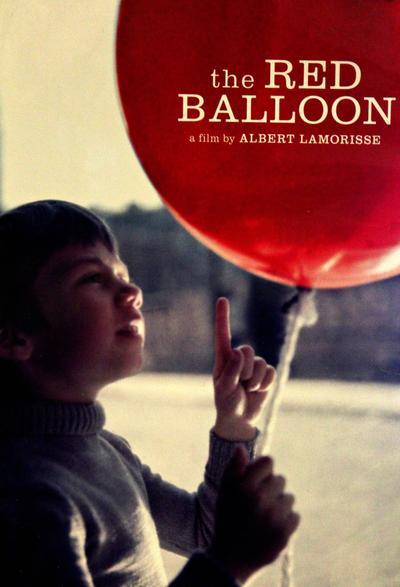
The story of a boy and his toy, The Red Balloon is widely praised for its narrative and visual “purity,” but not enough is said about the movie’s delightful manipulation. A quasi-silent comedy with musical cues straight out of the Charlie Chaplin tradition, Albert Lamorisse’s film plays a game with its audience, just as the little boy (Pascal Lamorisse) and his glowing red orb cling to, fall away from, and chase each other throughout the 34-minute running time. With its many stairs and sloping alleyways, the blue-gray Ménilmontant neighborhood of Paris is like a maze, constantly threatening to come in between the boy and his new pal, but like a magnet or a dog starved for attention, the balloon always comes back to him. He lets go of it on his apartment balcony and watches it fall to him downstairs. He directs it to “wait here” while he buys a treat at the local bakery. A group of neighborhood bullies chase the balloon through a perilously narrow corridor, throwing rocks as it tries to escape. The honeymoon is short-lived, but Lamorisse suggests that kids are always keenly attuned to the objects of the world around them: After the boy loses his red friend, a montage of balloons across the city shows them flying to his side and, in the final shot, launching him into the sky. For Lamorisse, then, the pleasures of childhood are as fleeting as they are ecstatic.Read More »
-
Albert Lamorisse – Le ballon rouge AKA The Red Balloon (1956)
1951-1960Albert LamorisseDramaFranceShort Film -
Max Ophüls – Divine (1935)
1931-1940ClassicsDramaFranceMax OphülsSynopsis:
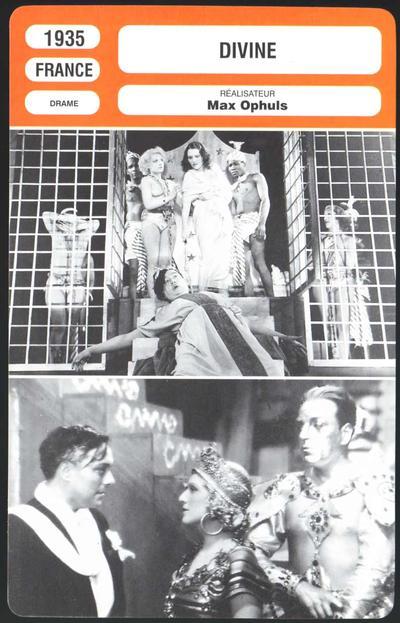
Ludivine Jarisse is a young woman who lives a contented but unexciting life in the country. One day, she is visited by Roberte, an old friend who has made a career for herself as an actress at a Paris music hall, L’Empyrée. Roberte intends to take a break and invites her friend to take her place. Ludivine readily accepts, and soon becomes a musical hall diva under the name Divine, although she is at first reluctant to expose herself in the revealing costumes she is given. One of her colleagues attempts to take advantage of her naivety, but when she resists, he implicates her in a drugs trafficking affair. Divine remains untainted by all this vice and falls in love with an honest milkman, Antonin. He offers to marry her and she is finally able to leave the music hall to start a new life, back in the country.Read More » -
Marianne Lambert – I Don’t Belong Anywhere: The Cinema of Chantal Akerman (2015)
2011-2020BelgiumDocumentaryMarianne LambertSynopsis:
I DON’T BELONG ANYWHERE: THE CINEMA OF CHANTAL AKERMAN explores some of the Belgian filmmaker’s 40 plus films, and from Brussels to Tel Aviv, from Paris to New York, it charts the sites of her peregrinations. An experimental filmmaker, a nomad, Chantal Akerman shared with Marianne Lambert her cinematic trajectory, one that never ceased to interrogate the meaning of her existence. And with her editor and long-time collaborator, Claire Atherton, she examines the origins of her film language, and aesthetic stance.Read More » -
Nima Javidi – Melbourne (2014)
2011-2020DramaIranNima JavidiThrillerThe film recounts the story of a young couple on their way to Melbourne to continue their studies. However, just a few hours before the departure of their flight, they are unintentionally involved in a tragic event.
Quote:
This remarkable debut feature by Nima Javidi naturally reminds one of Asghar Farhadi’s films, with its strong sense of drama, tremendous actor interpretations and mature writing that does not compromise the integrity of any of the characters. But there is also something particularly “new generational” about it in the way it harnesses the choice in front of affluent young Tehranians: to stay in Iran and own up its problems or to leave the country to start life anew. The inciting event in the film that dramatizes this choice stops the train of life dead in its tracks, exposing its protagonists to the unbearable “nowness” of the present. It is a terribly universal predicament in which time freezes around the material reality before you and all plans for the future and memories of the past seem like a remote, inaccessible country, a crisis that makes you want to either regress in time (“wish mother were here”) or to jump to a future day when the clouds have cleared, a moment where husband and wife see each other’s innermost character in all its stark nakedness. Though the couple might physically arrive at the eponymous neverland, the utopia it once represented is irrevocably lost. – The Seventh ArtRead More » -
Jerzy Skolimowski – Le départ AKA The Departure [+Extras] (1967)
Arthouse1961-1970BelgiumComedyJerzy SkolimowskiSynopsis:
A fast-paced comedy about a young Belgian car nut and hairdresser’s apprentice, his girlfriend, and their legal and illegal attempts to get a Porsche under him for his nearing debut race. — IMDb.Read More » -
Masahiro Shinoda – Kaseki no mori AKA The Petrified Forest (1973)
1971-1980CrimeDramaJapanMasahiro ShinodaSynopsis:
Based on novel by Shintaro Ishihara, this is a human drama about the complex relationship of parent and child. Haruo spends his time working in a university hospital when he meets a childhood friend. On the other hand Haruo’s long estranged mother wishes to make amends with her lost son.Review:
One day, a young medicine student Hauro Himoto (Ken’ichi Hagiwara) runs into his attractive ex-schoolmate Eiko Izawa (Sayoko Ninomiya) and they fall in love with each other in no time at all. The only obstacle which intrudes the couple is the owner of a barbershop who simultaneously is her lover and her employer and pesters Eiko out of his jealousy. Hauro and Eiko resolve to get rid of the insufferable male so that they can remain together without further complications… Read More » -
Zhangke Jia – Zhantai AKA Platform (2000)
1991-2000ChinaDramaZhangke JiaQuote:
Platform opens to an appropriately temporally indeterminate sight of a bustling, crowded backstage of a provincial theater as a group of itinerant performers await the commencement of their traveling cultural education program that equally extols the country’s technological and social progress made possible by the Communist Revolution and celebrates its principal architect, Chairman Mao Zedong. However, a cut to a shot of the company tour bus as the manager provides constructive criticism on the performance of the peasant troupe (apparently caused by inaccurate mimicking of train sounds by some members who have never seen a train in real life) begins to reveal the disparity between their state-commissioned, official message of national modernization and the reality of life in the rural provinces.Read More » -
Kiumars Poorahmad – Sharm AKA Shame (1992)
1991-2000ArthouseDramaIranKiumars PoorahmadMajid makes an 8-mm film with some poorly-lit sequences. To repeat the shots, Majid needs highly sensitive negatives and, therefore, some money. He comes up with the money by working as a coolie, but before buying the negative, a relative asks him to do something and Majid loses his money his money while doing it because of his shyness.Read More »
-
Anthony Asquith – French Without Tears (1940)
Comedy1931-1940Anthony AsquithUnited KingdomIMDB review:
This amiable Ratigan Farce is based on Ratigans’ own experiences in a French tuition school in Normandy.It was brought to the stage in London featuring Rex Harrison,Trevor Howard,Kay Hammond and Roland Culver.It was purchased by Paramount initially as a vehicle for Marlene Dietrich!However they decided that the featured actors,Culver apart,were not sufficient box office and replaced them.Whilst Ray Milland is quite enjoyable as the main lead one can only conjecture what the film could have been if Harrison had reprised his role for the screen.I saw the original 86 minute version at the Museum of London in 1983.I have just seen the American version which is some 20 minutes shorter.I cannot remember what is missing.A number of matters of interest.Mantovanni is featured in the party scene.The release of this film coincided with the outbreak of war,when all places of entertainment were closed.The director was “Puffin”Asquith,the son of the World war 1 PM.His mother used her influence with cabinet Ministers to get the cinemas reopened,according to the biography of David Lean.Lean was the editor on this film.Cinemas reopened 3 days later and the film was a success at the box office.Read More »