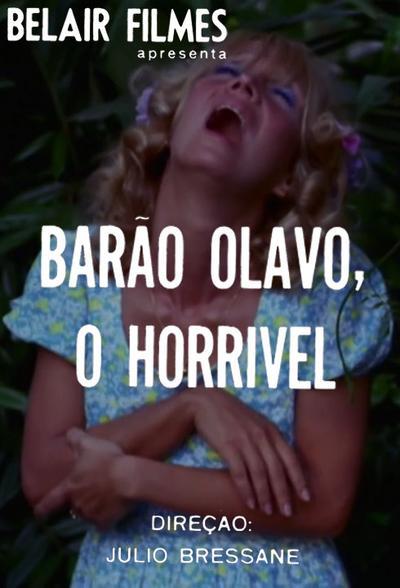
Bressane’s first color film, shot in the home of the artist Elyseu Visconti. Part of it is missing sound and final editing because the director was forced to leave Brazil. Horror and humor to deal with the subject of insanity: “In the end everyone leaves the house as though they were laboratory mice escaping, they invade the city and contaminate the world”. “If we talk about horror, this film deals with national horror, with Mojica Marins as an emblem. There might be a few touches of Corman and English horror, but it is another level of horror. What transformed the film was the location where we were shooting, the house of a 19th century painter, a receptacle of light. When I arrived and saw that house, that light, I said: ‘This is the film. This is the horror’. The meaning of the film, its appeal, derives from this laboratory of light” (J. Bressane). — Torino Film FestivalRead More »
-
Júlio Bressane – Barão Olavo, o Horrível (1970)
1961-1970ArthouseBrazilExperimentalJúlio Bressane -
Lawrence Schiller – The Executioner’s Song (1982)
1981-1990CrimeDramaLawrence SchillerUSAQuote:
The Executioner’s Song is one of the best films about crime and punishment ever made. Far from being lurid or simpleminded, it paints a stark picture of how it must have been to live around Gilmore during that time. It doesn’t glamorize him or turn him into a cardboard villain, but instead depicts him as a man whose inability to handle his growing rage and alienation led him to destroy his life and the lives of those around him. It’s smart enough to know that there can never be a definitive answer as to why someone would commit murder, but that it’s also important to try to understand those reasons nonetheless. It’s also a vital film whatever your views on the issue of capital punishment, as it renders many clichés on the subject useless (and predates the more acclaimed Dead Man Walking by a good thirteen years). Add one of the finest performances of Tommy Lee Jones’ career, and The Executioner’s Song is highly recommended for anyone interested in a thoughtful crime drama.Read More » -
Alfred Hitchcock – Rebecca (1940)
1931-1940Alfred HitchcockClassicsDramaUSA

Quote:
Rebecca is a 1940 psychological/dramatic noir thriller directed by Alfred Hitchcock as his first American project, and his first film produced under his contract with David O. Selznick. The film’s screenplay was an adaptation by Joan Harrison and Robert E. Sherwood from Philip MacDonald and Michael Hogan’s adaptation of Daphne du Maurier’s 1938 novel of the same name, and was produced by Selznick.[1] It stars Laurence Olivier as the aristocratic widower Maxim de Winter, Joan Fontaine as his second wife, and Judith Anderson as the housekeeper, Mrs. Danvers.Read More » -
Abdellatif Kechiche – La graine et le mulet AKA The Secret of the Grain (2007)
2001-2010Abdellatif KechicheDramaFranceQuote:
The winner of four César awards, including best picture and director, Abdellatif Kechiche’s The Secret of the Grain is a stirring drama about the daily joys and struggles of a bustling French-Arab family. It has the texture of a documentary but a classic, almost Shakespearean structure: when patriarch Slimane acts on his wish to open a portside restaurant specializing in his ex-wife’s couscous and fish, the extended clan’s passions and problems explode, leading to an engrossing, suspenseful climax. With sensitivity and grit, The Secret of the Grain celebrates the role food plays in family life and gets to the core of contemporary immigrant experience.Read More » -
Mario Camerini – Ma non è una cosa seria AKA But It’s Nothing Serious (1937)
1931-1940ClassicsComedyItalyMario CameriniSynopsis:
Based on a Pirandello play, Vittori De Sica plays a wealthy young social lion who has to constantly fight off a horde of women who are eager to marry him because of his position and money. He weds Elisa Cegani, a servant girl, who turns out to be a more appealing wife than any of the others could have been. Assis Noris decorates the screen well as one of the chasers and pursuers. In 1937, De Sica and Noris made a film, “II Signor Max,” which, other than the setting and character role names, basically has the same plot as this film.Read More » -
Urszula Antoniak – Nothing Personal (2009)
2001-2010DramaIrelandUrszula AntoniakQuote:
Alone in her empty flat, from her window Anne observes the people passing by who nervously snatch up the personal belongings and pieces of furniture she has put out on the pavement. Her final gesture of taking a ring off her finger signals she is leaving her previous life in Holland behind. She goes to Ireland, where she chooses to lead a solitary, wandering existence, striding through the austere landscapes of Connemara. During her travels, she discovers a house that is home to a hermit, Martin.Read More » -
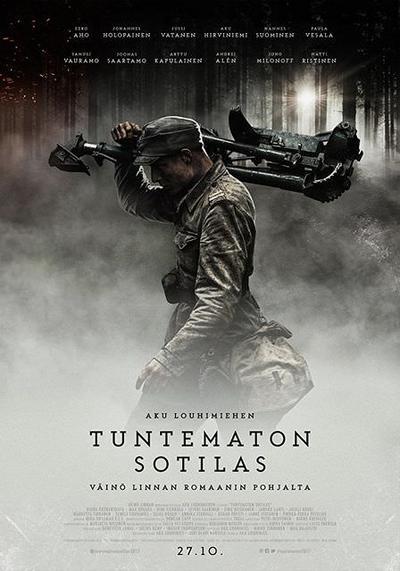
Aku Louhimies – Tuntematon sotilas AKA The Unknown Soldier (2017)
2011-2020Aku LouhimiesDramaFinlandWarSynopsis:
A film adaptation of Väinö Linna’s best selling novel The Unknown Soldier (1954) and the novel’s unedited manuscript version, Sotaromaani.The film’s setting is based on the unit Väinö Linna served in during the Continuation War, Infantry Regiment 8 (Finnish: Jalkaväkirykmentti 8). It follows a fictional Finnish Army machine gun company in the Karelian front from mobilisation in 1941 to armistice in 1944. The soldiers of the company are sympathetic but realistic portraits of men from all over Finland with widely varying backgrounds. Their attitude is relaxed, disrespectful of formalities, and business-like, even childish and jolly, throughout the story despite the war and the losses the company suffers. The film also occasionally shifts to the homefront.Read More »
-
Sidney Lumet – Murder on the Orient Express (1974)
1971-1980DramaMysterySidney LumetUSAQuote:
Had Dame Agatha Christie’s “Murder on the Orient Express” been made into a movie 40 years ago (when it was published here as “Murder on the Calais Coach”), it would have been photographed in black-and-white on a back lot in Burbank or Culver City, with one or two stars and a dozen character actors and studio contract players. Its running time would have been around 67 minutes and it could have been a very respectable B-picture.“Murder on the Orient Express” wasn’t made into a movie 40 years ago, and after you see the Sidney Lumet production that opened yesterday at the Coronet, you may be both surprised and glad it wasn’t. An earlier adaptation could have interfered with plans to produce this terrifically entertaining super-valentine to a kind of whodunit that may well be one of the last fixed points in our inflationary universe.Read More »
-
Ulli Lommel – The Boogeyman (1980)
1971-1980HorrorUlli LommelUSAQuote:
A young girl witnesses her brother murder a man through a reflection in a mirror. Twenty years later the mirror is shattered, freeing his evil spirit, which seeks revenge for his death.Read More »