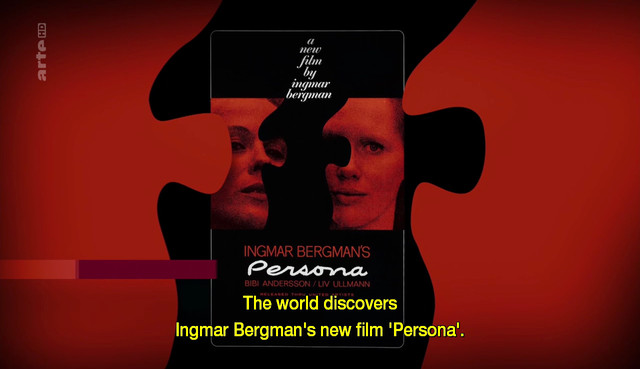
In 1965, Ingmar Bergman directed “Persona”, a cult film that sums up all the obsessions of the Swedish master, born a hundred years ago. This Arte TV documentary explores the film, based on interviews with film critics, collaborators and the maser himself. Read More »
-
Manuelle Blanc – Persona, le film qui a sauvé Ingmar Bergman AKA Persona – The Film That Saved Ingmar Bergman (2018)
2011-2020DocumentaryFranceIngmar BergmanManuelle BlancTV -
Serge Bard – Ici et maintenant aka Here and now (1968)
1961-1970ExperimentalFrancePoliticsSerge BardThe Films of May '68“I had the idea to call my film ICI ET MAINTENANT, because the cinema is exactly the contrary of the here and now. The cinema is always elsewhere and before…It seemed important to rediscover the magic of the present, that is the here and now. I wanted the spectator during the film to return to himself and thus not to participate in the usual process of identification where he is able to escape from himself” (Serge Bard). Emblematic of the Zanzibar movement’s youthful, revolutionary zeal, the title of Bard’s film ICI ET MAINTENANT is a “seize the day” clarion call, fitting for a generation who sought to change the world. Shot in Brittany, with Caroline de Bendern and Olivier Mosset who were lovers at the time, and no script, the film took as its subject the idea of “contestation .” With its loose, radicalized narrative, and hyper-aestheticized flamboyance, ICI ET MAINTENANT depicts a series of symbolic attacks against society and an atomic factory threatened by sketchy characters. This was the final film Bard made before decamping for Africa and clandestinely converting to Islam, expeditiously sending his film crew, many of whom had worked on ICI ET MAINTENANT, back to Paris, bewildered.Read More »
-
Apostolos C. Doxiadis – Terirem (1987)
1981-1990Apostolos C. DoxiadisArthouseDramaGreeceΤεριρέμ
The mute wife (Olia Lazaridou) of a shadow-theater player (Antonis Kafetzopoulos) is suffering from cancer. An old woman, guided by her visions, discovers a Byzantine religious icon buried in a field. Her nephew sells the find to a thief, who then murders the old woman, without knowing that she had told the village priest about the holy icon she found. Two priests arrive in the village together with the puppeteer and his ailing wife, and there the wife sees a vision of the icon and where it was located in the field, which leads to the discovery of the bones of a saint. The wife sleeps on the spot where the holy relics were discovered and, upon awaking the following morning, regains her speech. Read More » -
Fritz Lang – While the City Sleeps (1956)
1951-1960DramaFilm NoirFritz LangUSAQuote:
While the City Sleeps (1954) was Fritz Lang’s last fully successful film, one of a pair of movies that he made with independent producer Bert E. Friedlob (the other was Beyond a Reasonable Doubt). Additionally, it has proved to be one of his more enduring successes over the decades, due to the combination of its virtues as a thriller and also as a snapshot of American mores circa 1954. It may not be as respected as, say, M (1931) or Fury (1936), but it might be the Lang film that Americans of the baby-boom generation know best, through countless television showings in the 1960s and ’70s, and like most for its sinister subtext. Strangely enough, While the City Sleeps was not a story that Lang that set out to tell — producer Bert E. Friedlob rejected several of the director’s proposed subjects and imposed the story on Lang, as he had already bought the rights to Charles Einstein’s novel The Bloody Spur. That book was based on the criminal career of William Heirens, who had terrorized that city with a string of burglaries, sexual assaults, and murders during the mid-’40s. Heirens was identified as the “Lipstick Killer” when he left a message, scrawled in lipstick, at one of his crime scenes, asking the police to stop him. He was later caught, and he confessed and was given a life sentence (which he was still serving as of 2003). Read More » -
Seijun Suzuki – Kemono no nemuri AKA The Sleeping Beast Within (1960)
1951-1960AsianDramaJapanSeijun Suzukiけものの眠り
A man never returns from an office party, sending his wife and daughter in to a frenzied search for clues. They acquire the help of a journalist friend, who goes on a chase down the seedy underworld of Yokohama, where bar girls, strange cults and drug pushers rule the night. Read More »
-
Gregory Ratoff – Wife, Husband and Friend (1939)
1931-1940ClassicsComedyGregory RatoffScrewball ComedyUSA20th Century-Fox evidently adored “triangle” comedies like Wife, Husband and Friend; apparently so did Loretta Young, who appeared in most of these films. Young plays the wife of businessman Warner Baxter, while “friend” Cesar Romero is an amorous singing teacher who convinces Young that she has a future in opera. To show up his wife, Baxter takes lessons from diva Binnie Barnes–and as it turns out, he’s the one with the ideal operatic voice. The romantic quadrangle is resolved when Baxter makes a disastrous stage debut, whereupon Romero and Barnes exit and Baxter and Young realize the error of their ways. Wife, Husband and Friend was remade in 1949 as Everybody Does It, with Paul Douglas (of all people) as the would-be Caruso. ~ Hal Erickson, All Movie GuideRead More »
-
Paul Morrissey – Flesh (1968)
1961-1970CultDramaPaul MorrisseyQueer Cinema(s)USAQuote:
Flesh was filmmaker Paul Morrissey’s first production for Andy Warhol. The story concerns a bisexual hustler (Joe Dallesandro) who does tricks so that he can pay for his wife’s lover’s abortion. The film made headlines when it was confiscated by the police during one of its earliest showings in 1970. Though this event is unlikely to repeat itself, Flesh is still explicit enough to elicit gasps from even the most jaded of underground-film enthusiasts. — Hal EricksonRead More » -
Albertina Carri – Géminis (2005)
2011-2020Albertina CarriArgentinaDramaQuote:
An incestuous love affair. Meme and Jeremias are the younger children in a typical bourgeois family. Their mother Lucia is the dominant force in the household, but her fixation on upholding the niceties of upper-middle-class life has prevented her from seeing what is going on under her roof. When the siblings’ older brother and his fiancee arrive home for their wedding, it seems inevitable that the concealment will be impossible to sustain. But equally, it becomes apparent that if Lucia were to find out about the affair, there would be catastrophic consequences.Read More » -
Sidney Lumet – 12 Angry Men (1957) (HD)
1951-1960DramaSidney LumetUSASYNOPSIS
A Puerto Rican youth is on trial for murder, accused of knifing his father to death. The twelve jurors retire to the jury room, having been admonished that the defendant is innocent until proven guilty beyond a reasonable doubt. Eleven of the jurors vote for conviction, each for reasons of his own. The sole holdout is Juror #8, played by Henry Fonda. As Fonda persuades the weary jurors to re-examine the evidence, we learn the backstory of each man. Juror #3 (Lee J. Cobb), a bullying self-made man, has estranged himself from his own son. Juror #7 (Jack Warden) has an ingrained mistrust of foreigners; so, to a lesser extent, does Juror #6 (Edward Binns). Jurors #10 (Ed Begley) and #11 (George Voskovec), so certain of the infallibility of the Law, assume that if the boy was arrested, he must be guilty. Juror #4 (E.G. Marshall) is an advocate of dispassionate deductive reasoning. Juror #5 (Jack Klugman), like the defendant a product of “the streets,” hopes that his guilty vote will distance himself from his past. Juror #12 (Robert Webber), an advertising man, doesn’t understand anything that he can’t package and market. And Jurors #1 (Martin Balsam), #2 (John Fiedler) and #9 (Joseph Sweeney), anxious not to make waves, “go with the flow.” The excruciatingly hot day drags into an even hotter night; still, Fonda chips away at the guilty verdict, insisting that his fellow jurors bear in mind those words “reasonable doubt.” A pet project of Henry Fonda’s, Twelve Angry Men was his only foray into film production; the actor’s partner in this venture was Reginald Rose, who wrote the 1954 television play on which the film was based. Carried over from the TV version was director Sidney Lumet, here making his feature-film debut. A flop when it first came out (surprisingly, since it cost almost nothing to make), Twelve Angry Men holds up beautifully when seen today. It was remade for television in 1997 by director William Friedkin with Jack Lemmon and George C. Scott.
Hal Erickson on All Movie GuideRead More »