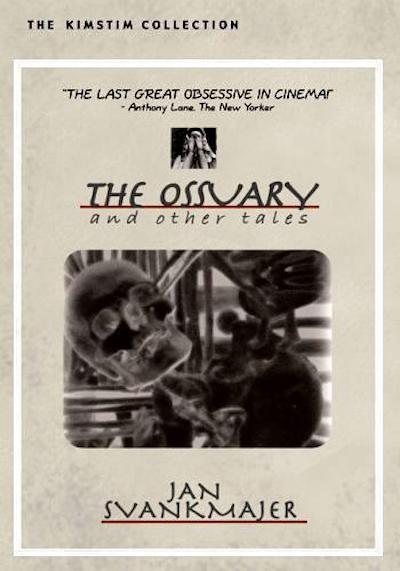
A eight-part animatied portrait of various species, accompanied by a different style of music – the various parts are: Aquatilia (foxtrot), Hexapoda (bolero), Pisces (blues), Reptilia (tarantella), Aves (tango), Mammalia (minuet), Simiae (polka) and Homo (waltz). Each animation mixes drawings, pictures, real animals and animated skeletonsRead More »
-
Jan Svankmajer – Historia Naturae, Suita AKA Historia Nature Suite (1967)
1961-1970AnimationCzech RepublicJan SvankmajerShort Film -
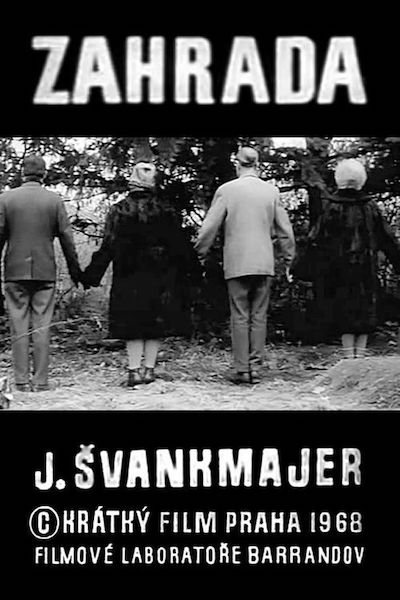
Jan Svankmajer – Zahrada AKA The Garden (1968)
1961-1970Czech RepublicJan SvankmajerShort Film

Frank visits his friend Josef, who introduces him to his pedigree rabbits and his wife Mary. Frank is more interested in the slightly unsettling fact that Josef and Mary’s garden fence is entirely made up of living people holding hands. Finally, Frank asks Josef how he manages to keep the fence together… Read More »
-
Jan Svankmajer – Tichý týden v dome AKA A Quiet Week In the House (1969)
1961-1970Czech RepublicJan SvankmajerShort FilmA man, apparently on the run, takes shelter in a dilapidated house. Every day, he drills a hole through a wall and looks into one of the rooms, each time seeing a different surreal vision… Read More »
-
Jan Svankmajer – Kostnice AKA Ossuary (1970)
1961-1970Czech RepublicJan SvankmajerShort FilmA non-narrative voyage round Sedlec Ossuary, which has been constructed from over 50,000 human skeletons (victims of the Black Death).Read More »
-
Lionel Barrymore – Madame X (1929)
1921-1930ClassicsDramaLionel BarrymoreUSA
Plot: Young Raymond Floriot, following in his father Louis Floriot’s professional footsteps, he now France’s attorney general, has just passed the bar exam. Raymond’s first case, appointed to him by the courts, is a murder case. His pitiful and poor Jane Doe client, who refers to herself only as Madame X, admits to killing the scoundrel of a man named Laroque, but won’t disclose why or in turn defend herself in court. Raymond knows nothing of her past, which includes once being a woman of class, married to man of prestige. But that marriage ended because he treated her without love, which resulted in her leaving him for another man, who in turn passed away shortly thereafter. Read More »
-
Aleksandr Dovzhenko – The Cultural Heritage [Disc 1] (1926 – 1928)
1921-1930Aleksandr DovzhenkoArthouseSilentUSSR
Love’s Berries 1926
The mistress of hairdresser Jean Kovbasyuk throws a baby up to him. Jean decides in any method to be delivered from a “natural” child…Getting a call to the judicial investigator, Kovbasyuk is given up to search a child. A mistress labours for in the court of people’s “justice”. However much it turns out after registration of marriage, that Jean and in actual fact was not the father of child. But lately…Read More » -
Aleksandr Dovzhenko – Arsenal (The Cultural Heritage) [Disc 2] (1928)
Drama1921-1930Aleksandr DovzhenkoArthouseUSSR

In Arsenal, Alexander Dovzhenko, perhaps the most radical of the Soviet directors of the silent period, altered the already extended conventions of cinematic structure to a degree greater than had even the innovative Sergei Eisenstein in his bold October. The effect of this tinkering with the more or less accepted proprieties of motion picture construction produced a work that is actually less a film than it is a highly symbolic visual poem. For example, in a more linearly structured piece like October, the metaphors, allusions, and analogies that arise through the construction of the various montages replace rather than comment on essential actions within the film. In Arsenal, however, the symbolism is so purposely esoteric, with seemingly deliberate barriers established to block the viewer’s perception, that the relationship of individual symbols or sequences to the various actions of the film is not immediately clear.Read More »
-
Aleksandr Dovzhenko – Zemlya – versions of 1930 & 1971 (The Cultural Heritage [Disc 3]) (1930)
1921-1930Aleksandr DovzhenkoArthouseDramaUSSR
Earh (1930) 59 min.
Poetic cinema story about events related to collectivization in Ukraine at the end of 20th years of the last century, about creation of the first of a collective farm communes, about class enmity on a village.
The best film Dovzhenko and one of the best films in history world to the cinema.
A film “Earth” on the World exhibition in Brussels of 1958 was adopted among the twelve best films of all times and people as a result of questioning, conducted Belgian cinematic among 117 film critics andconnoisseurs of the films from 26 countries of the world. During many subsequent years “Earth” was multiple included in the various lists of the best films of the world of XX century.Read More » -
Ivan Pyryev – Skazanie o zemle sibirskoy AKA The Tale of Siberian Land (1947)
1941-1950DramaIvan PyryevMusicalUSSR
From Mosfilm:
Andrey Balashov, a pianist, had to quit music after being wounded during the Great Patriotic War. Having failed to say goodbye to his friends and Natasha whom he loved he left for Siberia. He worked at the construction of an industrial complex and sang in a teahouse. An accidental meeting with his friends and Natasha changed his life. Andrey left for the Arctic region where being inspired by heroic labor of the builders he wrote a symphonic oratorio «Tale of Siberian Land» that won everybody’s recognition and made him popular in Moscow where Natasha was looking forward to see her true-love.Read More »