Quote:
A living chronicle of the residents of Béguinage neighbourhood – so named because it is situated on the site of former Béguinage. Designed as an encyclopaedic inventory, the film comprises around thirty chapters, each imbricated with the other, like so many pieces of a puzzle, or resembling a termite mound with many intersecting galleries. It takes place within the space and interstices of a day, starting at dawn and ending at night. (Boris Lehman)Read More »

-
Boris Lehman – Magnum Begynasium Bruxellense (1978)
Boris Lehman1971-1980BelgiumDocumentaryExperimental -
Fernando Ayala – Los Tallos Amargos AKA The Bitter Stems (1956)
1951-1960ArgentinaCrimeFernando AyalaFilm NoirA washed up reporter teams up with an immigrant from Hungary to start a fake journalism by correspondence school.Read More »
-
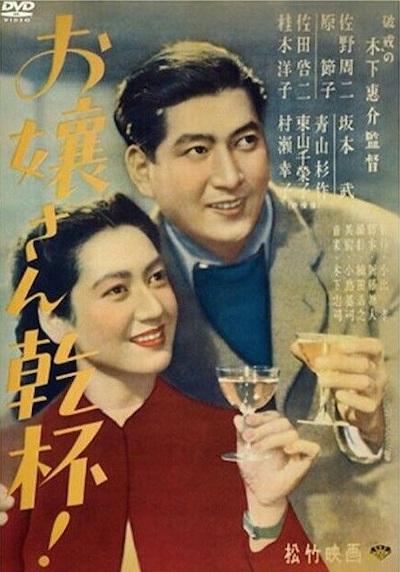
Keisuke Kinoshita – Ojôsan kanpai AKA Here’s to the Young Lady AKA Here’s to the Girls (1949)
Keisuke Kinoshita1941-1950ComedyJapanRomance

Quote:
Sentimental egalitarianism in a love story that crosses class barriers. A lower-class entrepreneur on his way up is proposed a match wth a lovely girl of an aristocratic family. He soon learns her household is bankrupt and hoping he will bail them out, and he feels he has none of the refined culture this girl enjoys. But in the end the girl herself realizes she is really in love with this boorish but charmingly frank and devoted young man…Read More » -
Vicente Aranda & Román Gubern – Brillante porvenir (1965)
Vicente Aranda1961-1970DramaRomán GubernSpainSynopsis
Antonio, a young man with a modest job in a small town, lives a monotonous existence until he is transferred to Barcelona to work in an architecture company. From that moment on, a new life will open before his eyes. He befriends Lorenzo, one of his co-workers. Lorenzo has more experience than Antonio and shows him a new, more sophisticated life in which Antonio feels out of place. In addition, Antonio falls in love with Montse, Lorenzo’s sister.
(imdb)Read More » -
Michel Deville – La maladie de Sachs AKA Sachs’ Disease (1999)
Michel Deville1991-2000DramaFranceQuote:
This absorbing and intimate portrait of an ordinary town doctor is characteristic of Michel Deville’s cinema: sombre, slow moving, filled with humanity, and unashamedly naturalistic.Albert Dupontel is captivating as the film’s central character, Dr Sachs, conveying not just the sense of ennui of a man who is locked into a life he no longer appreciates, but also his yearning for some kind of release, for the fulfilment that has so far eluded him. It is an underplayed, introspective, spiritual kind of film, focused exclusively on Sachs’ daily routine and his matter-of-fact interactions with his patients. The repetitive nature of the consultations, the drab colour scheme and the dreary locations do weigh the film down by they emphasise the sense of aching emptiness that is apparently pushing Sachs towards self-destruction.Read More »
-
Julien Duvivier – Le petit roi aka The Little King (1933)
Julien Duvivier1931-1940ComedyDramaFrance

The young monarch of a kingdom situated in eastern Europe is sent to France because of his poor health status. There, he meets again with his mother who had been exiled from the kingdom.Read More »
-
Ishirô Honda – Matango AKA Attack of the Mushroom People (1963)
Ishirô Honda1961-1970HorrorJapan

Quote:
Five vacationers and two crewmen become stranded on a tropical island near the equator. The island has little edible food for them to use as they try to live in a fungus covered hulk while repairing their yacht. Eventually they struggle over the food rations which were left behind by the former crew. Soon they discover something unfriendly there.Read More » -
James Benning – Four Corners (1998)
James Benning1991-2000DocumentaryExperimentalUSAQuote:
I’ve been brooding a lot lately about the way in which many of the best movies around have been ravaged by “narrative correctness.” This is the notion fostered by producers, distributors, and critics — often collaborating as script doctors and always deeply invested in hackwork — that there are “correct” and “incorrect” ways of telling stories in movies. And woe to the filmmaker who steps out of line. Much as “political correctness” can point to a displaced political impotence — a desire to control language and representation that sets in after one despairs of changing the political conditions of power — “narrative correctness” has more to do with what supposedly makes a movie commercial than with what makes it interesting, artful, or innovative. Invariably narrative correctness means identifying with the people who pay for the pictures rather than with the people who make them.Read More » -
Giuseppe Fina – Pelle viva (1962)
1961-1970DramaGiuseppe FinaItalyThe story of Rosaria, a woman from Apulia, who works in Milan and returns to her village each Saturday to see her illegitimate little boy, who is in a charitable institution
The film entered the 23rd Venice International Film Festival, in which it received a special mention In 2008 it was restored and shown as part of the retrospective “Questi fantasmi: Cinema italiano ritrovato” at the 65th Venice International Film Festival.Read More »