PLOT: In the castle Vogeloed, a few aristocrats are awaiting baroness Safferstätt. But first count Oetsch invites himself.. Everyone thinks he murdered his brother, baroness Safferstat’s first husband, three years ago. So he is rather undesirable. But Oetsch stays; arguing he is not the murderer and will find the real one…Read More »
Quote: Released in America as The Song of Life, this German film stirred up quite a tempest back in 1931 for its depiction of a Caesarian birth. Though not much was really shown, it was enough to cause women filmgoers — and not a few men — to faint dead away. The film was banned outright in Germany and ran into some censorship problems in the US; still, by its very controversial nature it proved to be a hit wherever it was shown. And oh, yes, there was a plot, albeit a somewhat nonsensical one: After discovering that her elderly fiance has false teeth, a young bride-to-be becomes so distraught that she contemplates suicide! She is rescued by a young sailor, with whom she has a baby, leading to the aforementioned “C-section” sequence. ~ Hal Erickson, RoviRead More »
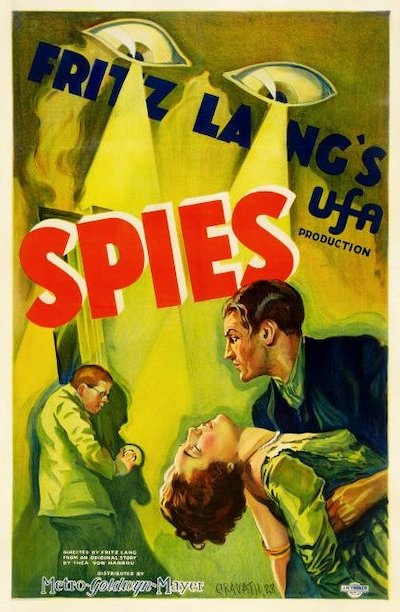
Synopsis: Spies (Spione) was the first independent production of German “thriller” director Fritz Lang. The years-ahead-of-its-time plotline involves Russian espionage activity in London. The mastermind is Haghi (Rudolph Klein-Rogge), a supposedly respectable carnival sideshow entertainer. Heading the good guys is Agent 326 (Willy Fritsch), with the help of defecting Russian spy Sonya (Gerda Maurus). The film moves swiftly to several potential climaxes, each one more exciting than its predecessor. Haghi’s ultimate demise is a superbly staged Pirandellian vignette. Anticipating Citizen Kane by a dozen years, director Lang dispenses with all transitional dissolves and fade-outs, flat-cutting territory from one scene to another. The film was co-scripted by Lang and his then-wife Thea Von Harbou. – Hal Erickson (AMG)Read More »
Still shocking even today, From Morn to Midnight remains one of the boldest examples of German expressionist cinema. Based on a play by one of the era’s most respected expressionist writers, Georg Kaiser, the story centres on a bank cashier (Ernst Deutsch) who steals money after becoming enraptured by an elegant customer (Erna Morena). Driven by lust, he begs the customer to come away with him, but she laughs in his face. Distraught at having to return home to his drab family life, the cashier goes on the run, determined to seek out the pleasure and passion he has been missing. But he is continually haunted by visions of death, and his relationship with the stolen money soon sours.Read More »
German suspense/horror film, not about vampires in the modern sense. A ‘Vampire’ or ‘Vamp’ in 1920 was a purely sexual woman who lured men to their deaths. (Theda Bara was probably the most famous) This is an expressionist film, make on the heals of ‘Cabinet of Dr. Caligari’ by the same director, cameraman and art directors. The title Genuine, is the name of the lead character, played by Fern Andra.Read More »
Posters and photos from the Weimar Republic serve as starting points for passing on the history of the first German republic and the reasons for its failure to future generations.Read More »
A short silent documentary by Gerhard Lamprecht in which the director documented the most beautiful moments of his four week vacation to Sicily, Italy.Read More »
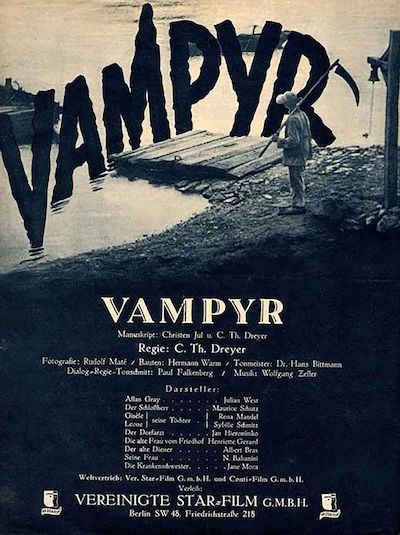
Traveler Allan Gray arrives in the village of Courtempierre and takes lodgings in a small inn. Gray has a great interest in the supernatural, particularly vampires. He’s barely settled in when he feels a sinister force descending upon him. In the night an old man enters his room to tell him ‘she must not die’. One of the old man’s daughters, Leone, has been bitten by a vampire. In order to break the curse, Gray and Leone’s sister Gisele must find the original vampire and drive a stake through her heart.Read More »
It starts straight away with our young hero trying to shoot a bullet into his head. No explanation whatsoever is given as to his motives – moviegoers in the Germany of 1931 obviously did not need any. He is disturbed by a burglar and puts a contract on himself, so to speak. The burglar tells him that he will hit him in the near future and dutifully makes a cross on his back with a piece of chalk – not unlike the ‚M’ in Fritz Lang’s movie of the same year. With the cross on his back the young hero goes to a nightclub – and falls in love with a young girl. Of course he tries to rescind from the contract and desperately looks for the burglar, only to learn that he had passed on the job to a subcontractor! Not just any subcontractor, but the very same Jim, the man with the scar, as he solemnly declares.Read More »