Paul Muni’s film debut. Muni earned an Academy Award nomination for his performance, the first of six in his long career.
A drifter with a clouded past accidentally kills the key witness to a crime, then sacrifices himself to the law under an assumed name rather than disgrace his family. In this manner, Muni is certain that he’s redeemed himself for his previous misdeeds–but a curious police inspector tries to probe his past. The Valiant was remade in 1940 as THE MAN WHO WOULDN’T TALK, with Lloyd Nolan in the Muni role.Read More »
USA
-
William K. Howard – The Valiant (1929)
1921-1930DramaUSAWilliam K. Howard -
Jim Hillier – Cahiers du Cinéma: The 1950s: Neo-Realism, Hollywood, New Wave (1985)
1981-1990BooksJim HillierUSAAbout the Book
Cahiers du Cinema is the most prestigious and influential film journal ever published. An anthology devoted entirely to its writings, in English translation, is long overdue.
The selections in this volume are drawn from the colorful first decade of Cahiers, 1951-1959, when a group of young iconoclasts racked the world of film criticism with their provocative views an international cinema–American, Italian, and French in particular. They challenged long-established Anglo-Saxon attitudes by championing American popular movies, addressing genres such as the Western and the thriller and the aesthetics of technological developments like CinemaScope, emphasizing mise en scéne as much as thematic content, and assessing the work of individual filmmakers such as Hawks, Hitchcock, and Nicholas Ray in terms of a new theory of the director as author, auteur, a revolutionary concept at the time. Italian film, especially the work of Rossellini, prompted sharp debates about realism that helped shift the focus of critical discussion from content toward style. The critiques of French cinema have special interest because many of the journal’s major contributors and theorists Godard, Truffaut, Rohmer, Rivette, Chabrol were to become same of France’s most important film directors and leaders of the New Wave.Read More » -
Philippe Grandrieux – La Vie Nouvelle AKA A New Life (2002)
1981-1990BooksJim HillierUSAAbout the Book
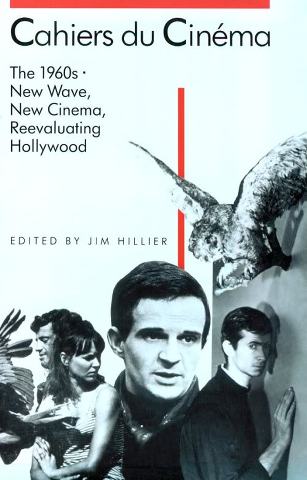
In the turbulent sixties, the provocative French film journal Cahiers du Cinema was at its most influential and controversial. The first successes of the New Wave by major Cahiers contributors such as Jean-Luc Godard, Fran?ois Truffaut, Jacques Rivette, Eric Rohmer, and Claude Chabrol focused international attention on the revitalization of French cinema and its relation to film criticism; and in the early 1960s the journal’s laudatory critiques of popular American movies were attaining the greatest notoriety.
As the lively articles, interviews, and polemical discussions in this volume reveal, the 1960s saw the beginnings of significant new directions in filmmaking and film criticism changes in which the New Wave itself was a major factor. The auteur theory that the journal had championed in the 1950s began to be rethought and revalued. At the same time, along with a reassessment of American film, Cahiers began to embrace new, often oppositional forms of cinema and criticism, culminating in the political and aesthetic radicalism of the ensuing decade.
The selections, translated under the supervision of the British Film Institute, are annotated by Hillier, and context is provided in his general introduction and part introductions. For an understanding of the important changes that took place in cinema and film criticism in the 1960s and beyond, this book is essential reading.Read More » -
Brian De Palma – Dionysus (1970)
1961-1970Brian De PalmaExperimentalPerformanceUSA“NY Times wrote:
RICHARD SCHECHNER’S “Dionysus in 69” played during 1968 and 1969 in a converted garage on Wooster Street. Brian De Palma made his movie version in the course of just two actual performances. It opened yesterday at the Kips Bay Theater.Although rough in a few technical details, it is a film of extraordinary grace and power. With exceptional imagination and intelligence, De Palma has managed both to preserve the complex immediacies of Schechner’s dramatic event (based on “The Bacchae” of Euripides) and to work those immediacies into the passionate and formal properties of his own creationRead More »
-
Robert Altman – Nightmare in Chicago (1964)
1961-1970CrimeDramaRobert AltmanUSAThis serial killer suspense thriller by Robert Altman was originally broadcast as an episode of Kraft Mystery Theater, then expanded into a longer cut and released to theaters. It stars Charles McGraw, Ted Knight, and Carroll O’Connor, among others, and features an orchestral musical score by John Williams (billed as “Johnny Williams”) before he became famous with his scores for Jaws, Star Wars, and Superman.Read More »
-
Tobe Hooper – Eaten Alive (1976)
1971-1980CultHorrorTobe HooperUSA

Quote:
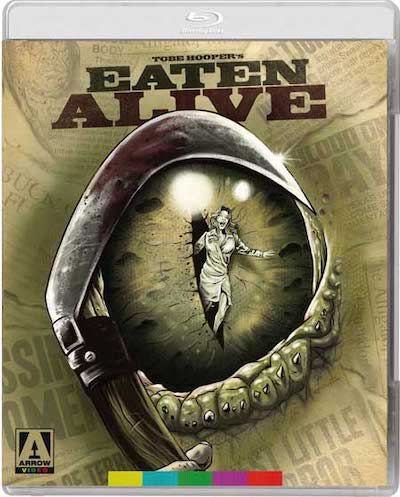
“Eaten Alive” is director Tobe Hooper’s 1977 follow up to “The Texas Chain Saw Massacre” (1974). While it is still a horror film that takes place in the deep South, it is a much different kind of film, and much like “Texas Chain Saw’s” first sequel, deals with a lot of humor, as well as over-the-top violence.The story starts with an awkward semi-rape scene involving Buck (played by a young Robert Englund) and a young prostitute. Englund has said that the Japanese version of this opening sequence inserted images of a stunt double’s genitalia, though the American version was more tame.Read More »
-
Paul Schrader – Light of Day (1987)
1981-1990DramaMusicalPaul SchraderUSASynopsis: The siblings Patty and Joe live in an industrial suburb. While Patty’s ambition is their rock band “The Barbusters” only, Joe also cares for the family and the upbringing of Patty’s young son Benji. Their pious mother reproaches them for their way of life, especially when they quit their jobs and go on tour, taking Benji with them.Read More »
-
Vivienne Dick – Staten Island (1978)
1971-1980CultExperimentalUSAVivienne Dick“Born in Donegal, Ireland, Vivienne Dick moved to New York in 1975. There she became part of a group of filmmakers affiliated to the music and aesthetics known as ‘No Wave’. Shot mainly on Super-8, Dick’s films from this period feature many people and musicians from the No Wave movement in New York, such as Lydia Lunch, Pat Place, James Chance and Ikue Mori. Invoking the spirit of ’60s underground filmmakers, her work betrays an interest in individual transgression, urban street life, kitsch and pop culture. Multilayered and open-ended, the work is framed from a female perspective, with an overriding concern for social conditioning and sexual politics”.Read More »
-
Amos Poe – The Foreigner (1978)
USA1971-1980Amos PoeArthouseThriller
Underground filmmaker Amos Poe (“Blank Generation”) wrote and directed this punk-flavored thriller about a terrorist agent whose mission in New York exposes him to constant danger and a bizarre array of friends and enemies. Eric Mitchell, Patti Astor star, with appearances by The Cramps and Debbie Harry.Read More »