
(From Wikipedia)
Mary Ellen Bute (November 21, 1906 – October 17, 1983) was a pioneer film animator who did much of her work in visual music. She was one of the first female experimental filmmakers in the U.S. From 1934 until 1953, she made 14 short, musical abstract films, working in New York. Many of these were seen in regular U.S. movie theaters, such as Radio City Music Hall, often before a prestigious film. Several of her films were also called “Seeing Sound” films.Read More »
USA
-
Mary Ellen Bute – Seven short films by Mary Ellen Bute (1934 – 1940)
1931-1940AnimationExperimentalMary Ellen ButeUSA -
Chris Smith – The Pool (2007)
2001-2010Chris SmithDramaUSA

Quote:
The Pool is the story of Venkatesh, a “room boy” working at a hotel in Panjim, Goa, who sees from his perch in a mango tree a luxuriant garden and shimmering pool hidden behind a wall. In making whatever efforts he can to better himself, Venkatesh offers his services to the wealthy owner of the home. Not content to simply dream about a different life, Venkatesh is inquisitive about the home’s inhabitants – indeed about the world around him – and his curiosity changes the shape of his future. Read More » -
Abel Ferrara – 4:44 Last Day on Earth (2011)
2011-2020Abel FerraraDramaSci-FiUSA
4:44 is a look at how a painter and a successful actor spend their last day together before the world comes to an end.
Ferrara began shooting the film in April 2011 with his longtime cinematographer Ken Kelsch. 4:44 is Willem Dafoe’s third collaboration with Ferrara after 1998’s New Rose Hotel and his last feature film, 2007’s Go Go Tales. During Montclair State University’s film forum event in February 2011, Ferrara revealed that Ethan Hawke was slated to star originally. The film was shot in one location, an apartment, set during the course of the last 24 hours before the biblical apocalypse.
The film showed in competition at the 68th Venice International Film Festival in September 2011. It had a limited theatrical release on 25 March 2012.Read More »
-
Gregg Araki – Nowhere (1997)
USA1991-2000ArthouseComedyGregg ArakiQueer Cinema(s)
Quote:
“Described by director Gregg Araki as “A Beverly Hills 90210 episode on acid” (with no suggestions of what it might be cut with), Nowhere is a companion piece with Araki’s previous meditations on youth gone wild in the 1990s, Totally F***ed Up and The Doom Generation — Araki’s self-described “teen apocalypse trilogy.” Nowhere follows 18-year-old Dark Smith (James Duval) as he goes through a fairly typical day in Los Angeles. Dark needs, but rarely gets, emotional support from his girlfriend Mel (Rachel True). Mel, however, is also involved with a girl named Lucifer (Kathleen Robertson), while Dark moons over hunky Montgomery (Nathan Bexton). Dark’s best friend Cowboy (Guillermo Diaz) has troubles of his own, as his boyfriend and bandmate Bart (Jeremy Jordan) is back on drugs and spending most of his time with his dealer. Mel’s friends include sugar junkie Dingbat (Christina Applegate), doomsday poetess Alyssa (Jordan Ladd), and Egg (Sarah Lassez), who is being unexpectedly wooed by a Famous Teen Idol (Jason Simmons). Egg’s brother Ducky (Scott Caan) has a crush on Alyssa, but she’s keeping company with a biker named Elvis (Thyme Lewis). Alyssa’s assignation with Elvis gets a psychic boost by her twin brother Shad (Ryan Phillippe) and his tryst with Lilith (Heather Graham). Read More » -
Orson Welles – Citizen Kane (1941)
1941-1950ClassicsDramaOrson WellesUSA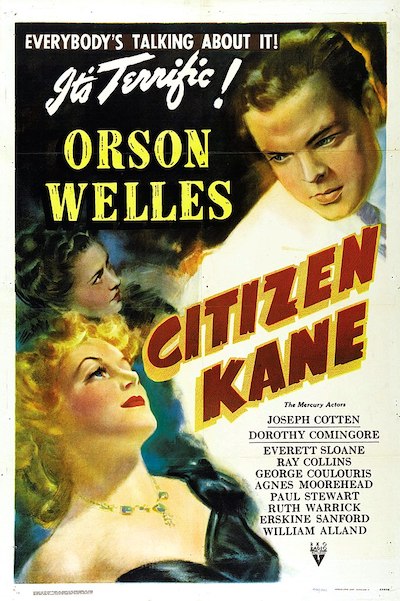
Citizen Kane is a 1941 mystery/drama film released by RKO Pictures, the first feature film directed by Orson Welles. It tells the fictional story of Charles Foster Kane, a man whose fight for power in the publishing world transformed from sheer thrill-seeking to ruthless war, and how his life affected everyone in his orbit. The storyline follows a reporter seeking to find what Kane meant by his dying word: “Rosebud.”
The film’s main character, Kane, is a composite of several historical individuals: newspaper magnate William Randolph Hearst; the reclusive aerospace and movie mogul Howard Hughes; and the Chicago utilities magnate Samuel Insull. Citizen Kane is widely considered to be a masterpiece by critics and viewers alike, and is often cited as being one of the greatest and most innovative works in the history of film.Read More »
-
Richard Koszarski – Film History: An International Journal – Exploitation Film (1994)
1991-2000BooksRichard KoszarskiUSA
The subject of Film History is the historical development of the motion picture, and the social, technological, and economic context in which this has occurred. Its areas of interest range from the technical through all aspects of production and distribution.
With this issue on the Exploitation Film, Film History investigates one of the more obscure corners of cinema. If there is a grand narrative of film history, the exploitation film has not had its chapter therein. There are many reasons for this. This ‘Exploitation Film’ issue demonstrates the scholarly activity devoted to this marginal mode of film production and its position in regard to main- stream forms of cinematic production and representation.Read More »
-
Morgan Fisher – Standard Gauge (1984)
1981-1990ExperimentalMorgan FisherUSA
Standard Gauge
1984, 16mm, colour, sound, 35 min“While on one level, Standard Gauge is Fisher’s homage to 35mm and to the diverse cinematic world it made possible, the irony of its having been filmed in 16mm reveals a conceptual paradox central to the film, and which unites it with the webs of irony and paradox evident in his earlier work. (…) As Fisher explains in his program notes, the thirty-two minute shot “is virtually the maximum length of a scene in 16mm, and is longer by far than 35mm is capable of.” For all its potentials and accomplishments, standard gauge is limited, and in ways that a non standard gauge-a gauge quite marginal to mainstream film history-is not”. (Scott MacDonald)Read More »
-
Arthur Pierson – Home Town Story (1951)
1951-1960Arthur PiersonDramaMarilyn MonroeUSA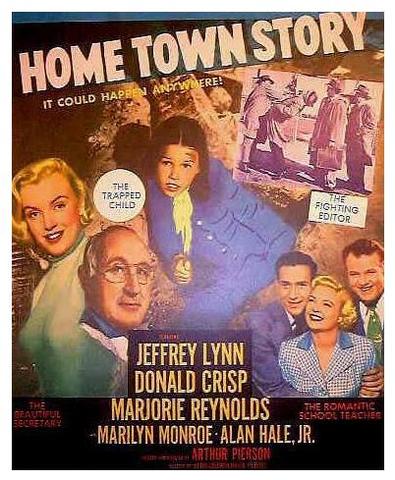
AMG: Home Town Story was commissioned as a pro-Big Business tract by General Motors. The story revolves around Blake Washburn, a mildly leftist newspaperman, played by Jeffrey Lynn. Returning to his home town, Washburn turns his journalistic vitriol upon the local business interests. Only after his kid sister Katie (Melinda Plowman), trapped in a cave-in, is rescued by locally produced technology, does Washburn realize the value of the capitalistic system. Home Town Story was fitfully distributed by MGM, then lapsed into obscurity. It might have remained there had it not been for the presence of a young Marilyn Monroe in a supporting part.Read More »
-
John Huston – The Asphalt Jungle (1950)
1941-1950250 Quintessential Film NoirsFilm NoirJohn HustonMarilyn MonroeUSA
The Asphalt Jungle is a brilliantly conceived and executed anatomy of a crime — or, as director John Huston and scripter Ben Maddow put it, “a left-handed form of human endeavor.” Recently paroled master criminal Erwin “Doc” Riedenschneider (Sam Jaffe), with funding from crooked attorney Emmerich (Louis Calhern), gathers several crooks together in Cincinnati for a Big Caper. Among those involved are Dix (Sterling Hayden), an impoverished hood who sees the upcoming jewel heist as a means to finance his dream of owning a horse farm. Hunch-backed cafe owner (James Whitmore) is hired on to be the driver for the heist; professional safecracker Louis Ciavelli (Anthony Caruso) assembles the tools of his trade; and a bookie (Marc Lawrence) acts as Emmerich’s go-between. The robbery is pulled off successfully, but an alert night watchman shoots Ciavelli. Corrupt cop (Barry Kelley), angry that his “patsy” (Lawrence) didn’t let him in on the caper, beats the bookie into confessing and fingering the other criminals involved. From this point on, the meticulously planned crime falls apart with the inevitability of a Greek tragedy. Way down on the cast list is Marilyn Monroe in her star-making bit as Emmerich’s sexy “niece”; whenever The Asphalt Jungle would be reissued, Monroe would figure prominently in the print ads as one of the stars. The Asphalt Jungle was based on a novel by the prolific W.R. Burnett, who also wrote Little Caesar and Saint Johnson (the fictionalized life story of Wyatt Earp). — Hal EricksonRead More »