Quote:
Hubert Selby’s controversial 1964 cult novel Last Exit To Brooklyn is adapted to the big screen by director Ulrich Edel in this drama. The story is set in the early 1950s in Red Hook, Brooklyn, a blighted waterfront town of boarded-up storefronts and striking factory workers. Harry Black (Stephen Lang), a machinist put in charge of the local union strike office, suddenly finds himself one of the most important men in town. But for all his sudden power, there’s something disturbing Harry. He rejects his wife’s caresses and discovers himself infatuated with a frail young man who calls himself Georgette (Alexis Arquette), who has a crush on well-muscled hood Vinnie (Peter Dobson). But Harry doesn’t confront his problem head-on until he falls head-over-heels in love with Regina (Zette), a local transvestite. As the strike becomes more intense, Harry sinks deeper into an obsessive affair with Regina, using the strike fund to shower him/her with personal gifts. As Harry sinks into obsession, other characters float through the decaying streets. There’s the attractive prostitute Tralala (Jennifer Jason Leigh) who falls in love with a sailor about to be shipped overseas. There is also an agreeable young man named Tommy (John Costelloe) who is beaten by his soon-to-be father-in-law Big Joe (Burt Young) for making his daughter Donna (Ricki Lake) pregnant. Everything comes to a tragic conclusion as the workers’ strike escalates into a violent confrontation.Read More »
USA
-
Uli Edel – Last Exit to Brooklyn (1989)
1981-1990CultDramaQueer Cinema(s)Uli EdelUSA -
Sam Newfield – Money Madness (1948)
1941-1950CrimeFilm NoirSam NewfieldUSAMoney Madness (1948)
link‘Money Madness’ (1948) Hugh Beaumont (Steve) Frances Rafferty (Julie) Cecil Weston (Aunt Cora) Harlan Warde (Attorney)
Leave it to Ward Cleaver. With a few deft strokes, he can ; stash the 200K he stole from a bank (and his cohorts) ; land a low-key hack job ; woo and marry a lovely and unsuspecting young soda jerk ; and manipulate his way to financial freedom – all in the few short weeks following his arrival in town on the noon bus (and a very ill wind).
In this lean and efficient programmer from the middle of the cycle, Beaumont impresses as moody crook-on-the-lam Steve Clark (an alias). Desperate to construct a front that will deceive the authorities and disgruntled fellow thugs alike – he blows into a strange town and rapidly spins the tangled web he deems necessary.
Read More » -
Orson Welles – The AFI Lifetime Achievement Award: A Tribute to Orson Welles (1975)
1971-1980Orson WellesTVUSAIn 1975, the American Film Institute bestowed upon Orson Welles their third Lifetime Achievement Award. (The first went to John Ford and the second to James Cagney.) This program, which originally aired on CBS, features a host of actors and other celebrities — Frank Sinatra, Johnny Carson, Joseph Cotton and Charlton Heston — who pay tribute to Welles’ brilliant but tumultuous career.
Throughout the night, many different people speak about the filmmaking contributions Welles made throughout his career, and clips from many of Welles’ films — Citizen Kane, The Magnificent Ambersons, The Lady from Shanghai, Touch of Evil, Falstaff etc. — are shown. It’s rumored that Welles didn’t want to show up unless the AFI would let him show some clips from his then in-production but now-incomplete film, The Other Side of the Wind, so the AFI indulged him and let him show a few clips. (The last screen grab is from one of the film’s scenes.)
For Welles fans, this is a must-see event, as it’s great to see him honored by so many of his colleagues.Read More »
-
Frank Borzage – Strange Cargo (1940)
1931-1940DramaFrank BorzageRomanceUSAPlot Synopsis by Hal Erickson
“Strange” is right: this mystical MGM melodrama has to be the oddest of the studio’s Clark Gable-Joan Crawford vehicles. When eight prisoners escape from a New Guinea penal colony, they are picked up by a sloop commandeered by another escapee named Verne (Gable) and his trollop girl friend Julie (Joan Crawford). Among the fugitives is Cambreau (Ian Hunter), a soft-spoken, messianic character who has a profound effect on his comrades. One by one, the escapees abandon their evil purposes and find God-and a peaceful death–through the auspices of the Christlike Cambreau. The last to succumb to Cambreau’s ministrations is Verne, who agrees to return to return to the prison colony serve out his sentence if Julie will wait for him (which she does). A superb Franz Waxman score provides a touch of show-biz grandeur to this haunting fable.
Read More » -
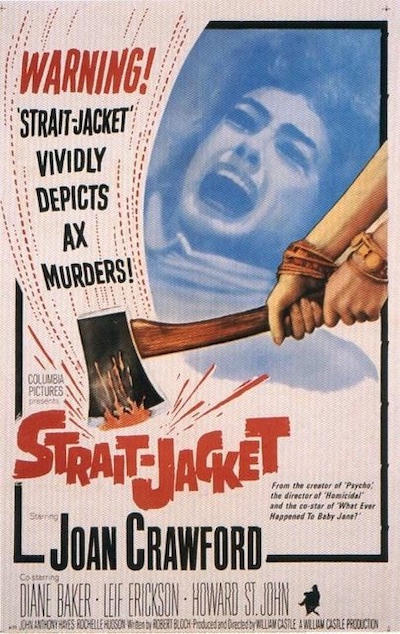
William Castle – Strait-Jacket (1964)
1961-1970DramaHorrorUSAWilliam Castle

Plot :
Lucy Harbin has spent 20-years in a psychiatric hospital for the decapitation axe-murder of her husband (Lee Majors) and his mistress, after catching him cheating on her. After she is released, she takes up residence at the farm of her brother Bill Cutler and sister-in-law Emily.Read More » -
Kelly Reichardt – River of Grass (1994)
1991-2000ArthouseDramaKelly ReichardtUSAQuote:
River of Grass has all the elements of a conventional road movie: a car, a gun, criminal plans, and young lovers on the run from an angry father who also happens to be a suspended police officer. But writer and director Kelly Reichardt has instead taken these familiar elements and fashioned an anti-road movie, a deadpan film that is more existentialist comedy than crime drama. The young lovers in question are Cozy, the cop’s daughter, and Lee Ray, a shady character from the wrong end of town.Lee Ray comes into possession of a pistol, and soon he and Cozy find themselves unintentionally involved in a shooting. Fearing capture by the law, the two make plans to leave town, committing a series of robberies on the way. However, they don’t manage to get very far; indeed, the film’s central premise is how the romantic myth of lovers on the lam proves disappointing in the face of a far more pedestrian reality.
Read More » -
James Benning – Two Cabins (2011)
2011-2020DocumentaryExperimentalJames BenningUSABetween July, 2007 and June, 2008, veteran independent film-maker,James Benning built replicas of two iconic American Cabins in a remote part of the High Sierras- Henry David Thoreau’s hut from Walden Pond and the one-room plywood shack in rural Montana from which Theodore John Kaczynski (the ‘Unabomber’) conducted his 16-year bombing campaign via the U.S. mail. The juxtaposition of these two simple structures invokes and implicates deeply conflicted and enduring foundational American myths concerning the scope and meaning of personal liberty, civic responsibility and the rule of law; individual conscience, democracy and civil disobedience; the transcendental value of nature, wilderness and the god-given right to exploit natural resources; American exceptionalism, environmental conservationism and faith in technological progress; the imperative to make oneself (anew), to ’succeed’ and, if necessary, to secede.
Read More » -
James Benning – Twenty Cigarettes (2011)
DocumentaryExperimentalJames BenningUSANaked Repose: A Conversation with James Benning about “Twenty Cigarettes”
Written by Darren Hughes
Published on 07 October 2011
James Benning“The guard is down and the mask is off, even more than in lone bedrooms where there’s a mirror. People’s faces are in naked repose down in the subway.” —Walker Evans
“So, have you ever smoked?” I laughed when James Benning asked me this question at the end of our conversation. “Honestly, I’ve probably smoked about twenty cigarettes,” I told him. “I’m a child of the 70s and 80s. Nancy Reagan told me to say ‘no.'” That was almost the full extent of our discussion of smoking, despite the fact that Benning’s feature-length video, Twenty Cigarettes, is constructed solely of portraits of smokers. The duration of each of the twenty shots is determined by the length of time it takes each subject to light, smoke, and discard a cigarette. Benning composed each shot, staged the person in front of a flat backdrop, and then walked away from the camera.Read More »
-
James Benning – Postscript (2012)
2011-2020ExperimentalJames BenningUSAIt’s a 2012 short-film, text by Theodore J. Kaczynski, made of scans of a document from a FBI Laboratory, about the danger of experiments with accelerated particles:
Read More »