Silent

  • Grigori Aleksandrov & Sergei M. Eisenstein – Oktyabr AKA October AKA Ten Days That Shook the World (1928)

    Politics1921-1930Grigori Aleksandrov and Sergei M. EisensteinSergei M. EisensteinSilentUSSR

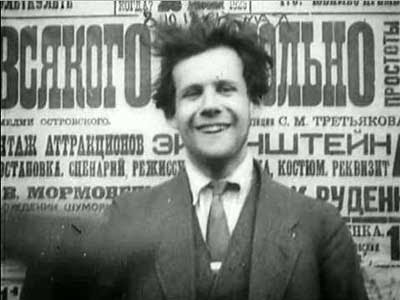
    Description: Expanding on his editing experiments in Battleship Potemkin (1925), Sergei Eisenstein melded documentary realism with narrative metaphor to depict the pivotal events of the Russian Revolution in October (1927). Commissioned to commemorate the 10th anniversary of the 1917 October Revolution, Eisenstein focused on a few key events from February 1917 to October 1917. Underlining the symbolic importance of those episodes, Eisenstein constructed October as an elaborate “intellectual montage,” deriving meaning from the metaphorical or symbolic relationships between shots. Drawing out narrative time through cutting, Eisenstein turns an opening drawbridge into a sign of the divisive struggle in St. Petersburg. Similarly exaggerating the time that it takes provisional leader Kerensky to climb a palatial staircase, and intercutting shots of Kerensky with a Napoleon statue and a mechanical peacock, Eisenstein satirically reveals Kerensky’s imperial hubris and vanity. Read More »

  • Aleksandr Razumnyj – Mat aka Mother [Incomplete] (1919)

    1911-1920Aleksandr RazumnyjDramaSilentUSSR

    29f7c043f76a2bde437fd0d52a185152

    First screen adaptation of Gorky’s ” Mother”
    Read More »

  • Antoni Bednarczyk – Dla ciebie, Polsko aka For You, Poland (1920)

    1911-1920Antoni BednarczykPolandSilentWar

    Image Hosted by ImageShack.us

    29f7c043f76a2bde437fd0d52a185152

    Quote:
    The film’s plot is set during the war between Poland and the Soviet Russia (1919 – 1921). Wartime brutally encroaches on the life of a couple in love – Franek and Hanka. The Bolshevik troops cause damage to Polish villages and manor houses, and in one of the manor houses the invaders have a carousel. Luckily, the Polish cavalry comes to the relief just in time. Unable to wait passively, Hanka becomes a sister of mercy in one of the field hospitals near Vilnius, while Franek gains wide recognition after capturing a Russian spy. The significant documents found on the spy contributed to the capture of Vilnius. The bloody battles end with the Polish troops entering the town, and Hanka and Franek finally find each other again, although in quite surprising circumstances. The film ends with the documentary recording of the ceremony of incorporating Vilnius into the Polish borders, with the participation of Marshal Piłsudski, the highest commanders of the Polish army and some foreign guests.Read More »

  • Lois Weber & Phillips Smalley – The Dumb Girl of Portici (1916)

    Drama1911-1920Lois WeberPhillips SmalleySilentUSA

    29f7c043f76a2bde437fd0d52a185152

    from the Milestone Films website:

    “Pavlova’s artistry is something that we are often asked to take on faith, something where you had to be there. Watching The Dumb Girl, you are there!” — Joan Acocella, The New Yorker

    In the early 20th century, when few stars were known by name, no woman had greater worldwide fame than ballet dancer and choreographer Anna Pavlova. Unlike movie actresses, whose celebrity spread with the international distribution of their films, Pavlova’s renown had to be earned theater by theater, performance by performance. Her legendary art was, by its nature, ephemeral. Still, no one traveled farther or worked harder than this slight daughter of a Russian laundress.Read More »

  • Louis Feuillade – Judex (1916)

    1911-1920DramaFranceLouis FeuilladeSilent

    http://ec1.images-amazon.com/images/P/B0001Y4MJA.01._SCLZZZZZZZ_.jpg

    29f7c043f76a2bde437fd0d52a185152

    Occupying a delicious place between Victorian melodrama and superhero comic books, Judex is one of the great serials from the career of French movie pioneer Louis Feuillade. From his castle lair high above the countryside, mystery man Judex (granite-faced Rene Creste) seeks to protect the lovely Jacqueline, while nursing a secret hatred for her fatcat father. Multiple kidnappings, assassination attempts, and narrow escapes follow; much of the mischief is orchestrated by wicked temptress Diana Monti (Musidora, the star of Feuillade’s Les Vampires). There’s also a delightfully overwhelmed detective (Marcel Levesque), who’s a sort of prototype of Monsieur Clouseau, and a streetwise Artful Dodger known as the Licorice Kid.Read More »

  • J. Soares – A Filha do Advogado aka The Daughter of the Lawyer (1926)

    1921-1930BrazilDramaJ. SoaresSilent

    Free Image Hosting at www.ImageShack.us

    29f7c043f76a2bde437fd0d52a185152

    “In Recife, Dr. Paulo is an important lawyer that has a daughter, Heloísa, with his paramour and living in the country. A few days before traveling to Europe, Dr. Paulo asks to a close friend to bring Heloísa to Recife. Meanwhile, his bohemian and irresponsible son Helvécio meets Heloísa, and without knowing that she is his sister, he tries to rape her, and she kills him. Heloísa is arrested and goes to trial without any evidence to prove that she self-defended her honor” Written by Claudio Carvalho, Rio de Janeiro, Brazil ( IMDB)
    Read More »

  • Arvid E. Gillstrom – The Hero (1917)

    1911-1920Arvid E. GillstromComedySilentUSA

    http://img826.imageshack.us/img826/1680/clip14y.jpg

    29f7c043f76a2bde437fd0d52a185152

    Plot: Another silent comedy with Billy aka Charley and very young Oliver Hardy. Rare movie!Read More »

  • Kevin Brownlow – D.W. Griffith: Father of Film (1993)

    USA1991-2000D.W. GriffithDocumentaryKevin BrownlowSilent

    29f7c043f76a2bde437fd0d52a185152

    This three-part documentary by Kevin Brownlow and David Gill explores D.W. Griffith’s career.Read More »

  • Dziga Vertov – Kino-Pravda No. 9 (1922)

    1921-1930DocumentaryDziga VertovSilentUSSR

    29f7c043f76a2bde437fd0d52a185152

    Quote:
    Between 1922 and 1925, a total of 23 issues of Dziga Vertov’s newsreel series Kino-Pravda (Kino-Truth) appeared (albeit irregularly and in very few copies). Vertov’s goal was to create a kind of “screen newspaper”; the title is a tribute to the newspaper Pravda founded by Lenin. Just like the Kinonedelja newsreel series (1918–19), the Kino-Pravda issues offer a fascinating insight into the early Soviet Union and demonstrate the rapid development of Vertov’s film language.

    The 22 surviving issues (No. 12 is lost) have been digitized and subtitled in German and English by the Austrian Film Museum in 2017/18 and are now available online.Read More »

Back to top button