Silent

  • Carl Theodor Dreyer – Prästänkan AKA The Parson’s Widow (1920)

    1911-1920Carl Theodor DreyerScandinavian Silent CinemaSilentSweden

    Quote:
    Although only Dreyer’s third film, The Parson’s Widow is an astonishingly mature achievement. Many of the director’s chief characteristics can be recognised, appearing not as blueprints but in their already fully-realised form. To people who only know his more celebrated later works, the most surprising feature of The Parson’s Widow is its humour. Its comedy is in the tradition – as becomes a Swedish production of the time – not only of Mauritz Stiller’s well-known frequentation of the genre, but also of some of Victor Sjöström’s less widely seen or underappreciated masterpieces, such as Hans nåds testamente (His Honor’s Testament, 1919) and Mästerman (1920). All of these films are quiet, poignant comedies of love and ageing, strangely foreshadowing some of Leo McCarey’s 1930s films.Read More »

  • William Wauer – Der Tunnel AKA The Tunnel (1915)

    Germany1911-1920Sci-FiSilentWilliam Wauer

    David Bordwell wrote:

    In 1913, the popular novelist Bernhard Kellermann published Der Tunnel. It’s not quite science-fiction, more a prophetic fiction or realist fantasy in the vein of Things to Come. The book became a best-seller and the basis of a 1915 film directed by William Wauer.Read More »

  • Rex Ingram – The Four Horsemen of the Apocalypse (1921)

    1921-1930DramaRex IngramSilentUSAWorld War One

    Plot Summary:
    Madariaga is an Argentinian cattle baron with two daughters: one married a Frenchman, the other a German. Madariaga favors his French grandson, Julio, as his heir, but Julio is a wastrel and rake whose greatest achivement is tangoing well. When Madariaga dies, his fortune is split between his daughters. The German side of the family goes back to Berlin, while the French half moves to Paris, where Julio becomes a painter and falls in love with Marguerite, a married woman. When WWI explodes (and is described by the mystic Tchernoff as the coming Apocalypse), and Marguerite’s husband is blinded, Julio decides he must join the army, and becomes a reformed character. But Death hasn’t finished gathering his harvest yet and Julio must face his own cousin on the battlefield.Read More »

  • Sifrid Miladinov – Galicnik (1940)

    1931-1940DocumentarySifrid MiladinovSilentYugoslavia

    Quote:
    This ethnographic and historical silent 16mm cinematic jewel was filmed in 1940 by Sifrid Miladinov – a professional photographer and amateur filmmaker from Kumanovo, a man with eclectic range of interests.
    In 16 short but precious minutes you will see what the village of Galichnik, the famous Galichnik wedding and our ancestors looked like 80 years ago – in color! – very unusual at that time. Maybe some of you will recognize your great-grandfather, great-great-grandmother, old family house, alley, tree, entrance door. Sifrid Miladinov’s film is a rare opportunity to look back in the past through authentic, original archive footage. We thank the descendants of this film enthusiast, the Miladinovi family from Zagreb, for depositing the film in our national film archive – the Cinematheque – several years ago.Read More »

  • Alfred Machin & Henry Wulschleger – Le manoir de la peur AKA The Manor House of Fear (1924)

    1921-1930Alfred MachinFranceHenry WulschlegerHorrorSilent

    Quote:

    Since a mysterious stranger and his servant settled in a manor near a Provençal village, a wave of crimes has beenfall the country and spread terror among the inhabitants. Young Jean Lormeau, refusing to give in to fear, leaves to meet the disturbing owner to discover his secret.Read More »

  • Robert Wiene – Raskolnikow AKA Crime and Punishment [Italian] (1923)

    1921-1930CrimeGermanyRobert WieneSilentWeimar Republic cinema

    Synopsis:
    Rodion Raskolnikov, an impoverished ex-student in Saint Petersburg, driven to utter desperation by grinding poverty and near-starvation, formulates a plan to kill an unscrupulous pawnbroker for her money, afterward falling prey to the torment of his own conscience.Read More »

  • Leo Birinsky & Paul Leni – Das Wachsfigurenkabinett AKA Waxworks (1924)

    1921-1930FantasyGermanyLeo BirinskyPaul LeniSilentWeimar Republic cinema

    A wax museum hires a writer to give the sculptures stories. The writer imagines himself and the museum owner’s daughter in the stories.Read More »

  • Hans Werckmeister – Algol – Tragödie der Macht AKA Tragedy of Power (1920)

    1911-1920FantasyGermanyHans WerckmeisterSilentWeimar Republic cinema

    Quote:
    “The rule of coal is gone. The bios plants will provide power to the world from today!” In this rediscovery of Weimar cinema, a dystopian vision of unfettered capitalism that is eerily contemporary, a coal miner makes a Faustian pact with the otherworldly Algol, an alien who teaches him how to harness the energy of his home star and become the most powerful man on earth. Together they become megalomaniacal CEOs of the “Bios-Werke,” lording over the nations of the world by monopolizing renewable energy and by turning workers into slaves.Read More »

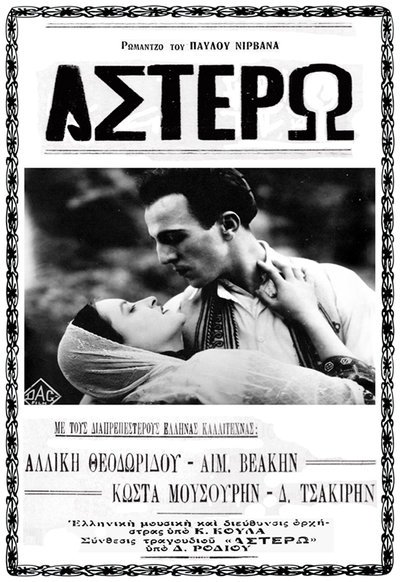
  • Dimitris Gaziadis – Astero (1929)

    1921-1930Dimitris GaziadisDramaGreeceSilent

    Quote:
    The story is set in a leafy village of Peloponnese, on the fabled hillsides of mount Helmos, around places that inspired a German poet to write: “Everything changed in Greece / Time changed everything / Not only did it change/ flock and shepherd.” Here lies the property of Kyr-Mitros, a rich peasant who lives with his son, Thymios, and his adopted daughter, Astero. The two kids grow up together, supporting each other and becoming good friends. Overtime, their friendship evolves into something deeper and more intimate. However, their dreams and wishes come to an end by tough Kyr-Mitros’ master-plan. When Stamos, a prosperous herder, comes to town, he falls in love with Astero and takes her with him. Will there be a twist of fate? Driven by guilt and watching his son withering, Kyr-Mitros reveals an important secret… This pastoral romance mesmerized audiences of the time. The screenplay is based on a literary piece by Pavlos Nirvanas, published under the title Ramona.Read More »

Back to top button