

Quote:
Paloma, a farm worker, wants a traditional wedding in a church with her boyfriend Zé. The local priest refuses her request. But Paloma, a transgender woman, will fight back for her dream.Read More »
Quote:
Paloma, a farm worker, wants a traditional wedding in a church with her boyfriend Zé. The local priest refuses her request. But Paloma, a transgender woman, will fight back for her dream.Read More »

Quote:
Fred Halsted, S&M aficionado and XXX film actor, emerged as a director rivaling Kenneth Anger in the genre of gay art-erotica. L.A. Plays Itself (1972) was his take on the same territory as Anger’s Scorpio Rising. When it opened at the 55th Street Playhouse, doubled billed with his Sex Garage, it was a case of see-it-now, or now you don’t. The police shut it down – not for the notorious fisting vignette that climaxes L.A. Plays Itself (which is cut from the video versions), but for a scene in which a guy gets it on with his motorcycle.Read More »

Quote:
Two women on the verge of a breakup, in a hospital, are further stressed on the night of a big demonstration by the overwhelmed staff and by angry, injured protestors who land up besieging the building.Read More »

Quote:
Stanley Kubrick envisioned Eyes Wide Shut as an Odyssean chronicle of marital drift. After a series of absurd encounters with the unseemly, naughty bourgeois and the diseased rejects that pander to their ludicrous peccadilloes, Tom Cruise’s wandering soul gets the hint: don’t stray! Jean-Claude Brisseau’s subversive Secret Things is nowhere near as structurally rigorous as Kubrick’s swan song, but it certainly feels more daring. First, think Celine and Julie Go Masturbating. On what appears to be a lonely stage, the sexy Nathalie (Coralie Revel) begins to pleasure herself. Then the delirious swell of an opera piece, perfectly timed to the movement of Brisseau’s camera, which pans to the right to reveal a roomful of bar patrons, including innocent barmaid Sandrine (Sabrina Seyvecou), ogling the spectacle of Nathalie’s uninhibited libido. Read More »

Synopsis:
For young PhD student Manon, far from being (just) a last-resort need to engage in sordid activities in order to make ends meet, stripping is also a means to explore her relationship with desire. Just as she thinks, upon entering into the lair of sensuality, that she’s exploring her potential to awaken her desire, she ends up encountering another desire of an overwhelming kind. She who thought she’d be meeting toxic women actually encounters fairies and muses, friends and lovers.
“Lucie Borleteau’s film de-dramatises the strip-club world, rendering it as tender as it is inflammatory...” ~CineuropaRead More »

In the bucolic hills of Mexico’s Jalisco highlands, iron-willed businesswoman Maria Garcia fights the impending collapse of her tequila factory.Read More »

Adolpho Arrietta was a major figure in the new cinemas that appeared in the sixties and seventies in various countries. Thus he became one of the fundamental film directors in the history of Spanish cinema. As with Buñuel, a long exile seems to have been the condition that allowed his work to keep up with the most important trends in the cinema of his era. Throughout the seventies he produced a series of “punk à la française” films, as Severo Sarduy called them, which for their originality and influence are among the most important in French cinema of that decade. In 1989 he returned to Madrid, and despite noteable intervals, which other Spanish film directors of his generation also experienced, his work proceeded. Alone, like in the era of El crimen de la pirindola but with a digital camera, he produced what for the moment is his latest film: Vacanza permanente (2006).Read More »

Quote:
Spiritual disciplines span the spectrum from quiet personal self-reflection to physically militant offensives against the ego that tyrannizes us all. Writer/Director Bertrand Bonello’s latest film On War deals with the latter.
On War is a film about purging—the purging of self, of attachment to the world, and of attachment to assumptions about one’s self in the world. As the characters in the film suggest, it is only through this purging that a person may fully release into the immediacy of joy and pleasure. And it is joy and pleasure, things real and authentic, that our protagonist Bertrand (Mathieu Amalric) is searching for.Read More »
Quote:
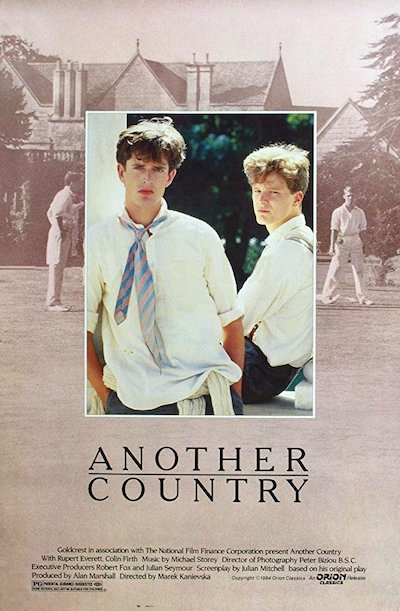
Based on the award winning play by Julian Mitchell, the film explores the effect of Public School life in the 1930’s on Guy Bennett as his homosexuality and unwillingness to “play the game” turns him eastwards towards communist Russia.Read More »