

A psycho-physiologist experiments with drugs and a sensory-deprivation tank and has visions he believes are genetic memories.Read More »
A psycho-physiologist experiments with drugs and a sensory-deprivation tank and has visions he believes are genetic memories.Read More »

Extract from the Radio Times for the broadcast:
We begin tonight with the comedy – Ken Russell’s version of The Diary Of A Nobody by the Brothers Grossmith. Ken Russell, who will be remembered from his many Monitor films, including those on Elgar and Bartok, has been an ardent admirer of this Victorian novel for many years. The film he has made of it is unusual, hilarious, and, at heart, very tender. It is an account, in the style of the early movies, of the life of a Victorian City clerk, Mr Pooter. We see Mr Pooter’s fervent desires for the well-being of his family coming to fruition – and sometimes coming to grief. (Radio Times, December 10, 1964 – Article by John McGrath).Read More »

IMDB wrote:
“The Planets” brings visual life to the classic Horst score with images that move beyond the graphic descriptions of the planets. It evokes thoughts of the solar system as it pertains to the systems that govern our lives, our society and our humanity. Ken Russell has always been known for his ability to let the audience feel uncomfortable. His images in this film are bold, but at the same time they show the subtle sensitivity that make all of his films so unforgettable.
He explores the same genre that Godfrey Reggio and Philip Glass made famous, but his work in this film stand completely on its own.Read More »

Guided throughout by the swells and dips of Tchaikovsky’s music, Ken Russell’s The Music Lovers examines the tragedies of Tchaikovsky’s life through opulent and fantastic musical sequences running alongside a narrative of the composer’s life between 1875 and 1881. Touching on his disastrous marriage with Antonina Miliukova, his relationship with his patroness Nadezhda von Meck, and his repressed homosexuality, The Music Lovers is anchored by magnetic central performances from Glenda Jackson following her Academy Award for Women in Love, coupled with Richard Chamberlain as a neurotic Tchaikovsky.Read More »
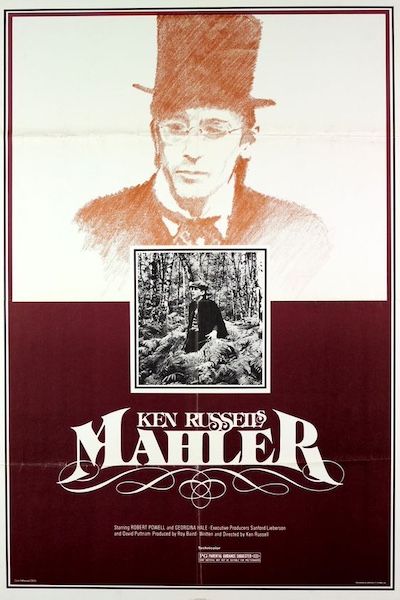
Both trifles and structure are tossed out the door by director Ken Russell in this film. Here, historical content matters not so much as metaphors, feelings, emotions, and interpretations, and pay close attention, as every word and frame is intended to be important. The film takes place on a single train ride, in which the sickly composer Gustav Mahler and his wife, Alma, confront the reasons behind their faltered marriage and dying love. Each word seems to evoke memories of past, and so the audience witnesses events of Mahler’s life that explain somewhat his present state. Included are his turbulent and dysfunctional family life as a child, his discovery of solace in the “natural” world, his brother’s suicide, his [unwanted] conversion from Judaism to Catholicism, his rocky marriage and the death of their young child. The movie weaves in and out of dreams, flashbacks, thoughts and reality as Russell poetically describes the man behind the music.Read More »

Quote:
Like the dissertation on Duncan, Russell’s look at painter/poet Rossetti and his own personal Hell (a clear allusion to the Dante of Divine Comedy fame) can be tough going at times. His relationship with Elizabeth Siddal is very upsetting, especially when we learn of her terminal illness and Rossetti’s mere indifference to it. There is also another woman, a dark haired succubus who seems to bring out the worst in the artist, constantly turning causal outings into turmoil even where situations finally seem settled. As mentioned before, Russell seems obsessed by the way women of the age interacted with men. There is a contemporary twist of course, but the overall interpretation seems wrapped up in an intricate combination of need, nurturing, and novelty. As played by Reed, Rossetti is a ruthless cad, treating everyone with determined disdain. At least in this situation, we see how the personalities of everyone involved influenced the art.Read More »

Synopsis:
The Music Lovers. Mahler. Valentino. In these and other films, Ken Russell explores the lives of artists and in turn finds inspiration for his own considerable cinematic creativity. Savage Messiah belongs to that Russell oeuvre and it draws from the filmmaker a work often studied in its pace yet exhilarating in its impact. It is the story of the short, influential career of pre-World War I French sculptor Henri Gaudier and of his intimate yet platonic friendship with a Polish émigré 20 years his senior. Scott Antony and Dorothy Tutin, perhaps better known to theater aficionados, play the two leads. Movie fans will readily identify the third-billed player: Helen Mirren in a memorable early-career role as a flamboyant, uninhibited suffragette.Read More »

Synopsis
The woman, in her thirties, stands gazing out to sea. The man, a rather studious type, lounges on the grass and finds the woman fascinating. The woman passes closely by without a glance in his direction. He follows her.
In the hotel dining room the man watches the woman nibbling a corn on the cob dripping with butter. A smile of satisfaction plays around the corner of her mouth. Before she has finished, “Mrs. Kirsch” is paged to come to reception. At least he knows her name.Read More »

A portrait of pop artists Peter Blake, Derek Boshier, Pauline Boty, and Peter Phillips.
For the first two years of his directing career for Monitor, Ken Russell had exclusively worked with shorter items of typically 10-15 minutes in length. By 1962, his reputation was such that Monitor’s head Huw Wheldon was prepared to entrust him with a full-length programme. Elgar, broadcast on November 11, was the best known, but a few months earlier Russell made Pop Goes The Easel, a 44-minute set of variations on a theme of Pop Art.Read More »