

Quote:
A motorcycle cop and a freelance photographer, having learned the location of 1 billion yen’s worth of the Imperial Navy’s gold, team up to salvage it.Read More »
Quote:
A motorcycle cop and a freelance photographer, having learned the location of 1 billion yen’s worth of the Imperial Navy’s gold, team up to salvage it.Read More »
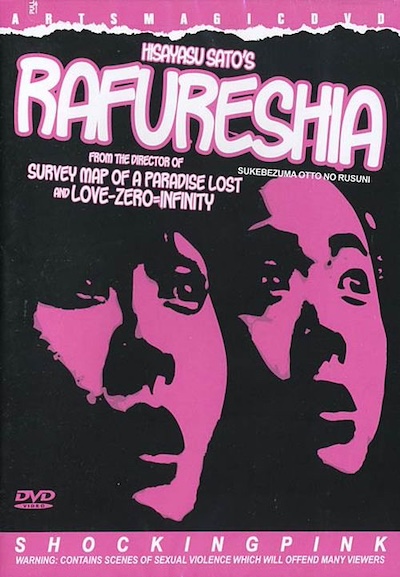
From The Director Of Survey Map Ofia Paradise Lost And Love-Zero=Infinity
Throughout the 1980s and 1990s, the sledgehammer style of Hisayasu Sato helped redefine Japanese erotic cinema with carefully constructed characters that would walk the fine line between decadence and innocence. Known for his guerrilla techniques, using a style born out of constricted budgets, Sato’s raw camerawork accurately depicts the reality of modern life.
Rafureshia, or as it is also known, Wife in Heat: While Husband Is Away, is the darkly humorous story of three very different women and their search through their sexuality into the freedom that lies beyond it.Read More »

Shinsaku was once a renowned playwright who has now been left behind by critics and is living a lethargic life in Oiso. His family is concerned for Shinsaku regaining his old vigor as a writer and Sakie, his daughter, finding a suitable match, while the family is struggling with the losses of war.Read More »

Synopsis:
Masumura’s 40th film, for which he collaborated on the script, shows plot irrationality perhaps due to the newspaper serial original, perhaps to the adolescent behavior he portrays. The extremes of self-sacrifice in some of the characters such as Hisayo and Sugiura contrast too sharply with the animal brutality of Sasabayashi and Namie, and the result is more caricature than realism. The harsh selfishness of Ichiro¯ and the abrupt techniques used to present his interior thoughts (double exposure of a naked Yuri as he undresses her with his eyes) prevent him in the end from winning audience sympathy. Part of a late sixties trend toward adolescent sexuality subject matter.Read More »

Summary:
In a Japanese women’s prison, the female prisoner Matsu, nicknamed Scorpion, is treated with extraordinary cruelty and sadism by the warden Goba. While being transferred, she is able to affect an escape along with six other women. Leading them across the wastelands, all the while pursued by Goba, they take their revenge on the men who seek to abuse them.Read More »

Quote:
This remarkable compilation follows an exchange of video letters that took place between Shuji Terayama and Shuntaro Tanikawa in the months immediately preceding Terayama’s death. It can be thought of as a home video produced by two preeminent poets and inter-laid with highly abstract philosophizing, slightly aberrant behavior and occasionally flamboyant visuals.Read More »
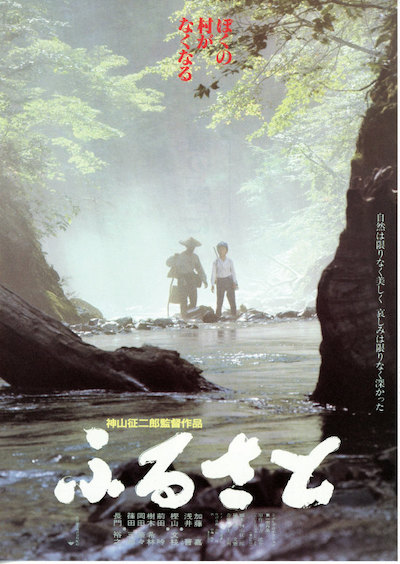
Synopsis:
Deep in the mountains of Japan where a dam is scheduled to be constructed, the residents of a village which will be submerged after the project is completed are busily preparing to relocate. Seventy-eight year old Denzo is now senile and has to stay in a detached room while his son and his wife are out working. Sentaro, a school student son of a neighbour sympathizes with lonely old Denzo. One day during summer vacation Denzo takes Sentaro to a stream to catch fish. The day they must leave the village is approaching. Sentaro asks Denzo to take him rather far up the stream. While fishing, Denzo suffers a heart attack and died before his son and neighbours can take him home.Read More »

A rarely seen but important 1965 work by Heinosuke Gosho.
Some remarks by Arthur Nolletti, in his book The Cinema of Gosho Heinosuke: Laughter Through Tears:
Gosho’s most critically acclaimed film of the 1960s… Ranked seventh in Kinema Jumpo’s “Best Ten” poll, it is rightly considered to be one of his most powerful works. Set on the Shimokita Peninsula in the northernmost area of Honshu, the film tells a stark and harrowing tale. Oshima Ayako (Yoshimura Jitsuko), a young woman in her teens, lives in a small, impoverished fishing village. Her father, Matsukichi (Yoshida Yoshio), is too ill to work. As a result, her mother, Kikuno (Sugai Kin), sells her to a nearby brothel. There she quickly is stripped of her innocence and illusions…Read More »
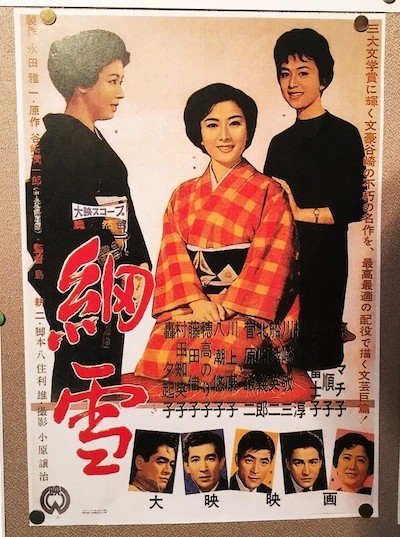
This is the second of three major film adaptation of Junichiro Tanizaki’s famous novel from the 1940s, the first one being the 1950 version directed by Yutaka Abe, the latter one being Kon Ichikawa’s The Makioka Sisters from 1983. Shima’s version stars Machiko Kyo, Fujiko Yamamoto, Junko Kano and Yukiko Todoroki in the roles of the sisters. The novel (and the films) follow the lives of the wealthy Makioka family of Osaka from the autumn of 1936 to April 1941, focusing on the family’s attempts to find a husband for the third sister, Yukiko. It depicts the decline of the family’s upper-middle-class, suburban lifestyle as the specter of World War II and Allied Occupation hangs over the novel.Read More »