

Synopsis:
Max Thorp, 25, succeeded everything : he manages a famous magazine, a nightclub, a recording studio and a radio station. But high was the price for this success…Read More »
Synopsis:
Max Thorp, 25, succeeded everything : he manages a famous magazine, a nightclub, a recording studio and a radio station. But high was the price for this success…Read More »

Quote:
Sale comme un ange is another dark portrayal of human sexuality from Catherine Breillat, her fourth in a series of provocative and unequivocally personal films. What is most striking about this film is its sense of realism and the totally unromantic way in which a romantic liaison is portrayed. By showing a consensual love affair between a young woman and a much older man in a sordid, almost animalistic way, Breillat risks offending the sensibilities of her public, but her boldness works – the end result stands as one of her most haunting and poetic films.Read More »

Fejos’s Spring Shower is one of the key Hungarian films of the 1930s and 1940s to explore the miserable lives led by maidservants. It tells the story of Mari, an austerely beautiful young peasant girl played by the French star, Annabella. Mari is seduced beneath a flowering tree by the admirer of one of the daughters of the prosperous family for whom she works, becomes pregnant and is cast out.Read More »

Quote:
The plot of Le Navire Night concerns a love affair between a young man and a woman, F., who first make contact by telephone one night, quite by chance. They have never seen each other or met before, but a relationship begins as a result of the conversation; F. continues telephoning. He, however, never learns F.’ s full name, telephone number or address, and all initiative for the relationship falls to her. The affair unfolds purely as an affair of the human voice, but this adds to the sexual intensity of the relationship rather than detracting from it: ‘C’est un orgasme noir,’ one hears the voice of Bulle Ogier saying. ‘Sans toucher réciproque. Ni visage. Les yeux fermés. Ta voix, seule’ (‘It’s a dark orgasm. Without mutual touching. Nor a face. Eyes closed. Just your voice’, N, 27–8). Three years go by, and the pair agree to meet. (In the 1978 magazine version the meeting is F.’ s idea, while, in the later version, it is the man who insists on seeing F., but only as a way of putting an end to his fear of seeing her [N, 33]; in this respect it is as though the desire to see belongs to neither her nor him, but circulates between them as a necessary step that must continually be envisaged yet constantly deferred.)Read More »

Quote:
Bresson’s first film is, totally uncharacteristically, a slapstick comedy, centred around two neighbouring republics, Crogandia and Miremia, and the various disasters that befall the ceremonial unveiling of a statue, the launching of a ship, and the crash-landing of a Miremian pilot in Crogandian territory.Read More »
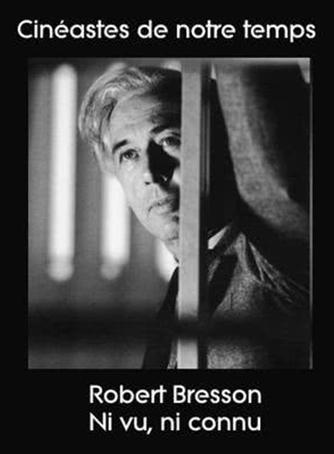
Description: Filmed mostly in his country home in 1965, ROBERT BRESSON – WITHOUT A TRACE is a revealing discussion with Bresson. Bresson at this time had completed six of his most well known films and was in the process of shooting Au Hasard Balthazar.
Usually a man of few words, having never before granted an interview on camera, Bresson agreed to answer the questions of a then-unknown writer François Weyergans, for the Cineaste de Notre Temps series.
Ranging over topics from the inspiration behind his films, to his ideas on the use of sound, actors, editing and music, and the state of (the then) contemporary cinema (from James Bond to the New Wave), Bresson describes his singular approach to filmmaking.Read More »

This is not a book about cinematography. Cinematography is what Bresson regards as valid film making, as opposed to cinema which is just photographing a play, or the theatre, which is just lies told on a stage (or something). This book contains all the little notes, ideas and bon mots that Bresson jotted down over the years. Some are insightful, most are quite arrogant and dismissive, and quite a few are a bit bonkers. Anyway it’s an interesting look into the mind of a master and fairly short (although that didn’t stop it from being a pain in the arse to scan).
Originally written in French (Notes sur le cinématographe), this is the English translation by Jonathon Griffin.Read More »
Quote:
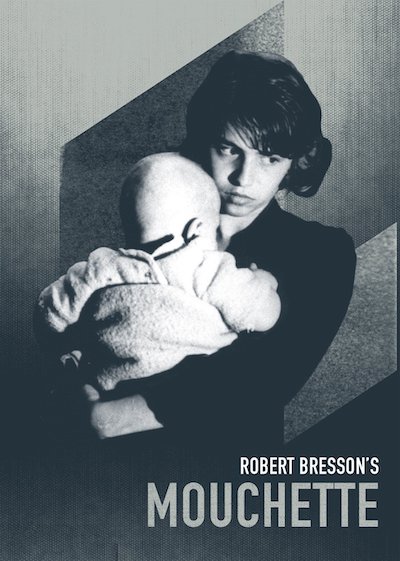
Robert Bresson plumbs great reservoirs of feeling with Mouchette, one of the most searing portraits of human desperation ever put on film. Faced with a dying mother, an absent, alcoholic father, and a baby brother in need of care, the teenage Mouchette seeks solace in nature and daily routine, a respite from her economic and pubescent turmoil. An essential work of French filmmaking, Bresson’s hugely empathetic drama elevates its trapped protagonist into one of the cinema’s great tragic figures*.Read More »

Un metteur en ordre: Robert Bresson (62 min.) is from a 1966 French television broadcast of Pour le plaisir, a cultural television program. This episode concentrates on Au Hasard Balthazar and includes interviews with Robert Bresson, Jean-Luc Godard, Louis Malle, Marguerite Duras and members of the film’s cast. Bresson explains the origin of the film’s title, while his contemporaries describe their reactions to the film. Several extensive clips from the film are presented, after which Bresson and his cast members offer their opinions of the meaning or consequences of those scenes.Read More »