Plot / Synopsis
Supertanker captain Marco Silvestri is called back urgently to Paris. His sister Sandra is desperate – her husband has committed suicide, the family business has gone under, her daughter is spiralling downwards. Sandra holds powerful businessman Edouard Laporte responsible. Marco moves into the building where Laporte has installed his mistress and her son. But he hasn’t planned for Sandra’s secrets, which muddy the waters…Read More »
France
-
Claire Denis – Les salauds aka Bastards (2013)
2011-2020Claire DenisDramaFrance -
Michel Drach – Les violons du bal aka Violins At The Ball (1974)
1971-1980DramaFranceMichel DrachPlot : In this WW II drama based on an autobiographical story by director Michel Drach, a Jewish boy and his family living in Nazi occupied France, attempt to escape the cruel invaders. Later the boy grows up to become a filmmaker obsessed with chronicling his childhood….
Awards : Best Actress for Marie-José Nat in Cannes Film Festival, 1974.Read More »
-
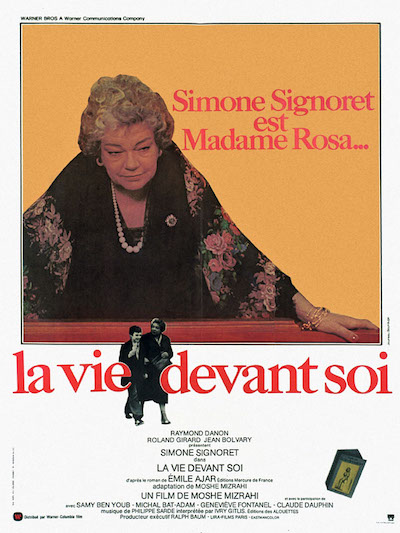
Moshé Mizrahi – La Vie devant soi AKA Madame Rosa (1977)
Drama1971-1980FranceMoshé Mizrahi

Synopsis
Madame Rosa, a former prostitute, lives in a top floor apartment in a mixed race district of Paris. Although her health is failing, she manages to look after the abandoned children of prostitutes, including a rebellious young Arab boy named Momo. An Auschwitz survivor, Madame Rosa imagines that the Nazis are still around and instructs Momo to protect her from them. Momo faithfully repays his guardian’s kindness by raising money to support her in her dying days, but he is curious to find out about his own origins…Read More » -
Pierre Thoretton – L’amour fou [+Extras] (2010)
2001-2010DocumentaryFrancePierre ThorettonA documentary on the relationship between fashion designer Yves Saint-Laurent and his lover, Pierre Berge.Read More »
-
Robert Bresson – Un condamné à mort s’est échappé ou Le vent souffle où il veut AKA A Man Escaped (1956)
1951-1960ArthouseDramaFranceRobert BressonQuote:
A Man Escaped opens with the indelible image of a pair of restless hands belonging to a French resistance officer named Lieutenant Fontaine (Francois Leterrier). His face is inscrutable and impassive, concealing his calculated attempt to flee from the escorted prison transport vehicle. He reaches for the door handle, retreats, then reaches again. At a momentary distraction of a crossing railcar, he seizes the opportunity, but is immediately recaptured, and is severely beaten by the German guards for the attempt. Imprisoned and condemned to die, Fontaine finds the courage and determination to escape his certain fate. Based on a true account by Andre Devigny, A Man Escaped is a visually minimalist, emotionally austere film about friendship, hope and perseverance. Read More » -
Bruno Dumont – Camille Claudel 1915 (2013)
2011-2020ArthouseBruno DumontDramaFranceThe sculptor Camille Claudel – sister to the poet and diplomat Paul Claudel, and former lover of the sculptor Auguste Rodin – is sent away by her brother and mother to to be committed in the Montdevergues insane asylum, where she is stripped of her freedom to create and condemned to live among the mentally ill for the rest of her days. The film takes place over a few days as she waits on her newly devout brother Paul to visit her. Starring Juliette Binoche, Jean-Luc Vincent, Emmanuel Kauffman.
Read More » -
Jean Renoir – Le Petit théâtre de Jean Renoir AKA Little Theater of Jean Renoir (1970)
1961-1970ArthouseFranceJean RenoirTVMade for television, this film consists of four parts: Part One, “The Last Christmas Dinner,” is about the relationship between an old man and an old woman, both homeless. Part Two, “The Electric Floor Polisher,” is an opera-like story of a woman who is obsessed with polishing her floors. Part Three is a musical interlude featuring Jeanne Moreau singing “When Love Dies.” Part Four, “The Virtue of Tolerance,” concerns an old man, his young wife, and how they come to terms when she has an affair with a man her own age.Read More »
-
Jacques Rivette – Va savoir (2001)
2001-2010ComedyDramaFranceJacques RivetteFrom French Film Guide:
The first years of the new millenium have marked something of a revival for the French New Wave, with Nouvelle Vague directors Claude Chabrol, Eric Rohmer and Jacques Rivette all releasing major works which achieved both popular success and critical acclaim. Rivette’s offering is a charming romantic comedy which reminds us of the director’s passion for the theatre seen in his earlier works, such as Paris nous appartient (1961).
Va savoir is constructed as a play within a play, and ultimately ends up with its denouement being played out on a theatre stage. The main action of the film, involving a rolling love cycle reminiscent of Max Ophüls’ La Ronde (1950), is inter-cut with scenes of the stage performance of an Italian play. The themes of this play, cheated love, deceit and revenge, are re-enacted by the characters in the “true life” part of the film, who each embark upon a whimsical diversion in their love lives. Although the film is shot and constructed as a conventional film, with naturalistic every-day sets and dialogue, it gives the impression that it is itself a stage play – indeed, watching the film in a cinema is very much a theatrical experience, in the best tradition of Shakespeare and Molière.Read More »
-
Claude Chabrol – Les biches aka Bad Girls [+Extras] (1968)
1961-1970Claude ChabrolDramaFranceMysteryBy Roger Ebert / January 16, 1969
Claude Chabrol’s “Les Biches” depends almost entirely on style, and as style it succeeds. He is not so much interested in his story as in how to tell it. He favors muted colors, mostly pastels, and many of his scenes are shot in the light of late afternoon.
His characters fit these colors and moods; they seem in a trance sometimes, moving slowly, speaking absently. And his camera movement is meticulously planned. We notice scenes where the camera and the actors move together in a sort of minuet. Three or four shots, using steps we don’t see or mirrors we don’t expect, have the grace of dance.
Chabrol is often considered the father of the French New Wave. He is known over here for “Les Cousins” (1959), “Les Bonnes Femmes” (1960) and last year’s “The Champagne Murders.” Unlike his colleagues in the New Wave (Godard, Truffaut, Resnais) he has steered away from politics and into a very smooth, almost ethereal directing style. “Les Biches,” a success at the 1968 New York Film Festival, ranks with his best work.Read More »