
Quote:
“Jolting in every sense of the word, this short masterwork flickers between stereographic cards depicting Victorian-era child laborers, creating a portrait of standardized horrors, endlessly reproduced.” —MoMARead More »


Quote:
“Jolting in every sense of the word, this short masterwork flickers between stereographic cards depicting Victorian-era child laborers, creating a portrait of standardized horrors, endlessly reproduced.” —MoMARead More »
Quote:
The moving camera shapes the screen image with great purposefulness, using the frame of a window as fulcrum upon which to wheel about the exterior scene. The zoom lens rips, pulling depth planes apart and slapping them together, contracting and expanding in concurrence with camera movements to impart a terrific apparent-motion to the complex of the object-forms pictured on the horizontal-vertical screen, its axis steadied by the audience’s sense of gravity. The camera’s movements in being transferred to objects tend also to be greatly magnified (instead of the camera the adjacent building turns). About four years of studying the window-complex preceded the afternoon of actual shooting (a true instance of cinematic action-painting). The film exists as it came out of the camera barring one mechanically necessary mid-reel splice. –K. J.Read More »
Quote:
To return again. To re-align is the object of these visits, perhaps. Geography of origin becoming catalyst for an inner re-alignment with the secret, private, unspoken work of one’s being. Peering into layers, sliding planes of windows and time, the fragmentary gesture of the dance.
A series of rapid contrasts, a synthesis of elemental and everyday experience.
Structures shift and intermingle, two worlds become one.Read More »
Lost dreams is made out of those little remnants of images,from a single glance to a detailed moment, of those women from youth’s love and young dreams. They are woven together, like fragments of the mind, and from the ends of film to the corners of the frame, into a memory of them. They are once again embraced and, if only briefly, poetically honoured.Read More »
Intoxicated by My Illness (in which images photographed by several people are extensively superimposed) loosely and dreamily tracks a phase in Dwoskin’s recent life that took him from medical examination to intensive care.
Mostly it is a reverie about erotic fantasy – especially the excruciating, poignant ambiguity of bodily sensation strung out between intense pain and exquisite pleasure, between the figures of the nurse, who might be imagined as a bondage mistress, and the bondage mistress, who touches the ‘dominated’ body in the most tender way imaginable. Dwoskin periodically overlays known ‘movie music’ in order to ironically foreground his own ‘self dramatisation’, all the while drawing us into a rare and precious intimacy in extremis.Read More »
Synopsis
Single frame exposures of words, color.(imdb)
Cinema of the signifier
When we watch films we see and hear representations of things, sights and sounds not present at the moment of viewing. However, we choose to take part in the illusion of cinema limited by its rules and technical deficiencies. Word Movie is just a little joke of a film that makes us aware of this.
On the screen you see words, another type of signifier, flashing and on the soundtrack you hear those same words read out loud. The only point this film makes is that there really is no difference between the photographic signifier, or in other words the image on the screen, and words flashing.(imdb)Read More »


Quote:
Radiating from the Darwinian text-fragments outward through the material is much pictorial and spoken signifying text having to do with issues such as communication, translation, dynamics of perception, art, science, isolation and social interaction etc. In a certain sense a meaning does arise from all of this. At the same time the endless groupings and regroupings of material suggest yet another realm of meaning. Finally it is the experience of our own selection of a pattern among the myriad richness of combining materials, superimposed on my own composed pattern, that opens up the real film–L. G.Read More »
Synopsis
‘Small metamorphoses’ is the name of an old game: different body parts drawn on cardboard were assembled to form endlessly varying characters. A couple and their child. The metamorphosis acts on the characters thanks to a catalyst which is time. This couple refuses this child in order to forget the failure of their love. Changes take place in the relationships, the clothes, the gestures, as time reveals the truth. The child’s awareness is materialised by the ‘miraculous’ death of his parents.Read More »


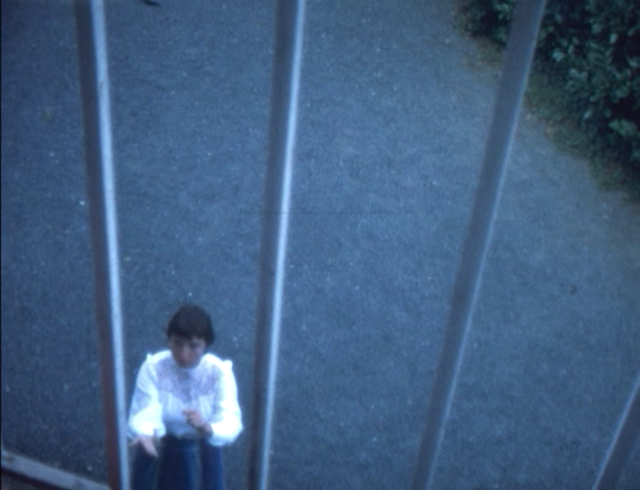
It is quite revealing how complex the simple form is. Shot one to one, a girl is confronted with nothing more than her thoughts. In the period of watching her (while she is looking at you) her expressions and movements turn into a ‘mirror’ for the viewer to experience his or herself. The experience is solely emotive between you and her, and occurs in “real” time. (Stephen Dwoskin)Read More »