Takashi Ito wrote: A film in which the one 60-story skyscraper that soars in the spaces between roofs spins with incredible speed. I centered the circumference with its 400 or 500 meter radius on the skyscraper and divided it into 48 sections, then took photographs from those spots and shot the photographs frame by frame.Read More »
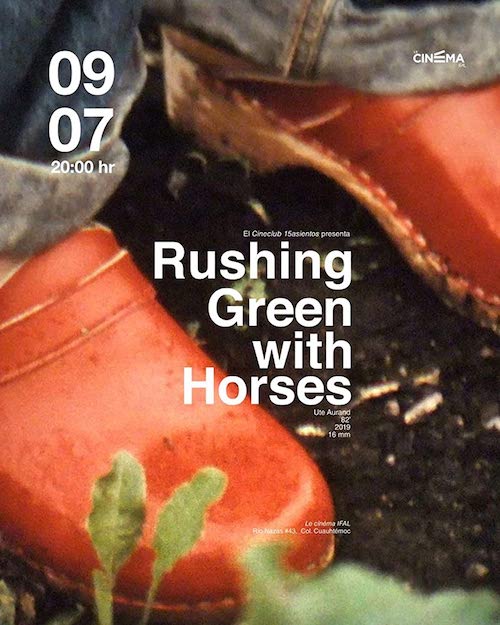
Rushing Green with Horses is a collection of brief moments, filmed between 1999 and 2018 on journeys, at home, with friends and alone. Private gestures attract my attention, spontaneously filmed beyond narration or documentary: Anton in his apartment, Lilian and Nanouk 10 days old, Jón’s 94th birthday, Sofia dancing, snow at Cape Cod, Detel in her atelier, Franz and Sabrina get married, a trip to Detroit, a stormy sea in black-and-white. We see the same people at various ages, as a child, as a teenager, as a young woman… sometimes hear someone speaking, hear music, or silence. Somewhere in the middle of the film there is a handwritten sentence: “A child asleep in its own life”. (Ute Aurand)Read More »
Quote: Belson has made reference to the hallucinatory quality of his films, and he associates this form of imagery with interior vision that corresponds to the inward spiritual journey the mind can achieve through meditation. In Belson’s words, “the hallucinatory aspect of imagery is certainly inherent in my work and in the ideas relevant to my work.” In a program note that accompanies Meditation (1971), Belson states, “by diving deep through your spiritual eye you will see into the fourth dimension, aglow with the wonders of the inner world. It is hard to get there, but how beautiful it is!”Read More »
Quote Each plant depicted in the film was hand developed in its own liquid essence, mixed with vitamin C and washing soda andused as a developer at precise times and temperatures. The film undergoes an eco- reversal process, is exposed to light, then a second eco-developer and is fixed. Lastly, the film is left to dry in the wind.Read More »
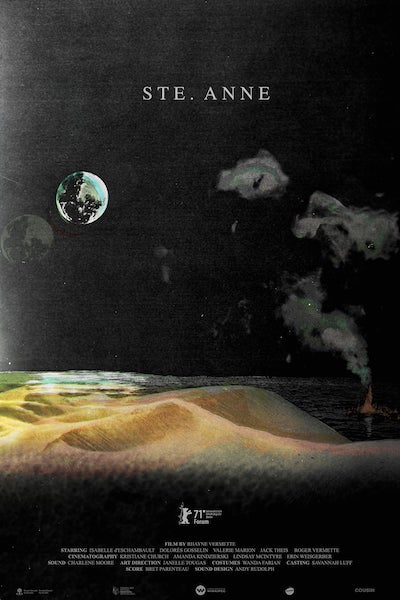
Quote: The fireside get-together is in full swing when news arrives: Renée has returned. She moves back to the rural family home which her brother Modeste now shares with his wife Elenore. The two of them have been bringing up Renée’s young daughter Athene as if she were their own. Athene tries to grasp the new situation, even as her mother’s feet are already starting to itch. Renée owns an empty lot in Sainte Anne, Manitoba, the one on the photo she shows to Athene, where a house is waiting to be built. But this is hardly the whole story, if you can even talk of a story for much of the time, it’s more a set of impressions, fragments, of the Treaty 1 territory, of daily life in the Métis Nation, to which Renée’s family belong, as do the director’s family who play them, she herself in the role of Renée. A dog in the snow, giggling nuns, hands on laden tables, shadows against corrugated plastic, the sound of the train and the image of the empty lot, again and again: in the flickering celluloid, colours fluctuate, motion slackens, hopes and dreams bleed into reality and past and present merge. Unlike what Athene says at the beginning, you needn’t be scared of the places your visions find.Read More »
Takashi Nakajima wrote: The filming of the entrance to the company dormitory in which the film-maker was living. Centering the film on one pillar, he warps the spaces to the left and right and creates an unstable space similar to painting that employs anamorphosis. Made as were SPACY and BOX with a large number of photographs, the film ends with a violent movement, but is poetic for this.Read More »
Synopsis Immediately after the Boston Marathon bombing in April 2013, amateur detectives took to the Internet chat rooms to try and find the culprits. Users on reddit, 4chan and other gathering spots poured over photographs uploaded to the sites, looking for any detail that might point to the guilt of potential suspects. Using texts and jpegs culled from these investigations, Watching the Detectives narrates the process of crowdsourcing culpability.Read More »
Takashi Ito wrote: In the early afternoon, a mother holding her child stands still in the park of a housing project. The kind of sight that is a symbol of beauty and love. Be as that may be, they have no face. The camera is aimed persistently at the spot from which they have vanished as if to find something. A work that began out of the search to understand the relation between the family and the self.Read More »