Drama

  • Michael Ritchie – Downhill Racer [+Extras] (1969)

    Drama1961-1970ActionMichael RitchieUSA

    29f7c043f76a2bde437fd0d52a185152

    Criterion wrote:
    Astonishing Alpine location photography and a young Robert Redford in one of his earliest starring roles are just two of the visual splendors of Michael Ritchie’s visceral debut feature, Downhill Racer. In a beautifully understated performance, Redford is David Chappellet, a ruthlessly ambitious skier competing for Olympic gold with an underdog American team in Europe, and Gene Hackman provides tough support as the coach who tries to temper the upstart’s narcissistic drive for glory. With a subtle screenplay by acclaimed novelist James Salter, Downhill Racer is a vivid character portrait buoyed by breathtakingly fast and furious imagery that brings the viewer directly into the mind of the competitor.Read More »

  • Frantisek Vlácil – Adelheid (1970)

    1961-1970ArthouseCzech RepublicDramaFrantisek Vlácil

    The first colour film by Czech master director František Vlácil ADELHEID is an emotional tale of two lovers trapped in the march of history.

    In the aftermath of WWII, a Czech airman returns home from his tour of duty with the British RAF, intending to claim a German factory located in the Sudetenland along the Czech-German border. There he meets the beautiful Adelheid, the former owner’s daughter who once lived in the estate but is now reduced to servitude. The Czech airman falls in love with Adelheid, but lingering resentment and bitter political strife stand in the way of their happiness. (-Second Run)Read More »

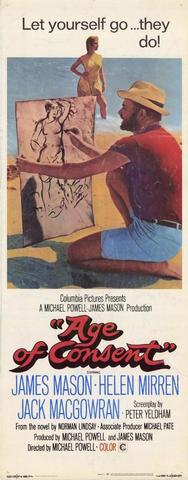
  • Michael Powell – Age of Consent [Extras] (1969)

    Drama1961-1970ComedyMichael PowellUSA

    29f7c043f76a2bde437fd0d52a185152

    An elderly artist thinks he has become too stale and is past his prime. His friend (and agent) persuades him to go to an offshore island to try once more. On the island he re-discovers his muse in the form of a young girl.
    Read More »

  • Arthur Penn – Alice’s Restaurant (1969)

    Drama1961-1970Arthur PennComedyUSA

    Arlo Guthrie’s song is converted into a motion picture.
    Arlo goes to see Alice for Thanksgivng and as a favor takes her trash to the dump. When the dump is closed, he drops it on top of another pile of garbage at the bottom of a ravine. When the local sheriff finds out a major manhunt begins. Arlo manages to survive the courtroom experience but it haunts him when he is to be inducted into the army via the draft. The movie follows the song with Arlo’s voice over as both music and narration.
    Read More »

  • Sidney Lanfield – Broadway Bad (1933)

    1931-1940DramaSidney LanfieldUSA

    29f7c043f76a2bde437fd0d52a185152

    TCM Synopsis:

    In varying degrees of undress, the chorus girls of the “Frolics of 1929” gossip that the show’s rich backer, brokerage head Craig Cutting, has “given the gate” to his mistress Aileen, one of the dancers, in preference to Antoinette “Tony” Landers, a dancer described as “a nice kid from a nice home.” As the girls chat, Tony is being seduced by her boyfriend, Bob North, the scion of a wealthy family, in the empty stadium at Yale, where he goes to college. Sometime later, as Tony prepares to go to her social debut at Craig’s party, Aileen confuses and upsets her with taunts about Craig’s “dividend checks” and “technique.” At the party, Tony learns that the dividend checks Craig has been giving her have not come, as she supposed, from the bonds her mother left her, but instead directly from Craig. She rebukes him for putting her in a position of obligation to him and refuses to succumb to his “technique” after he denies that he expects anything in return. Just then, Bob, whose suspicions have been fueled by Aileen, arrives and, after revealing that Tony is his wife, slaps her face with the cancelled checks, calls her a “dirty little tramp” and leaves. Tony confesses to Craig that she kept the marriage secret so that Bob would not be kicked out of college. When she asks Craig to help straighten out the situation, he refuses to interfere.
    Read More »

  • Ming-liang Tsai – Ni na bian ji dian AKA What Time Is It There? [+Extras] (2001)

    2001-2010ArthouseDramaMing-liang TsaiTaiwan

    29f7c043f76a2bde437fd0d52a185152

    Quote:
    Tsai Ming-Liang follows his trademark ‘pondering static camera’ (“Rebels of the Neon God”, “The River”, “The Hole” and “Vive L’Amour” ) with his fifth feature film, “What Time is it There?”. His unconventional style will deter many cinema goers who might envisage something more easily penetrable, perhaps requiring less speculation. In a pure minimalist vein, Tsai uses no music (aside from “The 400 Blows” theme played sparingly). There is no cinematographic panning shots… no camera movement for each take. Each scene is a single static shot. There are almost no close-ups. There are extremely long stretches without any dialogue. Hopefully, this does not send you running in the other direction because it is indeed a wonderful viewing experience touching upon many important modern emotional themes.
    Read More »

  • Alain Resnais – Stavisky… (1974)

    1971-1980Alain ResnaisDramaFrance

    Synopsis:
    Director Alain Resnais’s STAVISKY… is a stylized recounting of the life of Alexandre Stavisky, a masterful swindler who sold thousands of worthless bonds, working his way into a massive financial hole and drowning in a riotous political scandal. The film focuses on his heyday, which came in the years just before his arrest and subsequent death in 1934. Surrounded by an aristocratic class of financiers who, like Stavisky, delighted in transferring enormous sums among a multitude of accounts around Europe, he was an expert at moving money. Stavisky inhabited the lavish wooden parlors and grandiose theaters of Paris, the ocean overpasses and casinos of Biarritz, with sexy cars, planes, and women to get him from place to place. Read More »

  • Harmony Korine – Gummo (1997)

    1991-2000CultDramaHarmony KorineQueer Cinema(s)USA

    29f7c043f76a2bde437fd0d52a185152

    synopsis

    In this elliptical ensemble piece, which marks the directorial debut of indie bad boy Harmony Korine, the teens of tornado-scarred Xenia, OH, kill cats, tape their boobies, arm-wrestle, bathe, cross-dress, huff glue, avoid perverts, pay to have sex with retarded girls, lift makeshift dumbbells to the strains of Madonna’s “Like a Prayer,” fight, cuss, shave their eyebrows, undergo cancer treatment, euthanize senior citizens, and pee on passing cars. A hallucinatory barrage of images and scenarios with little in the way of traditional plot, Gummo has been variously described as a surrealist joke, a visual poem, and a worm’s-eye view of white-trash suffering. The main characters include Solomon (Jacob Reynolds), who sells cat carcasses to a middleman who procures them for use at a local Chinese restaurant; his mother (Linda Manz), who teaches him to tap dance while reminiscing about her dead husband; Tummler (Nick Sutton), a mullet-haired local sex symbol; a midget (Bryant L. Crenshaw); a pair of boy-crazy, bleach-blond sisters named Dot (Chloe Sevigny) and Helen (Carisa Bara); a slut with a lump in her breast (Lara Tosh); a group of drunken louts; and Bunny Boy (Jacob Sewell), who wanders the town enigmatically in a pair of long pink ears. In between scenes of these characters enacting their bizarre routines, Korine intersperses impressionistic and quasi-documentary scenes with voice-over narration that ranges from incest memoirs to arty dialogue along the lines of “He’s got what it takes to be a legend: He’s got a marvelous persona.” Shot just outside Nashville, TN, Gummo includes costume designs by Korine’s then-girlfriend, Chloe Sevigny, who also plays Dot and who previously starred in the Korine-scipted, Larry Clark-directed Kids. Jacob Reynolds would go on to appear in Getting to Know You, though few of the director’s other discoveries have appeared on film since.___by Brian J. DillardRead More »

  • Federico Fellini – Roma AKA Fellini’s Roma [+Extras] (1972)

    1971-1980ArthouseDramaFederico FelliniItaly

    The New York Times review, Published: October 16, 1972

    Roger Greenspun wrote:
    “Fellini’s Roma” is perhaps three-quarters Fellini and one-quarter Rome; a very good proportion for a movie. Although an appreciation of the city informs every part of the movie, Rome is not so much the subject as the occasion for a film that is not quite fiction and surely not fact, but rather the celebration of an imaginative collaboration full of love and awe, suspicion, admiration, exasperation and a measure of well-qualified respect.Read More »

Back to top button