This evocative tribute to the mother of American avantgarde film calls forth the spirit of one who was larger than life as recounted by those who knew her. Friends and contemporaries float through her homes, recalling in tiny bits and pieces words of Deren’s architectural and personal interior space. Clips from her films are projected back into the spaces where they were originally filmed. Fluid light projections of intimate space provide an elusive agency for a filmmaker most of us will never know.”
BERLINALERead More »
Documentary
-
Barbara Hammer – Maya Deren’s Sink (2011)
2011-2020Barbara HammerDocumentaryExperimentalMaya DerenUSA -
Ferdinand Khittl – Das magische Band AKA The Magic Tape (1959)
1951-1960DocumentaryFerdinand KhittlGermanyShort FilmDas magische Band – West Germany 1959, 21 min.
Directed by: Ferdinand Khittl
Written by: Bodo Blüthner, Ferdinand Khittl, Ernst von Khuon
Cinematography by: Ronald Martini
Music by: Oskar Sala
Edited by: Irmgard Henrici
Cast: Margot Trooger, Ferdinand Khittl
Produced by: Gesellschaft für bildende Filme, MünchenOne of the 3 short films that came as an extra on Edition Filmmuseum 47: Die Parallelstrasse AKA The Parallel Street (Ferdinand Khittl, 1962).
An innovative documentary on magnetic tape & sound recording, sort of in the style of Charles and Ray Eames.Read More »
-
James Benning – Measuring Change (2016)
2011-2020ArthouseDocumentaryJames BenningUSASynopsis
Measuring Change consists of two shots, which run for about 30 minutes each. The camera is completely still and its placement seems to be exactly the same for both. The film revisits Robert Smithson’s Spiral Jetty, his landmark 1970 sculptural work on the northeast shore of the Great Salt Lake, which the director had already interacted with in Casting a Glance (2007). The filmmaker seemingly repeats the vantage point of one of the shots he made ten years before, allowing the jetty to spiral towards the center of the frame. Yet, there are two major differences. While Casting a Glance was shot on 16mm, and dealt with the durational limitations of the film reel, Measuring Change is shot on digital, which allows one to watch Smithson’s work through Benning’s camera for a much longer period of time (in the Q&A after the screening, he mentioned that he actually prefers the digital image over film – something one doesn’t hear often coming from filmmakers). The other difference is that this time the lake has receded so far back that the Smithson’s piece is completely surrounded by land, while the shore gets lost in the horizon.Read More » -
Maria Helene Bertino & Dario Castelli & Alessandro Gagliardo – Un mito antropologico televisivo AKA An Anthropological Television Myth (2012)
2011-2020Alessandro GagliardoArthouseDario CastelliDocumentaryItalyMaria Helene BertinoAn Anthropological Television Myth is an excuse to introduce television anthropology into the culture debate, reading the history of a country and its people through the archives of hundreds of private TV stations scattered throughout Italy.
MUBI’s take wrote:
A great example of how seemingly mundane footage can be reused to create a work of social importance, this exercise in visual history-telling uses a medium representative of popular culture as a tool for the reading of social movements and citizen engagement in a Sicilian city.Read More » -
Gianfranco Angelucci & Liliane Betti – E il Casanova di Fellini? aka And Fellini’s Casanova? (1975)
Documentary1971-1980Federico FelliniGianfranco AngelucciItalyLiliane BettiQuote:
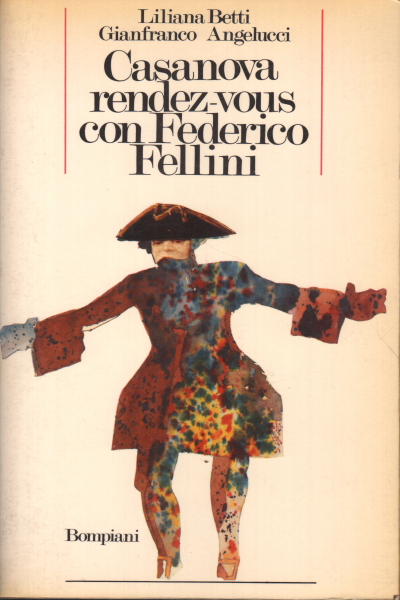
…the “crypto-documentary” by Gianfranco Angelucci amd Liliana Betti E il Casanova di Fellini? (And Fellini’s Casanova?) made for the RAI, in which Federico submits some friends to a screen test for the part of Casanova: Mastroianni, Tognazzi, Gassman, Alain Cuny and an exhilarating Alberto Sordi deeply involved in the part.Read More » -
Alexander Kluge, Basil Gelpke – Mensch 2.0 (2011)
2011-2020Alexander KlugeBasil GelpkeDocumentaryGermanyQuote:
Another mammoth-project with the “chronologist of our time” Alexander Kluge. With 12 hours film, Gelpke and Kluge try to get a better understanding of the new human, which arouse from the internet, artificial intelligence…. Like his last projects, this films are complilations of many fragments, shorts, fiction-interviews, opera, theatre etc.Read More » -
Claude Lanzmann – Tsahal (1994)
Documentary1991-2000Claude LanzmannIsraelPolitics

new york times review (january 1995)
If “Tsahal,” opening today at the Walter Reade Theater, initially seems to admire that toughness unquestioningly, it eventually grows into a thoughtful exegesis of a troubling, complex subject. This film provoked a tear-gas bombing at a Paris movie theater last November, but it isn’t inflammatory on its own merits. Mr. Lanzmann, whose background in philosophy shapes his film making in palpable ways, is more pensive than judgmental. He seeks the essence of Israel’s embattled existence during “46 years of perpetual alarm.” Slowly, doggedly, he arrives at a profound understanding of it by the time “Tsahal” is over.Read More » -
Anne Charlotte Robertson – Five Year Diary [Incomplete] (1982)
USA1981-1990Anne Charlotte RobertsonDocumentaryExperimentalIncludes reels : 01, 02, 03, 09, 22, 23, 26, 31, 40, 47, 80, 81, 83
Anne Charlotte Robertson, born in 1949, was a Massachusetts-based filmmaker who used her Super-8 camera and acute self-awareness to forge a radically intimate mode of first-person cinema. Although she was celebrated as an artist in her lifetime, only today is Robertson finally being acknowledged as an influential pioneer of the first-person diary cinema that has long flourished in the Boston-Cambridge area, perhaps best known in the work of Ed Pincus and Ross McElwee. Gripped by mental illness, Robertson discovered a vital form of self-therapy in the diaristic filmmaking practice invented and refined across her magnum opus, Five Year Diary (1981–1997), whose eighty-one individual chapters, or “reels,” meld bold formal experimentation, self-depreciatory humor, and raw emotion into a charged yet lyrical chronicle of an often painfully difficult life. Cathartic and devastating, rough-edged and poignantly delicate, disarmingly funny and meditative, Robertson’s Five Year Diary offers a remarkably frank and revealing self-portrait of an artist and woman struggling to understand the overwhelming desires and dark shadows that defined her world.Read More »
-
Orson Welles – Around the World with Orson Welles (1955) (HD)
1951-1960DocumentaryOrson WellesTVUnited KingdomSean Axmaker, Keyframe wrote:
When handed the raw materials from an unfinished documentary about Elmyr de Hory, an art forger whose life was being written up by biographer Clifford Irving, Orson Welles took the opportunity to make something far beyond the concept of the traditional documentary. F for Fake has been called the Orson Welles’ first essay film, a true enough statement if you limit the accounting to feature films, but he had been doing short-form non-fiction since 1955, when he made Around the World with Orson Welles (a.k.a. Around the World) for British television.Read More »