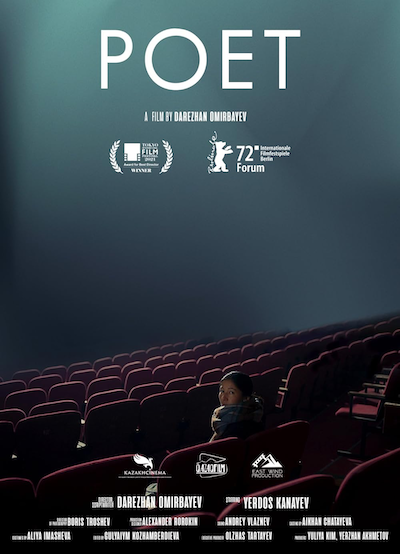
Didar is a poet, but he cannot live from his poetry.
He has to write early in the mornings before setting out for his day job as a newspaper editor.
Didar is surrounded by a sense of crisis, not just because of his economic situation,
but also due to discussions at work about the diminishing significance of Kazakh culture,
dying languages, and the worldwide dominance of English.
He is questioning whether poetry is still relevant in today’s world,
but finds solace in contemplating a rebellious 19th-century poet, Makhambet Otemisuly.Read More »
Quote: In the rural Soviet-era Kazakh village of Bazarbaï in the Kzylordinskye district, a reticent and impassive boy named Jasulan (Jasulan Asauov) watches his father ride away on horseback into the arid frontier before sneaking into the utility shed, activating the house portable generator, and returning to the living room – past the silent, disapproving gaze of his doting mother in the kitchen – to watch the faint, occasionally distorted black and white image of a Russian language television broadcast. Jasulan’s self-indulgent diversion, however, inevitably proves brief as the power abruptly goes out, having been disconnected by his pragmatic father who has unexpectedly returned home to the sound of the noisy, sputtering engine, and dismissively (and amusingly) scolds the boy for wasting scarce fuel “to see naked women”. Read More »
Quote: Marat works as a personal driver in Almaty, capital of Kazakhstan. When he hits a Mercedes, the nightmare begins. The loan he accepts to pay for the damages puts him at the mercy of a Mafia boss.Read More »
A slice-of-life story on globalised capitalism’s impact on Kazakhstan, its contemporary urban culture, and the lonely road that patrons of the arts walk in a country where art is often overlooked and underappreciated.Read More »
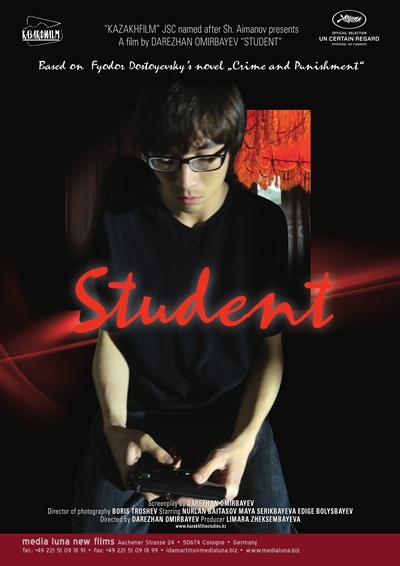
A solitary philosophy student steers his directionless life toward a violent crime, spurred on by a post-Soviet order characterized by growing inequality, institutional corruption and a ruthless ethic. Inspired by Dostoevsky’s Crime and Punishment. Official selection of the prestigious Global Lens Collection presented by the Global Film Initiative.Read More »
Educational film by Darezhan Omirbayev for film schools students.
AUTOGRAPHS A series of educational films, “Autographs” is a textbook for students of cinema department, which is dedicated to the works of great authors of word cinema. These films show and explore the most colorful and unique pieces that are typical and repetitive directorial techniques from the film (scenes), which are important in the work of one or another author. Read More »
This is a loose adaptation of Leo Tolstoy’s classic novel “Anna Karenina”. Kazakh auteur Darezhan Omirbayev (July, Kairat, Killer, Cardiogram) here makes an attempt to juxtapose the classic plot and contemporary Kazakhstan reality.Read More »
Review: Darezhan Omirbaev’s penchant for spare, elliptical narrative, muted figures, and disembodied framing (most notably, of hands and feet) have often been (favorably) compared to the rigorous aesthetic of Robert Bresson. However, in imposing such a somber – and inescapably cerebral – analogy, there is also a propensity to overlook the wry, self-effacing humor and irony of situation that pervade his films: a lyricism that equally captures the human comedy in all its contradictions and nobility from the margins of Soviet society. This sense of the quotidian as a continuum of human experience, elegantly rendered in Omirbaev’s recent film, The Road through Amir’s recurring daydream of a mother milking a cow and her intrusive child (who, in turn, looks remarkably like Amir’s own son) in rural Kazakhstan (an image that subsequently proves to be a catalytic historical memory from his childhood when man landed on the moon), can also be seen from the outset of Omirbaev’s cinema through his incorporation of a decidedly Buñuelian sequence in the short film, July of a young boy who, while on the lookout for guards near the foothills of a kolkhoz commissary, curiously finds himself wandering into a recital hall where the performance of a young pianist is punctuated by the appearance of a horseman on the stage. Read More »