

Quote:
Lonely residents of a tornado-stricken Ohio town wander the deserted landscape trying to fulfill their boring, nihilistic lives.Read More »
Quote:
Lonely residents of a tornado-stricken Ohio town wander the deserted landscape trying to fulfill their boring, nihilistic lives.Read More »

Asian warriors take a group of Western women hostage and bring them to their all-female village, leading to a culture clash.
Women Make Movies wrote:
Ulrike Ottinger’s epic adventure traces a fantastic encounter between two different worlds. Seven western women travelers meet aboard the sumptuous, meticulously reconstructed Trans-Siberian Express, a rolling museum of European culture. Lady Windemere, an elegant ethnographer played by the incomparable Delphine Seyrig in her last screen role, regales a young companion with Mongol myths and lore while other passengers-a prim tourist (Irm Hermann), a brash Broadway chanteuse and an all-girl klezmer trio-revel in campy dining car cabaret. Suddenly ambushed by a band of Mongol horsewomen, the company is abducted to the plains of Inner Mongolia and embark on a fantastic camel ride across the magnificent countryside. Breathtaking vistas, the lavish costumes of Princess Ulun Iga and her retinue, and the rituals of Mongol life are stunningly rendered by Ottinger’s cinematography. Dubbed a female Lawrence of Arabia and just as sweepingly romantic, JOHANNA D’ARC OF MONGOLIA is a grandly entertaining, unforgettable journey.Read More »

Quote:
The Big Bad Wolf and his friends are plotting to kidnap and ransom Mrs. Rada the Goat’s children for a bag full of gold.Read More »
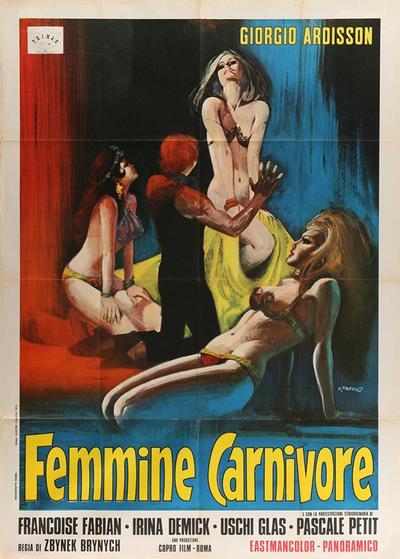
Outrageous sleaze joins an exclusive health clinic only to discover it’s run by feminist cannibals.Read More »
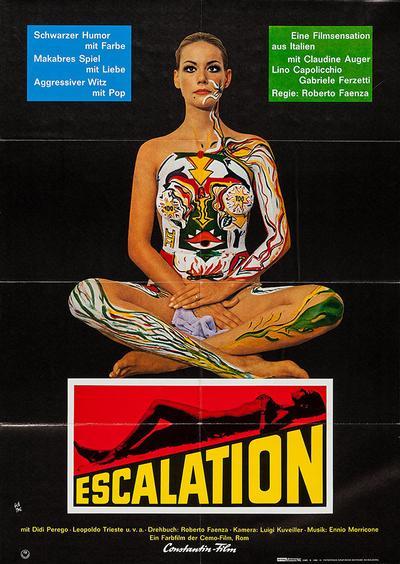
Synopsis:
‘1968, London. Luca, the son of an Italian rich owner, is living his ‘swinging’ years away from duties and responsibilities while his father wants him to be introduced to the family business at any cost. Luca is first forced to return to Italy, then he is kidnapped by his father’s collaborators, jailed into a sanitarium, put through the electroshock and other torments. Then, when ‘normalized’ Luca marries a woman who in reality is a psychologist paid by his father to brainwash him and turn him into a perfect businessman.’
– davideRead More »

Synopsis:
A documentary crew from the BBC arrives in L.A. intent on interviewing Heidi Fleiss, a year after her arrest for running a brothel but before her trial. Several months elapse before the interview, so the crew searches for anyone who’ll talk about the young woman. Two people have a lot to say to the camera: a retired madam named Alex for whom Fleiss once worked and Fleiss’s one-time boyfriend, Ivan Nagy, who introduced her to Alex. Alex and Nagy don’t like each other, so the crew shuttles between them with “she said” and “he said.” When they finally interview Fleiss, they spend their time reciting what Alex and Nagy have had to say and asking her reaction.Read More »

A compilation film designed to evoke nostalgia for the shared entertainment experiences of early baby boomers, “The Movie Orgy” includes clips from television programs and B-movies of the 1950s and 1960s, as well as commercials, music clips, newsreels, blooper outtakes, satiric short films and promotional and government films. The effect is something like a simulation of a lazy Saturday of channel surfing or a long double (or triple) matinee at the movies. The film is primarily structured around extended clips from Attack of the 50 Foot Woman (1958) and Speed Crazy (1959); as it progresses, segments primarily culled from about a dozen other films and programs are increasingly intercut to create the effect of a single disjointed story in which numerous monsters and assorted social menaces seem to inflict themselves simultaneously on various American cities and towns. This principal focus is occasionally interrupted by commercial breaks and other assorted side features. (IMDB, Written by scgary66)Read More »

Description from Beat Cinema
The End is in six numbered sections, each separated by long stretches of darkness during which Maclaine speaks directly to the audience. Each of the sections is a tale of a different person on the last day of his or her life. The characters in the first three sections meet their end either through random acts of violence or suicide (none depicted graphically), after which Maclaine (in dark humor mode) acknowledges that the audience may not yet be identifying with his characters (“These people are all violent!”). The characters in the second half seem to meet their end through a large-scale disaster, unspecified in Maclaine’s narration but undoubtedly the atomic explosion shown at the beginning and end of the film. The two halves of the film are bridged by Maclaine’s narrator, who equates the self-destruction of the first three characters with a complacent world awaiting “the grand suicide of the human race.” The finale of the film is the end of the world as Maclaine imagines it might look, set to the tune of Beethoven’s ninth symphony – presaging Stanley Kubrick, who would also juxtapose an atomic explosion with ironically uplifting music in Dr. Strangelove a decade later. The End is not just a stern warning, but a prophecy of absolute doom – Maclaine seems to have believed the world was ending before his very eyes, and the eyes of his audience.Read More »

Quote:
Punks hail Britannia in their own peculiar way in this little-seen gem by the late queer auteur
Jubilee (1978), Britain’s only decent punk film, still isn’t respected at home as much as it should be, and it remains pretty obscure everywhere else. Instead, we had to wait for Trainspotting (1996) to represent some sort of renaissance in “cool” British cinema. Yet, even though it is almost 20 years older, Jubilee makes Trainspotting’s self-congratulatory, CD tie-in antics look like a polite Edinburgh garden party.Read More »