Quote:
Three strangers arrive at a chateau inhabited by four women believed to be vampires. But are they vampires or are they under the hypnotic machinations of an old man? Rollin shot the first part of this film as a short subject to be billed with an American vampire film bought by a distributor that just over an hour (it too was designed for double billing). His producers were impressed with what he accomplished with next to nothing and asked him to expand the film to feature length. Thus, the first half hour (part one) is an intriguing short that makes the most of its found locations, make-shift production design, and available lighting (and a very early example of a turntable effect around two arguing actors to heighten the intensity of the scene). The second half (which necessitates resurrecting several of the characters that were killed at the end of the first and introduces the Queen of the Vampires played by Jacqueline Seiger (who was an instructor at Felix Guattari’s anti-psychology clinic at the time). Lacking the structure of the first part, the near-plotless remaining hour allows Rollin to cram in an entire serial’s worth of car chases, mad doctors, vampires, fist fights, and gun fire as well as several more arresting – and iconic in the Rollin oeuvre – images to bring the short to feature length. Part 2 features also Olivier Martin (the protagonist of Rollin’s LE VAMPIRE NUE – forthcoming from Redemption USA) and, despite his large role in the part, an uncredited Jean-Loup Philippe (co-writer and star of Rollin’s LEVRES DE SANG).Read More »

Cult
-
Jean Rollin – Le viol du vampire aka The Rape of the Vampire (1968)
1961-1970ArthouseCultFranceJean Rollin -
Khavn – Mondomanila, or: How I Fixed My Hair After a Rather Long Journey (2010)
2001-2010ArthouseCultKhavnPhilippinesA joyfully outrageous slice of life in the slums set to a punky soundtrack, Mondomanila is a slap in the face of Western expectations of politely miserabilist depictions of the downtrodden. A hyper kinetic, super stylised wild carnival of the destitute, it follows a midget, a one-armed rapper, a ‘day-glo fairy’, a disabled pimp and their friends as they try to get as much sex and drugs as they can (‘the only solution to their problems’, we are told by main character Tony at the beginning) and tackle a racist white paedophile. A toothless showman opens this exuberant bad taste spectacle, promising something horrible and creepy, but the Mondo-style shockumentary aspect is underpinned by the crude reality of life in Manila, making the film vital and energising.
Read More » -
Assi Dayan – Giv’at Halfon Eina Ona aka Halfon Hill Doesn’t Answer (1976)
1971-1980Assi DayanComedyCultIsraelQuote:
Sgt. Jinji is very interested in Yaeli, Mr. Hasson’s youngest daughter. After getting into a dispute with a fuming Mr. Hasson who falsely believed Jinji wanted to marry his eldest daughter, Jinji is kicked out of Mr. Hasson’s house. Having witnessed the scene, and unbeknownst to Mr. Hasson nor Jinji, Yaeli escapes too and hides in the back of Jinji’s jeep, intent to join him despite her father’s wishes.On the way to his army base, Jinji picks up Konstanza, a shady businessman, who has been evading reporting to reserve duty for a while. Konstanza also happens to owe money to Mr. Hasson (due to a very dubious business deal gone awry), and Mr. Hasson decides to look for Konstanza to get his money back. All our characters end up in the middle of the desert at a small, somewhat improvised military base.
Read More » -
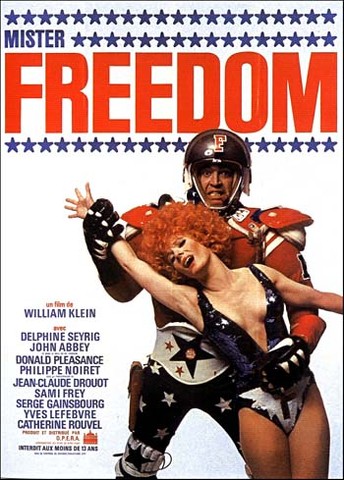
William Klein – Mr. Freedom (1969)
1961-1970Amos Vogel: Film as a Subversive ArtCultFrancePoliticsWilliam KleinMr.Freedom is a militaristic moron of a superhero. In his secret identity he is a United States sheriff, but when he enters his hidden closet hidden in his office behind a large American flag, he transforms into the patriotic superhuman. He takes orders from Doctor Freedom, the controller of Freedom Inc, who orders him to go to France and stop it from falling prey to the evils of Communism after the death of Freedom’s counterpart, Capitaine Formidable. Getting a less than rapturous welcome from the French, Mr.Freedom decides to save them all anyway…by destroying the entire country and everyone in it if he has to.Read More »
-
Ghannam Ghannam – Fatayat Haerat AKA Bewildered Girls (1981)
1981-1990CultExploitationGhannam GhannamSyriaSome university students change their views on sex after hearing a lecture on the blind Syrian philosopher Al-Maarri. He gets his way with one of them after sneaking what I imagine is rufees into one of their drinks which has disastrous consequences. After going to some wild bellydancing parties they are ensnared by a polyester-clad drug-dealer and womanizer/rapist. The victims’ friends plan to avenge her with the help of the local police. Includes numerous musical numbers and belly dancing scenes.
Read More » -
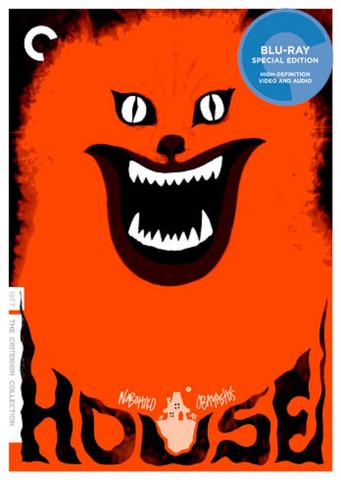
Nobuhiko Obayashi – Hausu aka House [+Extras] (1977)
1971-1980CultHorrorJapanNobuhiko ObayashiQuote:
How to describe Nobuhiko Obayashi’s indescribable 1977 movie House (Hausu)? As a psychedelic ghost tale? A stream-of-consciousness bedtime story? An episode of Scooby-Doo as directed by Mario Bava? Any of the above will do for this hallucinatory head trip about a schoolgirl who travels with six classmates to her ailing aunt’s creaky country home and comes face-to-face with evil spirits, a demonic house cat, a bloodthirsty piano, and other ghoulish visions, all realized by Obayashi via mattes, animation, and collage effects. Equally absurd and nightmarish, House might have been beamed to Earth from some other planet. Never before available on home video in the United States, it’s one of the most exciting cult discoveries in years.Read More » -
Chris Marker – Sans soleil (1983) (HD)
Documentary1981-1990Chris MarkerCultFranceChris Marker, filmmaker, poet, novelist, photographer, editor, and now videographer and digital multimedia artist, has been challenging moviegoers, philosophers, and himself for years with his complex queries about time, memory, and the rapid advancement of life on this planet. Sans Soleil is his mind-bending free-form travelogue that journeys from Africa to Japan.
Read More » -
Harmony Korine – Gummo (1997)
1991-2000CultDramaHarmony KorineQueer Cinema(s)USAsynopsis
In this elliptical ensemble piece, which marks the directorial debut of indie bad boy Harmony Korine, the teens of tornado-scarred Xenia, OH, kill cats, tape their boobies, arm-wrestle, bathe, cross-dress, huff glue, avoid perverts, pay to have sex with retarded girls, lift makeshift dumbbells to the strains of Madonna’s “Like a Prayer,” fight, cuss, shave their eyebrows, undergo cancer treatment, euthanize senior citizens, and pee on passing cars. A hallucinatory barrage of images and scenarios with little in the way of traditional plot, Gummo has been variously described as a surrealist joke, a visual poem, and a worm’s-eye view of white-trash suffering. The main characters include Solomon (Jacob Reynolds), who sells cat carcasses to a middleman who procures them for use at a local Chinese restaurant; his mother (Linda Manz), who teaches him to tap dance while reminiscing about her dead husband; Tummler (Nick Sutton), a mullet-haired local sex symbol; a midget (Bryant L. Crenshaw); a pair of boy-crazy, bleach-blond sisters named Dot (Chloe Sevigny) and Helen (Carisa Bara); a slut with a lump in her breast (Lara Tosh); a group of drunken louts; and Bunny Boy (Jacob Sewell), who wanders the town enigmatically in a pair of long pink ears. In between scenes of these characters enacting their bizarre routines, Korine intersperses impressionistic and quasi-documentary scenes with voice-over narration that ranges from incest memoirs to arty dialogue along the lines of “He’s got what it takes to be a legend: He’s got a marvelous persona.” Shot just outside Nashville, TN, Gummo includes costume designs by Korine’s then-girlfriend, Chloe Sevigny, who also plays Dot and who previously starred in the Korine-scipted, Larry Clark-directed Kids. Jacob Reynolds would go on to appear in Getting to Know You, though few of the director’s other discoveries have appeared on film since.___by Brian J. DillardRead More »
-
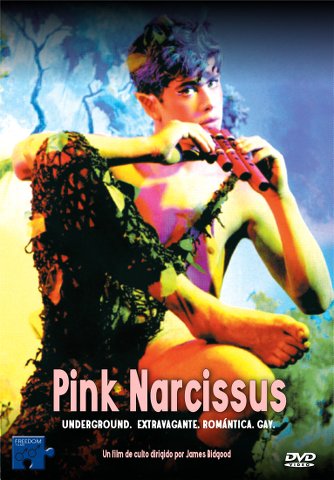
James Bidgood – Pink Narcissus (1971)
1971-1980CultEroticaJames BidgoodQueer Cinema(s)USABefore the art duo Pierre et Gilles, before fashion photographer David LaChapelle, before the artist Jeff Koons, and before the neo-Pop movement broke, there was director James Bidgood and his film PINK NARCISSUS. A cult classic, it is so considered more for its highly artistic production values than for its narrative.
The film is essentially a piece of gay erotica (more erotic than explicit) about an impossibly handsome young man (played by Bobby Kendall), obsessed with his own beauty and youth, who escapes the realities of street life through intricately choreographed fantasies in which he portrays a Roman slave, a matador, a wood nymph, and a harem boy. Characterized by searingly bright colors and highly stylized visual elements (sets, props, and costumes), Bidgood’s design for the film has been endlessly emulated by commercials and photographers to this day. PINK NARCISSUS is a “must see” for anyone interested in contemporary art, the pre-Stonewall sensibility, or the history of underground film.
Read More »