Quote:
This is Michael Haneke’s first feature film, made for Österreichischer Rundfunk and Südwestfunk and broadcast in 1976. Like many of his later films for television and for the screen, it is an adaptation of a literary work; but viewers will probably notice moments in it that strangely anticipate later films — from The Seventh Continent and 71 Fragments of a Chronology of Chance, to Code Inconnu and Caché. The film, which is 97 minutes long, is based on a novella by the Austrian author Ingeborg Bachmann, published in 1972, a year before her death following a fire in her Rome apartment.Read More »
Austria
-
Michael Haneke – Drei Wege zum See AKA Three Paths to the Lake (1976)
Drama1971-1980ArthouseAustriaMichael Haneke -
Peter Tscherkassky – Train Again (2021)
Peter Tscherkassky2021-2030AustriaExperimentalQuote:
18 years after Kurt Kren produced his third film 3/60 Bäume im Herbst, he shot his masterpiece 37/78 Tree Again. 18 years after I created my third darkroom film L’Arrivée (an homage to the Lumière brothers and their 1895 L’Arrivée d’un train), I embarked on Train Again. This third film in my “Rushes Series” is an homage to Kurt Kren that simultaneously taps into a classic motif in film history. My darkroom ride took a few years, but we finally arrived: All aboard! (Peter Tscherkassky)Read More » -
Michael Glawogger & Ulrich Seidl – Krieg in Wien (1989)
1981-1990AustriaDocumentaryMichael GlawoggerUlrich Seidl

SYNOPSIS:
A film about news, life, love and death. Four days in Vienna, four days in world news.
At home children are born, the dead are washed, or people simply wait for the bus. At the same time television broadcasts very different images. A ferry sinks off the Philippines, Sadam Hussein decorates his soldiers with medals, and in Vienna a war breaks out that in reality never took place. With news reports from: Argentina, Austria, China, Cuba, Finland, France, Great Britain, Greece, Hong Kong, Indonesia, Irak, Italy, Japan, Libya, Luxemburg, Monaco, Poland, Senegal, South Africa, South Korea, Spain, Switzerland, Syria, West Germany, USA, Yugoslavia, Zaire, Zambia.Read More » -
Sandra Wollner – Das unmögliche Bild AKA The Impossible Picture (2016)
2011-2020AustriaDramaSandra WollnerWith Wollner’s latest film, The Trouble with Being Born, having generated a lot of interest and controversy (just last week, it was dropped from the Melbourne International Film Festival program after a newspaper article denounced it as dangerous), here’s her little-seen debut feature, about a thirteen-year-old girl in 1950s Vienna documenting her family and herself with a handheld video camera.Read More »
-
Barbara Albert – Die Lebenden AKA The Dead and The Living (2012)
2011-2020AustriaBarbara AlbertDrama

The film deals with the story of my grandfather, who was an SS officer. He died in 1999, when I was 29 – and I really loved him… Barbara AlbertRead More »
-
Kurt Kren – 24/70: Western (1970)
1961-1970AustriaExperimentalKurt KrenShort Film

In 24/70 Western, recognition of the image being filmed (an anti-war poster picturing the My Lai massacre entitled And Babies) is withheld, through close-up filming of the surface of the image, never stepping back to reveal the whole. The method in this film (as in 20/68 Schatzi) acts to subvert the quick responses of viewers to such loaded imagery. In all of Kren’s films, the images are variously covered and uncovered, hidden and revealed, never taken for granted. – David Levi Strauss
Read More » -
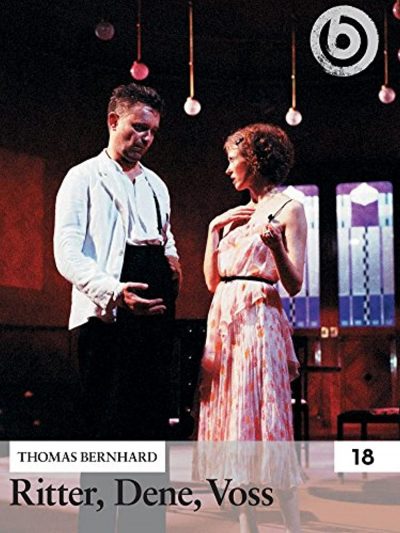
Claus Peymann – Thomas Bernhard: Ritter, Dene, Voss (1987)
Drama1981-1990AustriaClaus PeymannPerformanceRitter, Dene, Voss is a stage play by Thomas Bernhard from 1986. After the Premiere the same year at the Salzburger Festspiele under the direction of Claus Peymann, the play was taken into the repertoire of the Burgtheater in Vienna.
It was named after the three actors that were to play the roles in the world-premiere: Ilse Ritter, Kirsten Dene and Gert Voss. Thomas Bernhard started off writing it with a note saying “Ritter, Dene, Voss. intelligent actors”.
The play was inspired by the family of Ludwig Wittgenstein and his (Wittgensteins) nephew Paul, who was a friend of Bernhard and protagonist of his novel “Wittgensteins Nephew” from 1982.Read More » -
Claus Peymann – Thomas Bernhard: Der Theatermacher AKA Histrionics (1990)
Drama1981-1990AustriaClaus PeymannPerformance

Der Theatermacher (“The Theatre Maker”) is a play by austrian writer Thomas Bernhard. It was released in 1984 and had its world-premiere the following year at the Salzburger Festspiele under Claus Peymann. Centered around main protagonist Bruscon, it is full with allusions to the famous festival in Salzburg.
During a break in his latest tour the actor Bruscon tries to stage his play „Das Rad der Geschichte“ (“The wheel of history”) in the small village Utzbach. He involves his whole family in the production as actors – wife, daughter and son.Read More »
-
H.K. Breslauer – Die Stadt ohne Juden AKA The City Without Jews (1924)
Drama1921-1930AustriaH.K. BreslauerSilentQuote:
Despite the fact that, contrary to Bettauer’s book, the film is more a comedy rather than a real plea against antisemitism, and that it includes pretty negative archetypes against Jews, screenings of the film were actually subject to disturbances by NSDAP members. Furthermore Bettauer, who had not approved the changes made by Brelauer, was assassinated a few months later by a Nazi who, although accused as an “assassin”, had to spend only a few months in various mental hospitals and was released in 1927 without further requirements.Read More »