

Three lonely young denizens of Taipei unknowingly share an apartment used for sexual trysts.Read More »
Three lonely young denizens of Taipei unknowingly share an apartment used for sexual trysts.Read More »

Plot:Yu is a high school boy who lives with his father who became a priest after Yu’s mother died. But one day, a woman, Kaori, falls for Yu’s father although she knows that he is a priest. Yu is completely against this because he does not like Kaori’s eccentric presence intruding into the father and son’s peaceful life, and even more because she brings with her Yoko, the girl he fell in love with at first sight. He does not want the girl of his dreams to become a step-sister! One day, religious cult member Koike finds this so-called family an interesting group and kidnaps three of its members, leaving Yu behind on purpose hoping he will join the cult soon. He will not fall for Koike’s tricks, but instead will do anything to save the love of his life, Yoko, from this cult.Read More »

Set after the Tohoku earthquake and tsunami, all 14-year-old Yuichi Sumida (Shota Sometani) wants to become is a regular boy and live a decent life. His environment though repeatedly drags him into the mud. He runs his parent’s rental boat business, which is located next to a nondescript lake. His mother frequently comes home with different men and soon she leaves him entirely. His father only comes around looking for money. Whenever Yuichi’s father is drunk he tells Yuichi “I wish you were dead.”Read More »
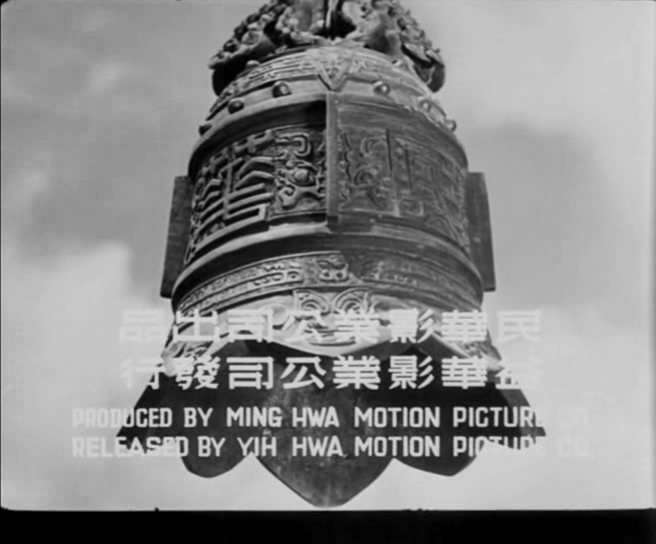
Confucius (Chinese: 孔夫子; pinyin: Kǒng Fūzǐ) is a 1940 Chinese film directed by Fei Mu. Produced during the war, the film was released twice in the 1940s before being thought lost. In 2001, the film was rediscovered when an anonymous donor sent a damaged copy of the print to the Hong Kong Film Archive (HKFA). The HKFA then spent seven years restoring the print which was finally screened to modern audiences at the 33rd Hong Kong International Film Festival in April 2009.
The film depicts Confucius’s later life, as he traveled across a China divided by war and strife in an ultimately futile effort to teach various warlords and kings his particular philosophy.
Read More »
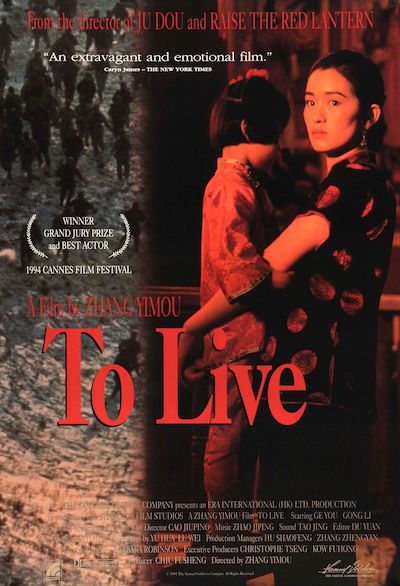
Roger Ebert wrote:
To Live is a simple title, but it conceals a universe. The film follows the life of one
family in China, from the heady days of gambling dens in the 1940s to the austere
hardship of the Cultural Revolution in the 1960s. And through all of their fierce struggles
with fate, all of the political twists and turns they endure, their hope is basically one
summed up by the heroine, a wife who loses wealth and position and children, and
who says, “All I ask is a quiet life together.” The movie has been directed by Zhang
Yimou, the leading Chinese filmmaker right now (although this film offended Beijing and
earned him a two-year ban from filmmaking). It stars his wife, Gong Li, the leading
Chinese actress (likewise banned). Together their credits include Ju Dou, Raise the Red
Lantern and The Story of Qui Ju. Like them it follows the fate of a strong woman, but
also this time a strong man; somehow they stick together through incredible hardships.Read More »
Quote:
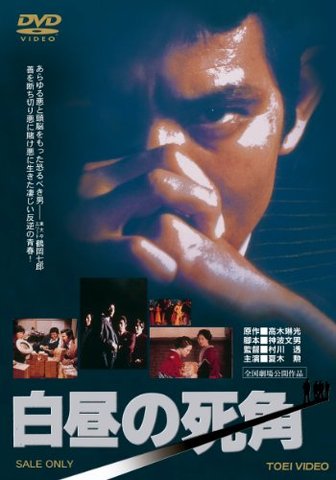
An extraordinary group of action stars join up together as elite college graduates in the 1950’s who commit perfect financial crimes through legal loopholes. Starring the great Natsuyagi Isao and Chiba Shinichi, along with legendary samurai star Amachi Shigeru. As with all things in life, nothing is perfect. Will justice prevail or is there really a perfect crime? Edge of the seat suspense highlights this superb crime drama!Read More »
Quote:
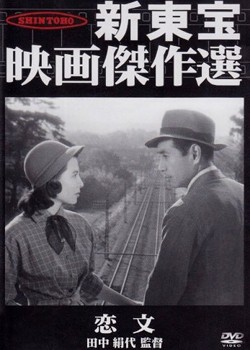
This is a rare chance to see a film by Kinuyo Tanaka as director. Tanaka was an actress known through her starring roles in many, many Japanese films in the pre-war and post-war golden ages – films like Mizoguchi’s The Life of Oharu (1952) – through to her tremendous and award winning performance in Kei Kumai’s Sandakan 8 (1974). Although not the first woman to direct a film in Japan Tanaka was able to produce a handful of films in the 50s that are very competently made and much better and more interesting than many in their treatment of women in society. Although it was said that her relationship with Mizoguchi was the reason she was able or allowed to direct it is clear that she had talent that was all her own and that she was able to work with the cream of Japan’s studio talent (the script writer is Keisuke Kinoshita). Koibumi was her first film as director.
Read More »
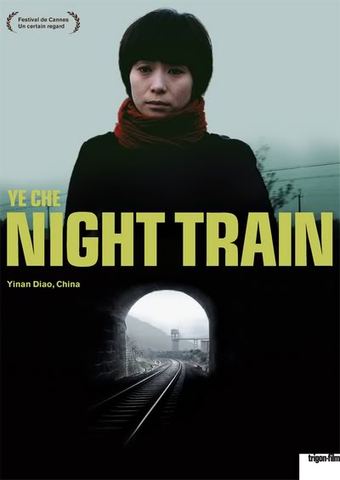
From DVD distributor trigon-film:
Wu Hongyan, woman executioner in her thirties, works at the court in the province of Shaanxi in China, where she executes women condemned to death only. In spite of her macabre job, Wu Hongyan travels every weekend to a town nearby to join parties organized by a marriage bureau. The result of her dating is mediocre, until she meets the mysterious Li Jun. But she is thousands of miles away of imagining that Li Jun’s wife is the last of the women she executed. Electrifying!Read More »

Quote:
The Japanese melodrama “Like Father, Like Son” turns on the kind of cruel twist — children switched at birth — that’s the stuff of tear-wringing headlines and fiction. It begins with the revelation that two 6-year-old boys were given at birth to the wrong families, which now need to decide on the best thing to do. For one set of parents, Ryota (Masaharu Fukuyama) and Midorino (Machiko Ono), a comfortably middle-class couple nestled high in a glass tower, the revelation that their only son, Keita (Keita Ninomiya), isn’t a blood relation is a blow to their tiny family. It’s also a wedge that — day by day, hurt by hurt — transforms these loving parents into sparring partners. Family ties wind through the work of the Japanese director Hirokazu Kore-eda, whose films include “Nobody Knows” (about four children abandoned by their mother) and “Still Walking” (about a family grieving for a dead son). In his last film, “I Wish,” he tells the story of two seemingly unsinkable young brothers separated by their mother and father’s bad marriage and choices: Each child lives with a different parent, having been divided up as if they were household possessions. In “Like Father, Like Son,” Mr. Hirokazu again creates a pair of irresistible charmers whose lives are, with increasing emotional violence, upended — with polite bows, civilized conversations and hollow-sounding rationalizations — by the very adults meant to take care of them. — Manohla Dargis
Read More »