Arthouse

  • Tengiz Abuladze – Natvris khe aka The Wishing Tree (1976)

    1971-1980ArthouseDramaTengiz AbuladzeUSSR

    This adaptation of Giorgi Leonidze’s short stories sees twenty-two episodes coalesce into one phantasmagoric narrative. Set in pre-revolutionary Georgia, it follows a young woman forced into marriage by her village elders despite her love for another man. Drifting poetically from one incident to the next, this gorgeously sustained pastorale from one of Georgia’s great auteurs creates a sense of the rich tapestry of Georgian village life, and the tragic consequences of community dispute.Read More »

  • Lars von Trier – Europa AKA Zentropa [+Extras] (1991)

    1991-2000ArthouseDenmarkDramaLars Von Trier

    29f7c043f76a2bde437fd0d52a185152

    Europa (retitled Zentropa for the American release) is an hallucinatory Danish film set in postwar Germany. Jean-Marc Barr plays a young German who aspires for a job as a street conductor. But this is no mere “Joe Job;” Barr’s adventures on the line are designed as a metaphor for the emergence of the “New Europe” following the war. Barbara Sukowa costars as the daughter of a railroad magnate–and possible Nazi sympathizer. Many of the special-effects sequences are computer enhanced, but even the “live” scenes have an unsettling, surreal quality to them (colors changing abruptly, backgrounds shifting without warning, etc.) This experimental film left some viewers confused, which may be why English-language prints of Zentropa are narrated by Max Von Sydow.Read More »

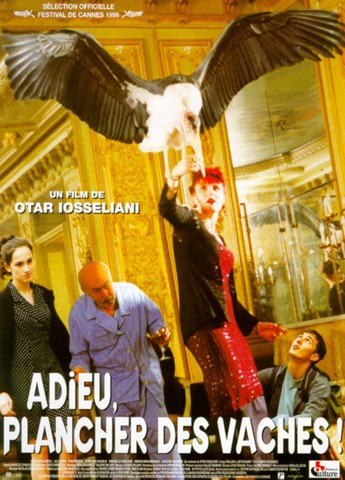
  • Otar Iosseliani – Adieu, plancher des vaches! aka In Vino Veritas aka Farewell, Home Sweet Home (1999)

    1991-2000ArthouseFranceOtar Iosseliani

    29f7c043f76a2bde437fd0d52a185152

    Review by Scott Tobias:

    A giant pet stork, with scanning eyes that quietly observe the human folly surrounding it, lends sanity and stability to Otar Ioseliani’s cracked comic roundelay Farewell, Home Sweet Home, perhaps because it’s the only character comfortable with its lot in life. The others, mainly members of a wealthy Parisian family, are leading absurd double lives in secret, illustrating the cliché, “the grass is greener on the other side.” With exceptionally fluid camerawork and a gently mocking touch, Ioseliani’s virtually plotless slice-of-life borrows elements from several great directors at once, combining the class-conscious irony of Luis Buñuel and the near-silent comedy of Jacques Tati with the daisy-chain elegance of Max Ophüls’ The Earrings Of Madame De… It takes time to get oriented to the peculiar rhythms of Ioseliani’s world, which establishes characters through behavior rather than dialogue, and takes only a slightly skewed perspective on the repetition and tedium of everyday life. There are no punchlines, no dramatic outbursts, and no traditional three-act structure, just an association of events that poke fun at the fickleness of human nature. Centering on the inhabitants of a suburban château, the characters attempt to escape their own lives by taking on separate identities. A well-to-do 19-year-old (Nico Tarielashvili) moonlights as a lowly dishwasher at a Paris bistro and hangs out with scruffy beggars; his mother (Lily Lavina), a businesswoman who flies to and from work in a helicopter, fancies herself a singer; and her father (Ioseliani) plays with a child’s train set while drinking himself into a stupor. Meanwhile, a penniless sailor (Philippe Bas) dresses up in a suit and picks up women in a rented Harley Davidson, including a pretty barmaid (Stephanie Hainque) who rebuffs Tarielashvili’s advances. There are at least another dozen other minor players, connected by the gliding camera movements that seamlessly link one comic vignette to the next. With its assured, breezily unassuming design, mapped out with architectural precision, Farewell, Home Sweet Home may sound like the work of an egghead formalist. But Ioseliani’s warm, open-ended style, combined with his remarkably adroit use of non-actors, impresses with the unpracticed spontaneity of real life.Read More »

  • Ming-liang Tsai – Ai qing wan sui AKA Vive l’amour (1994)

    1991-2000ArthouseAsianMing-liang TsaiQueer Cinema(s)Taiwan

    Three lonely young denizens of Taipei unknowingly share an apartment used for sexual trysts.Read More »

  • Shion Sono – Ore wa Sono Sion da! AKA I am Sion Sono! (1985)

    Arthouse1981-1990JapanShion Sono

    This is the highly experimental first film by the then 22-year-old Sono. The title means “I am Sono Sion!” Shot on 8mm, it is a free-wheeling, intimate, poetic cinematic journal in which the artist contemplates his life as he approaches his birthday. The film clearly reveals the experimental roots of a director whose subsequent work has made him a cult figure both inside and outside Japan.Read More »

  • Sebastian Mez – Metamorphosen AKA Métamorphoses (2013)

    2011-2020ArthouseDocumentaryGermanySebastian Mez

    29f7c043f76a2bde437fd0d52a185152

    SYNOPSIS

    Suddenly there was a powerful explosion, the earth trembled under my feet and the older people who had already experienced a war, thought this would be the start of a new one.” This is how Gulschara, a witness, describes one of the worst nuclear disasters to mankind.
    On September 29th, 1957 a tank containing highly radioactive waste exploded at the Mayak nuclear facility in the south Ural region in Russia and released large amounts of radioactivity, which spread up to 400km northeast of Mayak. Due to the meteorological situation the contamination accumulated to the south Ural area, so that the warning systems in Europe weren’t triggered. The accident could therefore be kept secret for more than 30 years until the Perestroika.
    In that time most of the people living in the affected areas were not properly informed. Many lived a normal life as if nothing had happened. Even today people have only been partially moved to a new settlement called New Muslyumovo, which is only two kilometres away from the old town and the Tetscha river, which originates in the secret area of Mayak and in which high-level radioactive waste was inserted repeatedly. “I am afraid of the radiation… but I don’t feel it a lot during day-to-day life”, says Nail, one of the residents of Muslyumovo.
    The filmmaker uses the cinematic language to capture a danger, that is not visual nor perceptible, and to show the strenght of people and nature who has to cope with it.
    Read More »

  • Alain Robbe-Grillet & Dimitri de Clercq – Un bruit qui rend fou aka Blue Villa (1995)

    1991-2000Alain Robbe-GrilletArthouseDimitri de ClercqFranceThriller

    29f7c043f76a2bde437fd0d52a185152

    Plot summary
    A sailor who was accused of killing a teenage girl and who was presumed to have drowned while making his escape, returns to the Mediterranean island where the alleged crime took place. But all is not what it appears. Robbe-Grillet keeps us guessing as to whether the murder actually took place and teases the viewer with the possibility that the sailor may be a restless spirit or a figment of the imagination conjured up by the victim’s father to assuage his own guilt. Too many questions and not enough answers make for a very frustrating investigation. Read More »

  • Vilgot Sjöman – Jag är nyfiken – en film i blått AKA I am Curious (Blue) (1968)

    1961-1970Amos Vogel: Film as a Subversive ArtArthouseExperimentalSwedenVilgot Sjöman

    29f7c043f76a2bde437fd0d52a185152

    Quote:
    A parallel film to Vilgot Sjöman’s controversial I Am Curious-Yellow, I Am Curious–Blue also follows young Lena on her journey of self-discovery. In Blue, Lena confronts issues of religion, sexuality, and the prison system, while at the same time exploring her own personal relationships. Like Yellow, Blue freely traverses the lines between fact and fiction, employing a mix of dramatic and documentary techniques. Criterion is proud to present Vilgot Sjöman’s infamous I Am Curious-Blue.
    Read More »

  • Vilgot Sjöman – Jag är nyfiken – en film i gult AKA I Am Curious (Yellow) (1967)

    1961-1970Amos Vogel: Film as a Subversive ArtArthouseExperimentalSwedenVilgot Sjöman

    29f7c043f76a2bde437fd0d52a185152

    Seized by customs upon entry to the United States, subject of a heated court battle, and banned in numerous cities, Vilgot Sjöman’s I Am Curious–Yellow is one of the most controversial films of all time. This landmark document of Swedish society during the sexual revolution has been declared both obscene and revolutionary. It tells the story of Lena (Lena Nyman), a searching and rebellious young woman, and her personal quest to understand the social and political conditions in 1960s Sweden, as well as her bold exploration of her own sexual identity. I Am Curious–Yellow is a subversive mix of dramatic and documentary techniques, attacking capitalist injustices and frankly addressing the politics of sexuality. Criterion is proud to present Vilgot Sjöman’s infamous I Am Curious-Yellow.
    Read More »

Back to top button