Quote:
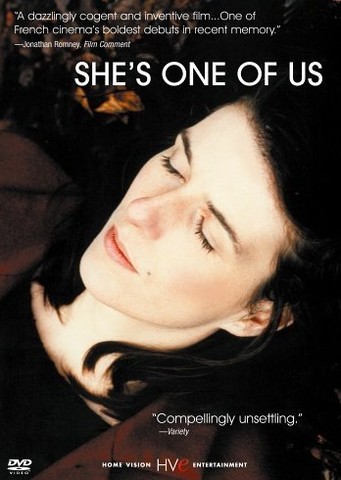
While the official jury opted for a long German joke, the deliberation for the FIPRESCI award in Stockholm transpired in, literally, a matter of seconds; the choice was that clear. As our citation states, “Elle est des nôtres” is an ambitious and extremely promising debut, a moving symbosis between its director, Siegrid Alnoy, and her lead actor, Sasha Andrès. Titled after a populist French song (and thus poorly translated to English as “For She’s a Jolly Good Fellow”), “Elle et des nôtres” resonates with a cultish ring of unwanted belonging; she is one of us, she is one of us. In a way, Siegrid Alnoy’s first feature, which premiered at the Critics Week earlier this year at Cannes – and has proven to be one of that awful festival’s true discoveries – is about possibly the most banal yet damaging cult of them all: human society in the early 21st century. Her main character, Christine Blanc (musician Sasha Andrès, remarkable in her first feature film role) is appropriately named: she is a blank. Perpetually clothed in the same red business suit, Christine toils in limbo as a temp for bosses who don’t know her name, aspiring to full-time employment and social acceptance in her suburban Annecy environment, all indistinct malls, glass office walls and stifling sterility, approaching her daily interactions with the false veneer of politeness.Read More »
Arthouse
-
Siegrid Alnoy – Elle est des nôtres AKA She’s One of Us (2003)
2001-2010ArthouseDramaFranceSiegrid AlnoyThe Female Gaze -
Laurent Cantet – L’emploi du temps AKA Timeout (2001)
2001-2010ArthouseDramaFranceLaurent CantetREVIEW
Film festivals are by their nature notoriously cut off, isolated in such a manner they rarely function as the best place to fully appreciate or accurately evaluate the merit of new works. Laurent Cantet’s astonishing “L’emploi du temps” (“Time Out”) suffers from no such equivocation. It is a masterpiece, the best film shown in this strong festival.
Cantet’s debut feature “Human Resources,” distributed in the U.S. through the Shooting Gallery Film Series, was a marvel of political urgency, social verisimilitude and human conflict. Outlined with some of the same Oedipal struggles of that film, “Time Out” is a perfectly made, emotionally piercing and artistically accomplished examination of the desperation and despair of an essentially good and caring man driven to craven, absurd acts of self-delusion. With echoes of Michelangelo Antonioni’s “The Passenger,” the movie presents a terrifying and gripping portrait of a man so alarmed at what he has become that he invents an idealized portrait to cover up his faults and limitations.Read More »
-
Andrzej Zulawski – Na srebrnym globie aka On The Silver Globe (1987)
1981-1990Andrzej ZulawskiArthouseCultPolandQuote:
A group of space researchers leaves earth to find freedom. Their spaceship crashes on the dark side of the moon. Shortly afterwards, all are dead save for the children and one adult. They create their own society, characterized by shamanism and the worship of fire. The last adult survivor is called the Old Man, who is both worshipped and loathed. The Old Man leaves the group of children for the mountains and sends his video diary in a rocket back to Earth. A space researcher named Marek (Andrzej Seweryn) receives the video diary and travels to the moon. When he arrives he is welcomed by the group of children as the messiah, seeing him as the reincarnation of the Old Man.Read More » -
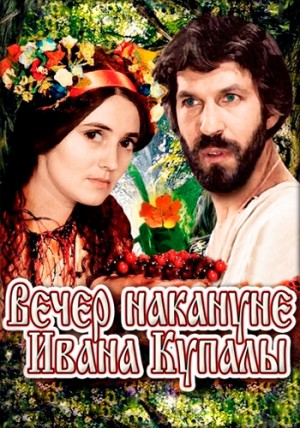
Yuri Ilyenko – Vecher nakanune Ivana Kupala AKA The Eve of Ivan Kupala (1968)
1961-1970ArthouseHorrorUSSRYuri IlyenkoBanned by the Soviet authorities, Vecher nakanune Ivana Kupala (The Eve of Ivan Kupalo) is widely held to be one of the masterpieces of Ukrainian Poetic Cinema. Adapted from a short story of Gogol, which had its roots in Ukrainian folklore, the film depicts an almost Faustian pact, in which Piotr makes an unholy deal with Bassaruv in order that he may win the hand of Pidorka from her father. The director Yuri Ilyenko brings the same rich, vivid imagery that he lent to Parajanov’s Shadows of Forgotten Ancestors where he worked as the cinematographer. The film often makes difficult first viewing for unaccustomed viewers due to its hallucinatory nature, but its lucid tapestry renders it a mandatory experience.Read More »
-
Robert Lepage & Pedro Pires – Triptyque (2013)
2011-2020ArthouseCanadaDramaRobert Lepage and Pedro PiresTriptych is a contemporary urban saga that tells the story of Michelle, a schizophrenic bookseller, her sister Marie, a singer and actress, and Thomas, a German neurologist and Maries future husband.
Against a backdrop of written and visual poetry, this film depicts three pivotal moments in the lives of these characters through the subjects of creation, mental equilibrium, social interaction, solitude, and emotional response, all the while maintaining the essence of the plays theme, which deals with the human voice. Its a study of the relationship humans have with speech and communication in all its complexity and variations. These three lives become the primary locus of personal identity and emotion, with their many manifestations, variations, and implications, through each characters inner development and burning desire for self-expression.
Triptych is a cinematographic adaptation of Lipsynch, directed by Robert Lepage.
Read More » -
Jacques Rivette – Paris nous appartient aka Paris is Ours (1960)
1951-1960ArthouseDramaFranceJacques RivettePlot:
Anne, a student in Paris, becomes involved with a group of her brother’s arty friends and gets sucked into a mystery involving Philip, an expatriate American escaping McCarthyism; Terry, a self-destructive femme fatale; theatre director Gérard; and Juan, a Spanish activist who apparently committed suicide, but was he murdered? Philip warns Anne that the forces that killed Juan will soon do the same to Gérard, who is struggling to rehearse Shakespeare’s Pericles. Anne takes a part in the play in an attempt to help him and also discover why Juan died.Read More »
-
Metin Erksan & David E. Durston – Susuz Yaz AKA Dry Summer (1964)
1961-1970ArthouseDramaMetin ErksanTurkeyWinner of the prestigious Golden Bear at the 1964 Berlin International Film Festival, Metin Erksan’s wallop of a melodrama follows the machinations of an unrepentantly selfish tobacco farmer who builds a dam to prevent water from flowing downhill to his neighbors’ crops. Alongside this tale of soul-devouring competition is one of overheated desire, as a love triangle develops between the farmer, his more decent brother, and the beautiful villager the latter takes as his bride. A benchmark of Turkish cinema, this is a visceral, innovatively shot and vibrantly acted depiction of the horrors of greed.
Excerpt from Criterion
Read More » -
Louis Malle – Les amants AKA The Lovers [+extras] (1958)
1951-1960ArthouseDramaFranceLouis MalleSynopsis:
Louis Malle unveiled the natural beauty of Jeanne Moreau in his breakthrough, Elevator to the Gallows. With his follow-up, the scandalous smash The Lovers> (Les amants), he made her a star once and for all. A deeply felt and luxuriously filmed fairy tale for grown-ups, perched on the edge between classical and New Wave cinemas, The Lovers presents Moreau as a restless bourgeois wife whose eye wanders from both her husband and her lover to an attractive passing stranger (Jean-Marc Bory). Thanks to its frank sexuality, The Lovers caused quite a stir, being censored and attacked for obscenity around the world. If today its shock has worn off, its glistening sensuality and seductive storytelling haven’t aged a day.Read More »
-
Luis Buñuel – Belle de jour (1967)
1961-1970ArthouseDramaFranceLuis BuñuelCatherine Deneuve’s porcelain perfection hides a cracked interior in one of the actress’s most iconic roles: Séverine, a Paris housewife who begins secretly spending her afternoon hours working in a bordello. This surreal and erotic late-sixties daydream from provocateur for the ages Luis Buñuel is an examination of desire and fetishistic pleasure (its characters’ and its viewers’), as well as a gently absurdist take on contemporary social mores and class divisions. Fantasy and reality commingle in this burst of cinematic transgression, which was one of Buñuel’s biggest hits. (~Criterion)Read More »