

Quote:
A young woman’s husband apparently commits suicide without warning or reason, leaving behind his wife and infant.Read More »
Quote:
A young woman’s husband apparently commits suicide without warning or reason, leaving behind his wife and infant.Read More »

Quote:
Bresson’s brilliant adaptation of Dostoevsky’s short story (A Gentle Creature) exhibits in its lapidary sequences the political and existential revolt of a young student in Paris. Sharing a theme that can be traced from Bresson’s Mouchette to his fantastic exploration of revolutionary choices in The Devil Probably, Une Femme Douce articulates in its inimitable minimalist mode a range of issues from the ideological options of France post-May ’68 to human relationships. Dominique Sanda is not the conventional, recognizable student revolutionary, but a “gentle” philosopher whose powers of sensitivity and social scrutiny exceed and tease the prosaic, crude disposition of her bourgeois husband. The sequences in the zoo, the museum of natural history and the performance of Hamlet are powerful. On another note, look out for Indian experimental filmmaker Kumar Shahani who was assisting Bresson at this time, sitting diagonally behind Sanda in the sequence at the movie theater.
Read More »

A Winter’s Tale is the second installment in French director Eric Rohmer’s Tale of Four Seasons series. Rohmer’s intention with these films is to “focus on attractive, intelligent, self-absorbed if not entirely self-aware young women who present their dilemmas with clarity and elegance and express their feelings in inspired and witty dialogue.”
Plot: Felicie and Charles have a serious if whirlwind holiday romance. Due to a mix-up on addresses they lose contact, and five years later at Christmas-time Felicie is living with her mother in a cold Paris with a daughter as a reminder of that long-ago summer. For male companionship she oscillates between hairdresser Maxence and the intellectual Loic, but seems unable to commit to either as the memory of Charles and what might have been hangs over everything.
Read More »

From Toronto International Film Festival website :
Truck driving is all sixty-year-old widower Germain (Julien Poulin) has ever known. When he is involved in a head-on collision that leaves a woman dead, his quiet life is suddenly thrown into a tailspin. Though he was not at fault, the remorse he experiences is debilitating, leaving him severely depressed and unwilling to get behind the wheel again.
Deeply concerned for his father, Germain’s son Samuel (Patrice Dubois) puts his job in Montreal on hold, travels to New Brunswick to collect his estranged older brother Alain (Stéphane Breton), and together they drive to their rural Quebec hometown to care for their stricken father. The brothers, however, have their own issues: reliable Samuel is still lovelorn decades after a teenage breakup, while Alain, an inveterate raconteur and incurable womanizer, drifts aimlessly from town to town, incapable of settling down.
As the men struggle to reconnect, it becomes apparent that all three are stuck in the past for different reasons, unable to move forward. Slowly, the brothers revive Germain’s will to live, and in the process discover fresh directions for their own lives.Read More »

Storyline
An episodic look at Grace Elliott (1760-1823) and Philippe, the Duke of Orleans, during the French Revolution. In 1790, they are friends, no longer lovers. He suggests she leave France, she warns him to quit the Revolution. In 1792, she must escape Paris on foot. Less than a month later, she returns on an errand of mercy and shows great courage saving the governor of Tuileries. The Duke in turn steps in to protect Grace. In early 1793, she demands a promise from the Duke that he vote to spare Louis’s life; he does not, and Grace is furious. In April, he warns her of a search; she is arrested and brought before the committee. Orleans, too, is suspect. The guillotine awaits. (From IMDb)Read More »
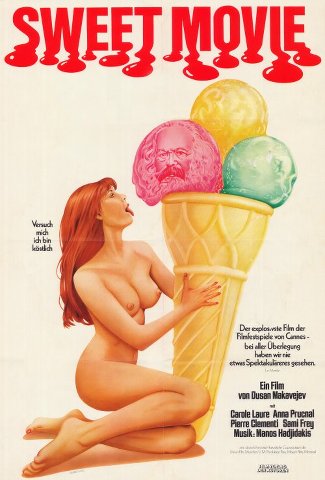
Dušan Makavejev’s anarchic 1974 comedy goes even further than his previous W.R., depicting more trangressions than the average viewer’s imagination could conjure up.
From Time Out London:
Potentially one of the most scandalous films ever made—except that it has been little seen outside France and has not aged well. Seemingly completely episodic, the ‘plot’ follows the adventures of a beauty queen (Laure), a certified virgin who escapes a disastrous honeymoon with the richest man in the world to join a group of carefree sensualists. The latter are the once-notorious Otto Muehl troupe, who delight in pissing and shitting as a public spectacle. This is cross-cut with the journey of the good ship SS Survival (which sports Karl Marx for a masthead) on the Seine. Laure herself sought legal suppression of certain shots which, in their blanked out form, ironically suggest even more sexual activity on her part. Sadly, this highly idiosyncratic melange of sex and politics, for all its liberating pretensions, only served to put Makavejev’s career back a good few steps. –David ThompsonRead More »

Synopsis:
Histoire d’eaux (Bernardo Bertolucci) – A whimsical, cross-cultural melding of east meets west romantic comedy presented in highly fractured (if unremarkable) ellipses that chronicle the couple’s chance encounter, marriage, extramarital temptation, and bizarre separation.
About Time 2 (Mike Figgis) – Multichannel split screening in the vein of Timecode, sometimes converging towards the encounter, other times intersecting temporal planes between childhood and adulthood, life and death. At each transection, the incompleteness of connection, the failure of intimacy, the painful awareness of intranscendable distance.
One Moment (Jirí Menzel) – Poetic, affectionate, lyrical, and elegy for actor Rudolf Hrusinsky composed of a wordless montage of slowed film footage spanning Hrusinsky’s entire career that embodies the human experience: toil, rest, education, romantic love, rejection, desire, aging, frailty. A recurring interstitial black screen with the words “ten minutes” becomes a constant reinforcement of transience, a career and life distilled to the precious few minutes of the film, a reflection of its brevity.Read More »
Quote:
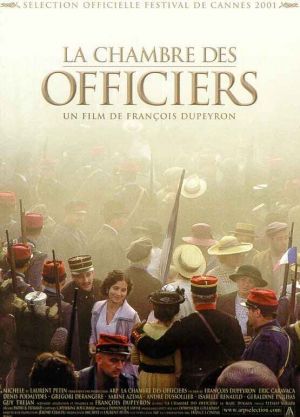
A man who thinks he’s found an easy ride through the Army during World War I has his world turned upside down when facial injuries render him unrecognizable in this wartime drama. In the summer of 1914, Adrien Fournier (Eric Caravaca) is an engineer conscripted into the French Army, where he is made a lieutenant and assigned to join a group of soldiers helping to design and build a bridge to move troops near the front lines. While scouting a suitable location for the bridge, Fournier and his fellows are caught in the middle of an attack, and a shell explodes in his face. Fournier survives the attack, but while his limbs and his body suffer only minimal damage, his face is torn to shreds — only landing in the mud prevents him from bleeding to death (the dried muck seals off a number of key blood vessels severed by the blast). It is some time before Fournier can be moved to an Army hospital, and he cannot talk through his ruined mouth, communicating with notes scratched onto a small chalkboard. Fournier finds himself in a special hospital wing for officers who’ve suffered severe injuries (a relatively comfortable area a good bit different from the crowded and spartan wards for common foot soldiers), and as a dedicated surgeon (Andre Dussollier) struggles to rebuild Fournier’s face with the primitive means available to him, the once-handsome engineer ponders an uncertain future. Commiserating with Fournier are Alain (Jean-Michel Portal), his best friend from college; Pierre (Gregori Derangere) and Henri (Denis Podalydes), a pair of fellow officers also suffering facial injuries; and Anais (Sabine Azema), a patient and warm-hearted nurse who brings hope to the hospital’s most severely injured men. La Chambre Des Officiers was screened in competition at the 2001 Cannes Film Festival.
Read More »

Quote:
Chronic traumatic encephalopathy (CTE) is a progressive degenerative disease found in individuals who have been subjected to multiple concussions and other forms of head injury. A variant of the condition, dementia pugilistica (DP), is primarily associated with boxing. CTE has been most commonly found in professional athletes participating in American football, ice hockey, professional wrestling and other contact sports, who have experienced head trauma, resulting in characteristic degeneration of brain tissue and the accumulation of tau protein. Individuals with CTE may show symptoms of dementia such as memory loss, aggression, confusion and depression which may appear within months of the trauma or many decades later. (Wikipedia)
Read More »