Blurring the line between fiction, documentary, and experimental filmmaking modes, Telaroli herself plays a director attempting to recreate a scene from Michael Curtiz’s Depression-era drama The Cabin in the Cotton. While Telaroli presides over a round robin of collaborators who take turns performing the same scene again and again, a roomful of cameras, phones, and laptops capture the scene and its production from every conceivable angle. Read More »
Arthouse
-
Gina Telaroli – Here’s to the Future! (2014)
2011-2020ArthouseExperimentalGina TelaroliUSA -
Jean-Luc Godard – For Ever Mozart [+commentary] (1996)
1991-2000ArthouseDramaFranceJean-Luc GodardQuote:
Jean-Luc Godard’s densely packed rumination on the need to create order and beauty in a world ruled by chaos is divided into four distinct but tangentially related stories, including the attempts by a young group of idealists to stage a play in war-torn Sarajevo and an elderly director’s efforts to complete his film.Read More » -
Ingmar Bergman – De två saliga AKA The Blessed Ones (1986)
1981-1990ArthouseDramaIngmar BergmanSweden“Things are never crazy in and of themselves. They only seem so from the outside.” De två saliga (The Blessed Ones or The Blessed Pair) is a 1986 made-for-television film directed by Ingmar Bergman, with a screenplay by Ulla Isaksson, based on her novel of the same name made two decades earlier in 1962. Isaksson’s novel, heavy in Christian imagery, follows a psychologist as he becomes more and more obsessed by Viveka and Sune, a former patient and her husband.Read More » -
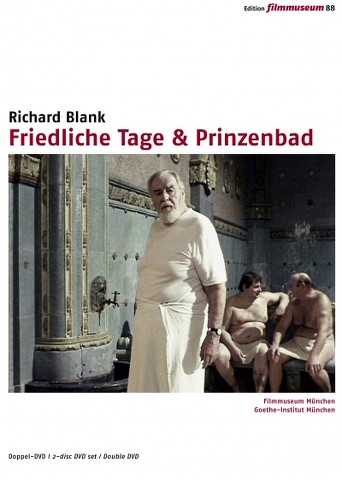
Richard Blank – Friedliche Tage AKA Peaceful Days (1984)
1981-1990ArthouseDramaGermanyRichard BlankQuote:
The dramatic arc of Friedliche Tage was developed from images and the people who sustained those images. As long as the film is set in the building where the executions are carried out and the delinquents await their end, the tale is told with “classic” suspense. After Hanna leaves there with Robert, her potential executioner played by Branko Samarowski the traditional, linear narrative form dissolves into individual motifs; images that taken together show that these two, as a couple, can’t manage in the “normal” world. And in the end, some viewers are happy that the executioner returns to his old domain. He knows his way around there, he admits to being guilty of leaving. His career is advancing there. Happy ending?Read More » -
François Girard – Le Violon Rouge aka The Red Violin (1998)
1991-2000ArthouseCanadaDramaFrançois GirardIn present day Montreal, a famous Nicolo Bussotti violin, known as “the red violin,” is being auctioned off. During the auction, we flash back to the creation of the violin in 17th century Italy, and follow the violin as it makes its way through an 18th century Austrian monastery, a violinist in 19th century Oxford, China during the Cultural Revolution, and back to Montreal, where a collector tries to establish the identity and the secrets of “the red violin.”Read More »
-
Julie Lopes-Curval – Bord de mer AKA Seaside (2002)
Drama2001-2010ArthouseFranceJulie Lopes-CurvalSeaside takes place in a small coastal town on the Bay of Somme. The year-round inhabitants find ways to make their lives work; Paul, a lifeguard in the summer, works at the grocery all winter. His mother, Rose (Ogier) likes to play the slots just about anytime; his girlfriend Marie works in the local factory – the town’s biggest business – but watching the summertime vacationers each year just makes her increasingly curious about what else might be out there. From these and several other stories, aided by close, revealing observations, we see a community perched between transition and stasis. (IMDb)
Awards:
Cannes Film Festival – Golden Camera – 2002Read More » -
Bartabas – Mazeppa (1993)
1991-2000ArthouseBartabasFantasyFranceQuote:
Mazeppa tells the story of a painter (Gericault) who is brought into the sensuous and strange world of a traveling “circus” — not like Ringling Bros., but more of a demonstration of horse training and acrobatic feats on horseback. The story is of Gericault’s immersion in the sensual pleasures of the circus — gorgeous horses, gorgeous music by Ukrainian singers, gorgeous women — and his transformation by that experience. The main strength of the movie is in the lush visuals, particularly in the portrayal of the sensuality of the horses’ bodies and movement. There isn’t a lot of dialogue, which allows the viewer to concentrate on everything else, but also leads to some confusion about what is happening and why. It was my sense that this was partly intentional, paralleling Gericault’s experience. The film has the visual richness of The Cook, the Thief, His Wife and Her Lover, but is not as disturbing (though there are some disturbing scenes at beginning and end). I loved this movie but gave it only a seven out of 10 because even after having seen it three or four times, I can’t really say what it’s about — I love the music and the imagery so much I’m willing to overlook that, but it’s hard to get anyone else to watch the movie with me.Read More » -
Manoel de Oliveira – A Divina Comédia AKA The Divine Comedy (1991)
1991-2000ArthouseDramaManoel de OliveiraPortugalQuote:
In a mental institution the patients see themselves as people like Jesus, Lázaro, Marta, Maria, Adão, Eve, Sonia, Raskolnikov, Aliosha e Ivan Karamasov, a Philosopher, a Profet, Santa Teresa d’Avila, reciting the Divine Comedy.Read More » -
Tonino De Bernardi – Verso la strada del sole (2015)
2011-2020ArthouseExperimentalItalyTonino De BernardiThis last short of Tonino De Bernardi is a meditative film about his life and cinema: he recovers an experimental short film made in the 60s and sticks in the final part of the film a sequence with his grandson – a line of continuity between Tonino’s cinema and grandson’s life.Read More »