Arthouse

  • Rita Azevedo Gomes – Altar (2003)

    Rita Azevedo Gomes2001-2010ArthouseDramaPortugal

    Quote:
    René, an actor, who has long lived withdrawn from reality after the death of his wife, Hélène. Proud in his isolation, he rarely sees anyone, yet enjoys spending hours on the phone with friends. His ghosts from a distant past haunt him. The deep restlessness of a first love remain indecipherable as before. Like Hermann Hesse’s short story Juin, from which the film is freely inspired by, it is about the mysteries of memory, about the strength of its expression through the spoken word. On the strength of the word as cinematic image.Read More »

  • Alexander Kluge – Vermischte Nachrichten AKA Miscellaneous News [+Extras] (1986)

    Alexander Kluge1981-1990ArthouseDramaGermany

    Quote:
    Let’s follow the lady announcer and listen to some stories: the one about Max the waiter and the black lady or the one about Nina Petrovna, or others about soldier lost at Stalingrad, about the sick woman, or the European military conventions and Helmut Schmidt’s visit to Erich Honecker.Read More »

  • Thierry Zéno – Bouche sans fond ouverte sur les horizons (1971)

    1971-1980ArthouseBelgiumDocumentaryThierry Zéno

    Quote:
    Bouche sans fond ouverte sur les horizons (1971, 26′)
    In 1971 Thierry Zéno creates a fascinating portrait of artist Georges Moinet in the form of a 16 mm medium-length film. A schizophrenic who lives in a psychiatric hospital near Namur, Moinet paints. After being mute for 24 years he chooses this cinematic encounter to explain his artist approach, revealing what lies behind his personal cosmogony. But this long logorrhoea proves disturbing and fails to provide possible clues to understanding his work, gradually becoming a form of music that blends in with the sounds and distant, invisible hubbub of the hospital. With Alessandro Ussai behind the camera and Roger Cambier responsible for the sound, Zéno gets up close to Moinet to better capture him in all his demiurgical excessiveness, his existence on the fringes but also his humanity, deconstructing in a series of very tight shots the man and his canvasses.Read More »

  • Werner Herzog – Wo die grünen Ameisen träumen AKA Where the Green Ants Dream [+Commentary] (1984)

    Werner Herzog1981-1990ArthouseDramaGermany

    Quote:
    The geologist Lance Hackett is employed by an Australian mining company to map the subsoil of a desert area covered with ant hills prior to a possible uranium extraction. His work is impeded by some aborigines who explain that this is the place where the green ants dream. Disturbing their dreaming will destroy humanity they claim. Hackett informs the company which offers various “solutions” such as a large amount of money or a percentage of a possible revenue. Invited on a trip to a city some of the aborigines sees a military aeroplane and express the wish to own it. The company buys it and gives it to the aborigines as a sign of good will. A runway is made in the desert and the plane is flown to the location. All negotiations concerning the area fail and the dispute goes to a court of the Commonwealth. Parties and experts are heard, obstacles are met such as an aborigine who is the sole survivor of his tribe (and language) and therefore no-one understands what he is saying.Read More »

  • Massimilian Breeder & Nina Breeder – Devil Come to Hell and Stay Where You Belong (2008)

    2001-2010ArthouseExperimentalMassimilian BreederNina BreederUSA

    From a small cabin in the mountains of New York, Nina Breeder and Massimilian Breeder begin a journey across the United States. California is just the initial destination, but just as the edge of the surrounding landscape expands, so does their ultimate d“Bonnie & Clyde meet Bruno Dumont in a sensually explosive road trip through the USA.” – CPH DOX Festival, Copenhagen, 2008Read More »

  • Med Hondo – Les Bicots-Nègres vos voisins (1974)

    Med Hondo1971-1980ArthouseFrance

    Quote:
    Arguably an outgrowth of Soleil Ô, Les Bicots-nègres analyses the living conditions of African migrant workers in France in the mid-1970s. The film has the potential to be a classic case study of cinematic over-determination. It comprises seven sequences exploring, respectively, the conditions of possibility of cinematic representation in Africa (the opening sequence), historical dissonance through the dialectic of past and present (the post-credit sequence), a flashback to the eve of African independence (the imaginary garden party sequence), the predicaments of the post-colony, an assessment of the living condition of migrant workers and the actions taken to transform these conditions, and a final sequence in a circular mode, which returns to the new cinema.
    In Les Bicots-nègres, Med Hondo engages the dual front of cinema and history through the production of what might be referred to as an indocile image. In the cinema of Med Hondo, the indocile image purports to do, undo and sometimes outdo both cinema and history.Read More »

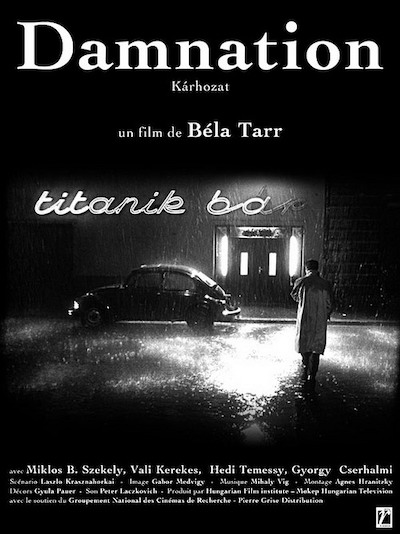
  • Béla Tarr – Kárhozat AKA Damnation [5:3] (1988) (HD)

    Béla Tarr1981-1990ArthouseDramaHungary

    Quote:
    Damnation tells the story of Karrer (Miklós B. Székely), a depressed man in love with a married torch singer (Vali Kerekes) from a local bar, the Titanik. The singer breaks off their affair, because she dreams of becoming famous. Karrer is offered smuggling work by Willarsky (Gyula Pauer), a local bartender. Karrer offers the job to the singer’s husband, Sebestyén (György Cserhalmi). This gets him out of the way, but things don’t go as Karrer plans. Betrayals follow. Karrer despairs.Read More »

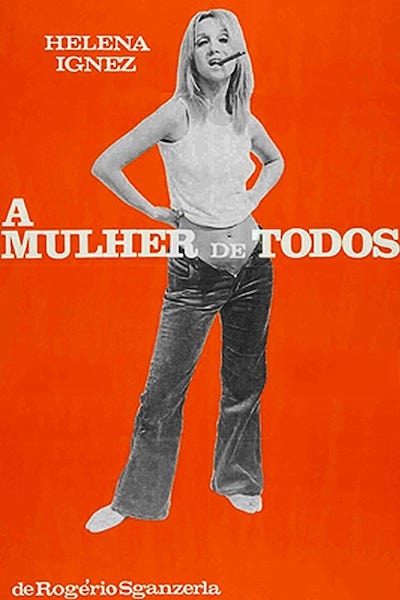
  • Rogério Sganzerla – A Mulher de Todos AKA The Woman of Everyone (1969)

    Rogério Sganzerla1961-1970ArthouseBrazilComedy

    Ângela Carne e Osso (Angela Meat and Bone), a young nymphomaniac, lives surrounded by delinquents, and exerts intense allure on them, dominating them all with her erotic power.Read More »

  • Jan Jakub Kolski – Ladny dzien aka A Nice Day (1988)

    Jan Jakub Kolski1991-2000ArthousePolandShort Film

    A pristine transport-stream recording of Jan Jakub Kolski’s beautiful early short film, Ładny dzień. Whilst his subsequent works are enjoyable, none have the same visual brilliance found here. One suspects that Kolski perhaps now views the work as immature, given that it’s so heavily influenced by Tarkovsky, but there’s a singular vision here that’s very special. The expressive use of colour, framing and montage is utterly captivating, and the beauty of the screenshots is self-evident.Read More »

Back to top button