1971-1980

  • Claude Mulot – Suprêmes jouissances AKA Supreme Delights (1976)

    1971-1980ClassicsClaude MulotEroticaFrance

    Three young women leave their chauvinist boyfriends, set up their own living situation in a luxurious apartment and revel in their sexual freedom.

    This film is also known as Suprêmes jouissances. The director Claude Mulot is credited as Frédéric Lansac.Read More »

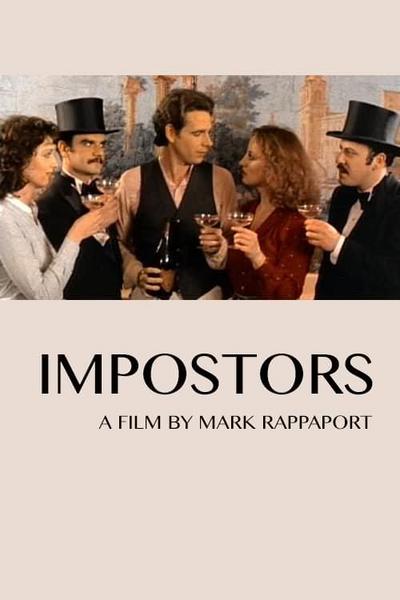
  • Mark Rappaport – Impostors (1979)

    1971-1980ArthouseComedyMark RappaportUSA

    29f7c043f76a2bde437fd0d52a185152

    Brecht said drama should always be performed with the house lights up so that that the spectator never forgot he was watching a play. Rappaport wants to remind us how artificial realism is, and how unreal our lives are. In this house of mirrors of one-size-fits-all, wash-and-wear identities, where is “reality”? In this echo-chamber of recycled one-liners, where is truth? What would it mean to escape from these permanent-press, ready-to-wear straight jackets? What would be left of language, thought, and emotion if we freed ourselves from the systems that we claim limit us? Life may be an elaborately coded charade, but what would expression be without the codes? We’d be invisible men if we took off our imaginative leisure suits. Rappaport takes his place alongside Poe, Hawthorne, and Melville, as an all-American explorer of the unreality of reality. It’s fitting that avant-garde theater pioneer Charles Ludlum is featured in one of the leads. —people.bu.edu/rcarneyRead More »

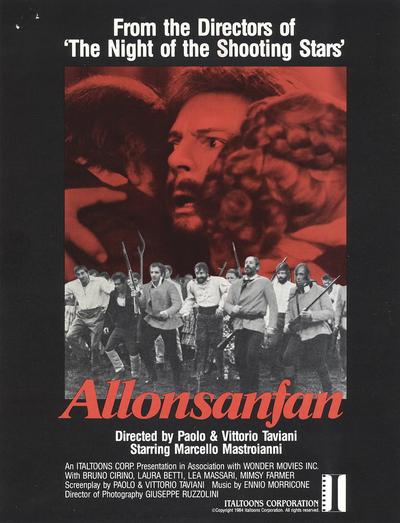
  • Paolo Taviani & Vittorio Taviani – Allonsanfan (1973)

    1971-1980DramaItalyPaolo Taviani and Vittorio TavianiPolitics

    29f7c043f76a2bde437fd0d52a185152

    Allonsanfàn
    Against the backdrop of the Bourbon Restoration, Lombard aristocrat Fulvio Imbriani, a former political extremist who once served under Napoleon, is finally released from an Austrian jail, after a lengthy sentence for his part in the secret Sublime Brotherhood. He strives to resume normal family life, but his Hungarian lover, Charlotte, together with his ex-comrades, succeeds in convincing him to take part in a revolutionary cause in the south. In fact, Fulvio considers the effort futile and fails to stop his sister Esther from reporting the conspirators. But the trap fails to catch the intended prey and, evading arrest, the comrades meet and bury Charlotte, who was killed in an exchange of fire with the gendarmerie.
    Read More »

  • Rainer Werner Fassbinder – Acht Stunden sind kein Tag AKA Eight Hours Don’t Make a Day (1972)

    Drama1971-1980ArthouseGermanyRainer Werner Fassbinder

    Stories about workers determined to use their own initiative

    On October 29, 1972, the first part of Fassbinder’s five-part family series flickered across West German TV screens. Over the next months, the public broadcaster ARD showed all five episodes, in each case on a Saturday evening in the prime-time slot: I. Jochen and Marion, (October 29, 1972), II. Grandma and Gregor (December 17, 1972), III. Franz and Ernst (January 2, 1973), IV. Harald and Monika (February 18, 1973), and V. Irmgard and Rolf (March 18, 1973). Ratings during this time ranged between 45 and 60%, figures comparable with those for the broadcaster’s top-rating crime series TATORT.Read More »

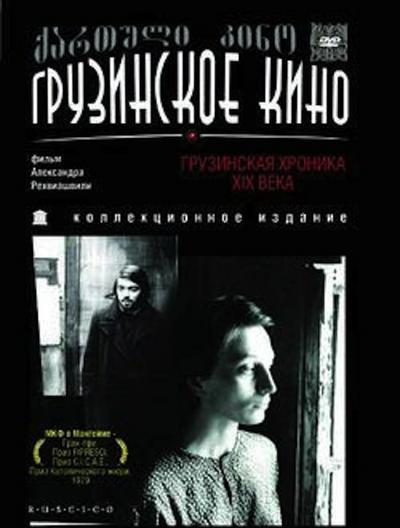
  • Aleqsandre Rekhviashvili – XIX saukunis qartuli qronika AKA The 19th Century Georgian Chronicle (1979)

    1971-1980Aleqsandre RekhviashviliArthouseDramaGeorgia

    29f7c043f76a2bde437fd0d52a185152

    The debut film by Alexander Rekhviashvili, one of the leaders of the new wave’s first flow, Georgian Chronicle of the 19th Century (Gruzinskaya hronika XIX veka, 1979), places us in a Kafkaesque city where a lonely student goes through all the circles of bureaucratic hell to help the peasants of his home village win back their land from bourgeois industrialists. The distorted urban sets in the Chronicle remind one of German expressionism and Caligari. The horrifyingly circular structure of the narrative, the morose suspense of the slow-paced action, the atmosphere of silent torture in a vacuum, bring to mind Orson Welles’s The Trial. The long sequence in the forest where two assassins chase the student and finally eliminate him, leaving the rest of the film without a hero, is obviously influenced by Kurosawa’s Rashomon. What is harder to find in Georgian Chronicle is the influence of Rekhviashvili’s native predecessors in the Georgian school.Read More »

  • Larry Gottheim – Four Shadows (1978)

    1971-1980DocumentaryExperimentalLarry GottheimUSA

    Like constellations wheeling round, a double chain of four image segments and four sound segments wheel past each other in sixteen combinations (a family of Gibbon apes, a landscape measured, a shadowed diagram after Paul Cézanne, a wintry urban scene, a text by William Wordsworth, a climactic scene from Claude Debussy’s opera “Pelleas et Melisande”). The stately ceremony can generate rich sensuous cinematic pleasure as well as a free-flowing stream of associations. Containment and flowing free, these are some of the issues. The third film in the Elective Affinities cycle.Read More »

  • Vladimir Carvalho – O País de São Saruê AKA The Land Of São Saruê & 3 shorts (1971)

    1971-1980ArthouseBrazilDocumentaryVladimir Carvalho

    O País de São Saruê (1971)

    Plot Outline: Documentary about a region in Northeast Brazil, situated in an area subject to severe drought, and the evolution of its economic activities.Read More »

  • Oldrich Lipsky – Sest medvedu s Cibulkou aka Sechs Baren mit Zwiebel aka Six Bears and a Clown (1972)

    1971-1980ComedyCzech RepublicOldrich Lipsky

    29f7c043f76a2bde437fd0d52a185152

    Quote:
    When the clown named Onion who is the trainer of a circus act involving six bears is fired, he takes a job as a cook at a school. In order to get the job, he has dressed up as a woman. When the bears come to the school to visit their friend, chaos erupts. Not only is no one prepared to cope with six friendly bears, but their visit occurs on the day when the state inspector of schools is to arrive. A chimpanzee named Tony tries to hide the six bears…
    A very warm comedy for the whole family. Made by one of the most famous Czech directors.
    Read More »

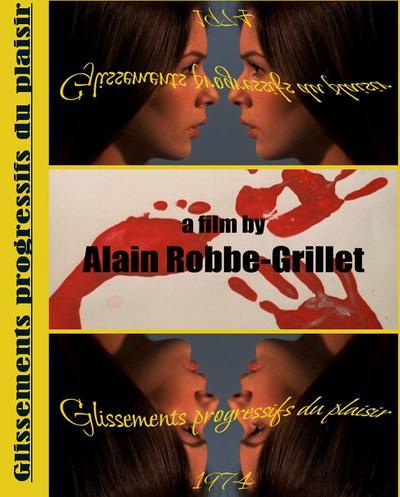
  • Alain Robbe-Grillet – Glissements progressifs du plaisir AKA Successive Slidings of Pleasure (1974)

    1971-1980Alain Robbe-GrilletArthouseFrance

    29f7c043f76a2bde437fd0d52a185152

    Quote:
    When you think of art house directors you probably think of some of the more famous filmmakers like Werner Herzog (Aguirre, the Wrath of God), Peter Greenaway (The Cook, the Thief, His Wife & Her Lover) or Alejandro Jodorowsky (Holy Mountain). Someone you may not know is French writer and filmmaker Alain Robbe-Grillet. Robbe-Grillet was part of the “nouveau roman” novelist movement which diverted from the classical style of writing and deviated from the norm with experimental prose. The same could be said with his film Glissements progressifs du plaisir (literal translation is “Gradual shifts of pleasure”) aka Successive Slidings of Pleasure where he blends dreamlike visuals with eroticism and, oddly, nunsploitation.Read More »

Back to top button