Standing out from all the stumbling efforts toward a new expression of cinema, Giovanni Pastrone’s story of the Second Punic War, Cabiria , demands special attention. Compared to the other colossal Italian spectacles of its time, it had an integrity and sense of purpose. From the beginning it was regarded as something special, and its premiere at the Teatro Vittorio Emmanuele, Turin, on 18 April 1914 was a great occasion. The film’s accompanying score by Ildebrando Pizzetti, performed by an orchestra of 80 and a choir of 70, added to the excitement. Viewed today, the film has lost little of its epic poetry to the zeitgeist, though the acting performances may seem dated.Read More »
1911-1920
-
Giovanni Pastrone – Cabiria (1914)
1911-1920EpicGiovanni PastroneItalySilent -
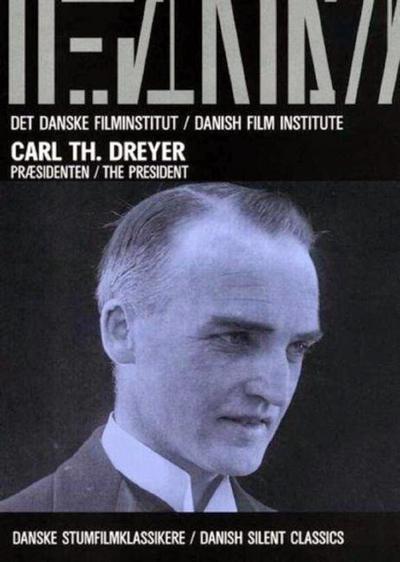
Carl Theodor Dreyer – Præsidenten AKA The President (1919)
Drama1911-1920Carl Theodor DreyerDenmark
Quote:
It perhaps comes as no surprise, given Carl Theodor Dreyer’s lifelong, idealized melancholy over his own unresolved parentage, that the scenario selected for his first film, The President would involve three generations of children conceived out of wedlock, and thematically crystallize on the legacy of their unreconciled paternity in the resolution of their own disparate lives. For Dreyer, this expurgation of such deep-seated trauma was not only manifested in the naïve idea of restoring the virtue and honor of a “fallen” woman (an archetypal surrogate for his own idealized, unwed, biological mother) through transcendence, but also in confronting the innate cruelty of the very institutions that socially (and inequitably) stigmatized such human transgressions through codified notions of morality and class division. Read More » -
Carl Theodor Dreyer – Der var engang AKA Once Upon a Time (1922)
Drama1911-19201921-1930Carl Theodor DreyerDenmarkFantasyQuote:
Once upon a Time (a.k.a. Der var engang) is an atypical film for the Danish filmmaker Carl Theodor Dreyer, a departure from his more usual realistic dramas into the realm of fantasy and fairytale. It was the only film that Dreyer made for the independent film producer Sophus Madsen, a Danish film enthusiast whose only other production was Laurids Skands’s all but forgotten Livets Karneval (1923). The film was adapted from a play by Holger Drachmann, written in 1885, that was itself based on Hans Christian Andersen’s fairytale Svinedrengen and Shakespeare’s The Taming of the
Shrew. From the outset, this was conceived as a lavish production, but it soon ran into financial difficulties. Even though some scenes were cut – including an extravagant market sequence – the film still ended up with a 150 per cent overspend on its 90,000
kroner budget.Read More » -
Louis Feuillade – L’Intruse (1913)
1911-1920FranceLouis FeuilladeShort FilmSilent -
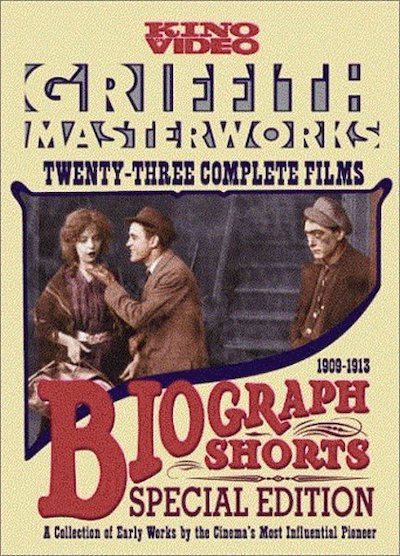
D.W. Griffith – The Painted Lady (1912)
Drama1911-1920D.W. GriffithSilentThe Birth of CinemaUSA

A lonely young woman lives with her strict father who forbids her to wear make-up. One day at an ice cream social, she meets a young man you seems interested in her. However, unknown to her, he is a burglar who is only interested in breaking into her father’s house. One night she is awakened by a noise. Grabbing a pistol, she enters her father’s downstairs office where she confronts a masked intruder . . . Read More »
-
Christy Cabanne – Reggie Mixes In (1916)
1911-1920Christy CabanneSilentUSA
Very early, rare Doug Fairbanks.
Douglas Fairbanks and Bessie Love, 28 January 2008
Author: drednm
Douglas Fairbanks started his film career in breezy little comedies that stressed his athleticism. REGGIE MIXES IN in a good example. Here he plays Reggie, a rich young man (he was 33) who oddly gets involved as a bouncer in a beer hall, a gang of thugs, and a love woman (Bessie Love). No much sense to the plot, rather a string of events loosely tied together and all aimed for Reggie to win the girl.Fairbanks started in films in 1915 and right from the start, refused to play love scenes. So even in this 1916 film, Fairbanks and Love clutch but never kiss. He has a few terrific stunts, however, that keep this film surprising and brisk (at 47 minutes). Co-stars include Alma Rubens (hysterically named Lemona), Joseph Singleton (as the butler Old Pickleface), Lillian Langdon (as the aunt), and Frank Bennett (as Sammy the thug).
Reggie is the perfect character for Fairbanks in these early films because they allow him to polish his acting skills and presage his astonishing career as the swashbuckling superstar of the 20s, a career that combined his great athletic skills with a great sense of fun.Read More »
-
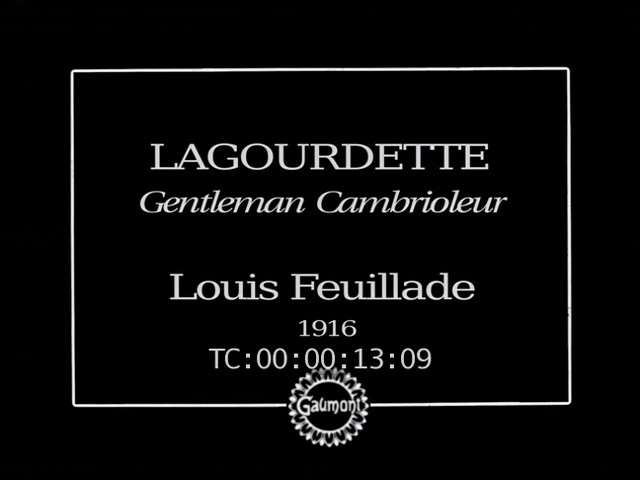
Louis Feuillade – Lagourdette, gentleman cambrioleur (1916)
1911-1920ComedyFranceLouis FeuilladeSilentWith the help of Lévesque and Musidora, Feuillade creates a light-hearted meta-fiction, self-parodying his own work.
Perdue dans la lecture des « Vampires », le séduisante Mlle Musi rêve de forfaitures et de crimes. Mais la visite qu’elle reçoit dans son salon est celle du triste Honoré Lagourdette qu’elle compte congédier rapidement. Celui-ci est en effet laid et ennuyeux. Mais pour tenter de la séduire, Lagourdette prétend être un habile voleur. Elle le met au défi de le prouver. Il s’assure de la complicité de ses domestiques, qu’il envoie à l’Opéra, et les détrousse devant les yeux médusés de Musi. Pris en flagrant délit par le commissaire, il avoue sa manipulation.Read More »
-
Louis Feuillade – Vendémiaire (1918)
1911-1920DramaFranceLouis FeuilladeSilentMovie serial “Vendemiaire” depicts a registering nationalist and regionalism concerns about the effects of the First World War.
« Réalisé dans les derniers mois de la guerre (sa sortie eut lieu en janvier 1919), en décors naturels, dans le Languedoc, ce film est une œuvre maîtresse de Louis Feuillade. Sous couvert d’un drame patriotique sur les civils en temps de guerre (les combats restent hors champ), structuré en un prologue et trois parties (« La vigne », « La cuve » et « Le vin nouveau »), il propose un film dont le réalisme quasi documentaire n’est cependant pas dépourvu de lyrisme et de poésie. Le récit, non chronologique, s’organise selon une narration présent/passé où alternent des séquences concernant les vendanges et le conflit au moment de l’invasion des régions du nord par les troupes allemandes.Read More »
-
Gilbert M. ‘Broncho Billy’ Anderson – His Regeneration (1915)
1911-1920Gilbert M. 'Broncho Billy' AndersonShort FilmSilentUSAQuote:
A rough criminal gets into an argument over a girl in a dance hall. The argument turns into a fight…Read More »