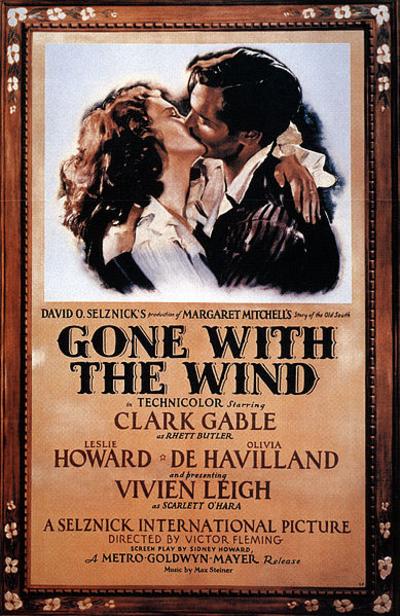

Gone With the Wind boils down to a story about a spoiled Southern girl’s hopeless love for a married man. Producer David O. Selznick managed to expand this concept, and Margaret Mitchell’s best-selling novel, into nearly four hours’ worth of screen time, on a then-astronomical 3.7-million-dollar budget, creating what would become one of the most beloved movies of all time. Gone With the Wind opens in April of 1861, at the palatial Southern estate of Tara, where Scarlett O’Hara (Vivien Leigh) hears that her casual beau Ashley Wilkes (Leslie Howard) plans to marry “mealy mouthed” Melanie Hamilton (Olivia de Havilland). Despite warnings from her father (Thomas Mitchell) and her faithful servant Mammy (Hattie McDaniel), Scarlett intends to throw herself at Ashley at an upcoming barbecue at Twelve Oaks. Alone with Ashley, she goes into a fit of histrionics, all of which is witnessed by roguish Rhett Butler (Clark Gable), the black sheep of a wealthy Charleston family, who is instantly fascinated by the feisty, thoroughly self-centered Scarlett: “We’re bad lots, both of us.” The movie’s famous action continues from the burning of Atlanta (actually the destruction of a huge wall left over from King Kong) through the now-classic closing line, “Frankly, my dear, I don’t give a damn.” Holding its own against stiff competition (many consider 1939 to be the greatest year of the classical Hollywood studios), Gone With the Wind won ten Academy Awards, including Best Picture, Best Director, Best Screenplay, Best Actress (Vivien Leigh), and Best Supporting Actress (Hattie McDaniel, the first African-American to win an Oscar). The film grossed nearly 192 million dollars, assuring that, just as he predicted, Selznick’s epitaph would be “The Man Who Made Gone With the Wind.” (AMG)Read More »
