Synopsis:
The film is set in Kyoto at the end of the Tokugawa period, when there is a fierce clash between the supporters of the Emperor, who are fighting for the overthrow of the Shogunate, and the Shinsengumi squad, who are chasing them.Read More »
While traveling through the countryside Kyoshiro is forced to defend himself against an angry samurai trying to kill an apparently innocent woman. He is soon to find out that the woman is far from innocent and he unwittingly becomes ensnared in a convoluted plot kill off a band of smugglers that have been siphoning off loot from the shogun’s treasury and giving it to one of the local (and very corrupt) officials. True to form, Kyoshiro sides with the underdogs and uses his blade to make things right. The sword battles in this film are very good and Kyoshiro dispenses his dark humor with the same flair as he wields his blade. As with the other films in this series, the camerawork and widescreen format are a treat and the acting and overall production values make this one a joy to watch. Oh yes, Kyoshiro takes special care of the “innocent” woman from the start of the film.Read More »
After Kyoshiro disposes of a half-dozen ambushers (and thus demonstrating his skill), their master, Lord Maeda, sends his ward Chisa to seduce him and set him agasinst his enemy, Chen Sun. Chen is trying to protect a document that, if revealed, will cause the downfall of Maeda’s Clan, an event Chen would relish. Deception is piled upon treachery, and to solve the mystery, Kyoshiro must find a man who is already dead, and get him to reveal the secret of The Chinese Jade. And then, of course, everyone will want him dead!Read More »
Quote:
Masaki Kobayashi’s six-part magnum opus, The Human Condition, based on Junpei Gomikawa’s postwar novel, bears the imprint of Kobayashi’s tutelage under legendary filmmaker Keisuke Kinoshita at Shochiku’s Ofuna studio, a critical, introspective, and deeply personal account of wartime Japan framed from the perspective of an idealistic everyman (and Kobayashi’s alterego), Kaji (Tatsuya Nakadai). Opening to the ironic image of lovers Kaji and Michiko (Michiyo Aratama) meeting under an archway auspiciously called the Southern Gate of Peace in Manchuria as Imperial troops march in the street, Kobayashi presents an incisive image of 1930s Japanese society that is morally consumed—and ravaged—by increasingly extremist values of militarism, occupation, and nationalism.Read More »
Fascinated with women from an early age, Yonosuke (Ichikawa Raizo) had his first sexual encounter at the age of seven. From that day on, he recklessly and forwardly pursues women, feeding his fascination and experience. As Yonosuke’s salacious behavior brings much cause for shame to the family, his father eventually breaks relations with him. Expelled from the family, 19-year-old Yonosuke embarks on a pilgrimage of lust, traveling far and wide to acquaint himself with women of all walks.Read More »
Weary of their lot, ten women – all mistresses of the same philandering businessman – join forces to wreak revenge upon him. A comedy of reversed expectations, gleefully upending traditional onscreen representations of gender (the women here act and talk like men, while the men are weak, confused or ineffectual), it’s shot in an exaggerated noir-ish manner – complete with multiple flashbacks and highly stylised visuals – that serves highlight the artificiality of its conceit.Read More »
Quote: This movie is probably as close to a chick flick as Raizo ever made! But there’s still good action and a very inventive sword fight at the end. Raizo fans cannot resist him any way. Info is sparse on this film, just recently translated into English, and once again, I rely on Paghat the Ratgirl for a review of this film:
Kiba-no-Masakichi, Masa for short, is a lumber worker who falls in love with Oshima (Tamao Nakamura) almost at first sight, in The One & Only Girl I Ever Loved (Nakayama shichiri, 1962).Read More »
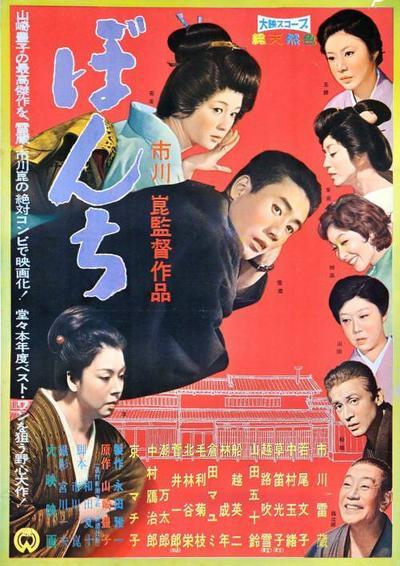
Where Ichikawa skewered patriarchal family values in Her Brother, in this savage satire he hoists the matriarchal system on its own apron strings. Raizo Ichikawa (“in his best role yet”-Variety) is the scion of an Osaka merchant family whose traditional power is matrilineal. Instructed by his overbearing mother and grandmother to give them an heiress for the family business, he stands by helplessly as wife after wife is thrown out of the house for producing sons. Driven to a life of dissipation-his mistresses also fail to produce daughters-in the end he is just too tired to care. Ichikawa’s frighteningly funny picture of the matriarchy’s efforts to perpetuate itself was received as antifeminist, if not downright misogynistic, but Joan Mellon suggests that the target once again is “the institution of the family [which] places its own survival ahead of the needs and feelings of individuals.” If this looks forward to The Makioka Sisters, so does Donald Richie’s comment, “We find this cruel matriarchal story…told in terms of the most transcendental beauty.”Read More »