Sue Lloyd

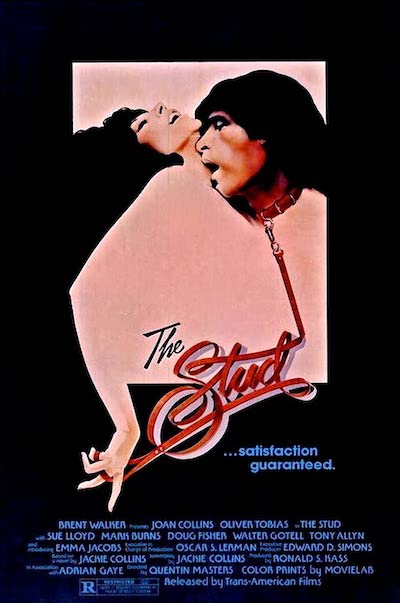
  • Quentin Masters – The Stud (1978)

    1971-1980CampDramaQuentin MastersUnited Kingdom

    Quote:
    Sometimes, when life is getting too much for you with lots of stupid dramas, there’s only one thing that will really cheer you up. And that’s a really classic trashy movie. If said movie happens to star Joan Collins, even better. The Stud is a movie tailor-made for these situations.

    Oliver Tobias is the stud of the title, Tony Blake. He was a waiter, a poor working-class kid with big ambitions, a pretty face and a hot body. He attracted the attention of the fabulously wealthy Fontaine Khaled (Joan Collins), or rather his hot body attracted her attention. So she set him up as manager of a night-club, although his main duties are to satisfy her sexual appetites. He’s constantly on call in case she has a sexual emergency that requires immediate servicing. And this happens to Fontaine quite frequently.Read More »

  • Noël Burch – Correction, Please or How We Got Into Pictures (1979)

    1971-1980ExperimentalNoël BurchPhilosophyUnited Kingdom

    Quote:
    Correction Please is a formally adventurous and rigorously philosophical essay on the nature of early cinema, made under the auspices of the Arts Council of Great Britain in the late 1970s. It emerged in the era of works like Laura Mulvey and Peter Wollen’s Riddles of the Sphinx (1977) and Anthony McCall and Andrew Tyndall’s Argument (1978), two other instances of filmmaking-as-film-theory to which Burch’s otherwise singular project might be compared. The topic of Correction Please is the development of narrative cinematic language from film’s inception to the period of sound—what Burch has dubbed “the gestation of the Institutional Mode”—investigated through a series of tautly structured segments, including ten archival examples of so-called “primitive” films made prior to 1906, animated diagrams explicating these early works, quotations from Maxim Gorky, Christian Metz, and Lillian Gish, and, most dramatically, a series of five staged sequences that recapitulate and analyze emblematic formal properties of five different chapters in cinema’s evolution.Read More »

Back to top button