Quote: Banned in Spain and denounced by the Vatican, Luis Buñuel’s irreverent vision of life as a beggar’s banquet is regarded by many as his masterpiece. In it, novice nun Viridiana does her utmost to maintain her Catholic principles, but her lecherous uncle and a motley assemblage of paupers force her to confront the limits of her idealism. Winner of the Palme d’or at the 1961 Cannes Film Festival, Viridiana is as audacious today as ever.Read More »
Quote: Quasi documentary about the creation of the Miraflores housing development after the Cuban revolution. In this first Cuban feature film made by an Afro-Cuban and by a woman, Sara Gómez uses innovative documentary and fictional techniques to focus on the marginalised in the poorest, most underdeveloped areas of Cuba. Against a backdrop of dismantled slums and new housing construction, the relationship between a mulatta and a Black Cuban unfolds as a conflict between ingrown ideas of race, class and gender and a Revolution that is trying to dismantle the old, outmoded structures.Read More »
After an accident that leaves him bedridden for two months, the filmmaker retrieves discard images he’s been collecting for eight years on his computer’s hard drive. With them he develops an intimate and poetic film, consisting of portraits of friends, walks through Barcelona and a trip to his native country, Venezuela, where chaos imposes its aesthetic appeal. A complex and fragmented film that shows the world of the filmmaker that sometimes happens to be as absurd and miraculous as a painting by Hieronymus Bosch.Read More »
A woman brings her family back to her childhood home, which used to be an orphanage for handicapped children. Before long, her son starts to communicate with an invisible new friend.Read More »
Short films by Montxo Armendáriz (b. 1949) LA DANZA DE LO GRACIOSO aka FUNNY DANCE (1979), 12 min. IMDb page
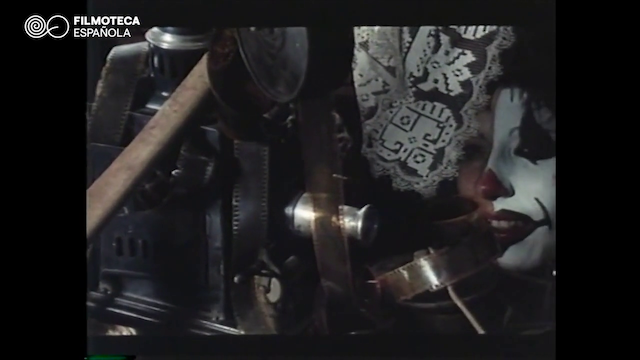
Quote: Monologue of a clown in front of a camera. Constant interruptions, which at first he accepts coily, prevent him from finishing his tale. The director interrupts him to insert some images representing a cliched reflection on the passage of time; the cameraman leaves him out of the shot to include bucolic Basque landscapes, and the producer interrupts him a third time.Read More »
In the early ‘70s, in Argentina, a group of homosexuals decided to confront the status quo. With testimonies from its survivors as its denouncement source, Sex and Revolution brings back the voices of those who thought in order to be recognized as political actors in a society that wasn’t prepared for them.Read More »
MY SON, THE HERO (1961) In northern Mexico, in the early twentieth century, Reynaldo and Martín Del Hierro are witnesses of the murder of their father by Pascual Velasco. Spurred to vengeance by their mother, they grow up to carry out a vendetta against the killer. But their revenge only begets more violence, a cycle the brothers are helpless to stop.Read More »
García Pelayo’s cardinal film is an urban collage: The love story between Ana and Miguel is determined by constant movement, towards each other and away from each other. It is the story of love as a starting point and a point of escape. Driven by a fantastic mix of eagerness to experiment on the one hand, and to act as a witness of the time period on the other, García Pelayo provides a first interim report on the after-effects of the Franco period and the transition; pointing out what political change makes people do, and what it does to them. Towards the end, this culminates in a powerfully eloquent speech about the Constitution, and the very need for it. This is an exercise in democracy by people who have been under oppression for too long. Besides, VIVIR EN SEVILLA is a perfect alternative city guide for an era, an Andalusia that has ceased to exist: García Pelayo dwells on street signs and local bars, loses himself occasionally when shooting bustling plazas, and enjoys casting local celebrities (or, at least, making actresses and actors appear as such).Read More »