
A woman, Betty, is visited by a strange salesman the day she is going away on a trip. The salesman stays in the house as a series of bizarre events occur with his arrival.Read More »
A woman, Betty, is visited by a strange salesman the day she is going away on a trip. The salesman stays in the house as a series of bizarre events occur with his arrival.Read More »

Paula, a 22-year-old student, witnesses the murder of her beloved father, a popular political science professor at a public university in the city of Medellín. From a distance, she catches a glimpse of the killer as he speeds away on a motorbike. Devastated by grief in the aftermath, Paula and her family will have to face official indolence. The authorities will make no effort to clarify what happened and the case will soon be shelved and suspended.
(translated from FILMAFFINITY)Read More »
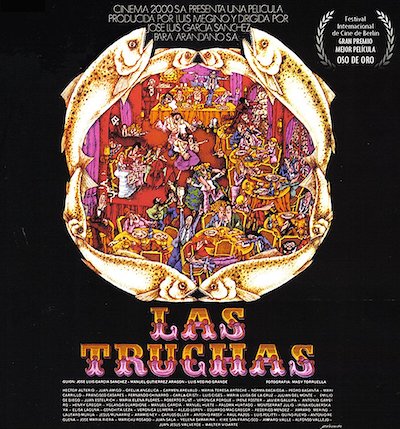
Synopsis
A grand banquet in honor of a sports association of anglers is being prepared in a restaurant, but several circumstances seem to have conspired to boycott the event.
Berlin Golden Bear Award Winner 1978Read More »
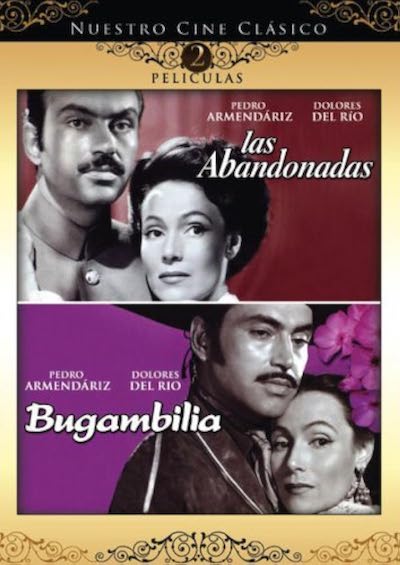
David Melville writes —
Fans of old Hollywood may remember Dolores del Rio as a ravishing beauty who couldn’t act. Moving from Mexico to the US in the late 20s, she played decorative roles in largely mediocre films. Even the classic South Seas romance Bird of Paradise (King Vidor, 1932) used her less as an actress than as a live Gauguin painting. The musical Wonder Bar (Lloyd Bacon, 1934) gave her little to do beyond a sadomasochist tango with whips. By the early 40s, not even her liaison with Orson Welles could get Dolores a role in a decent film.Read More »

A prostitute enters a brothel and establishes a rivalry disguised as affection with the old owner. She manages to take over the business and the old lady’s lover. After disputes with her now lover, she leaves the brothel, only to find out the next day that the old lady has died. Then, due to a passionate outburst, the new owner sets fire to the brothel and dies along with her lover.Read More »

Synopsis:
Etzel, the son of prosecutor Wolf Andergast, discovers that eight years ago his father condemned Léonard Maurizius to a life sentence in prison for the murder of his wife Elisabeth. The case made Andergast famous but Etzel knows that Maurizius’s conviction depended on the dubious testimony of a witness named Grégoire Waremme. Determined to find out the truth, Etzel tracks Waremme down to Zurich and discovers that the evidence he gave at the trial was not the whole truth…Read More »

Pilar lives in the south. She recently lost her father and is now on her own. María came to visit her, to keep her company and take a break from the boyfriend she’s on the point of leaving. Neither has the wherewithal to comfort the other. Neither knows what they want. They barely know what they don’t want. They don’t want to go back to their lives. They don’t want to think about the future. They don’t want to be alone. They don’t want their holiday to end. A timber yard about to close, a horse and a dog, a few men, a little alcohol and the cold waters of the southern lakes.Read More »

Released in three parts, Patricio Guzman’s epic documentary The Battle of Chile (1975-’79) captured such critical events as the bombing of the presidential palace during the 1973 military coup, but it wasn’t screened in Chile until the 1990s. That belated premiere inspired Guzman to make this 1997 documentary, in which clips from the earlier film are threaded among interviews and powerful sequences showing the reactions of Chilean viewers. Whereas The Battle of Chile uses voice-over narration to summarize its on-the-spot footage, manipulated only minimally by editing, Chile, Obstinate Memory is more expansive. Without ignoring or hyperbolizing the way politics affects our sense of the past, it presents many galvanizing moments; at one point a viewer who was a child during the coup shamefacedly recalls his pleasure at being allowed to stay home from school.Read More »

THE BATTLE OF CHILE (3): The Power of the People (1978) deals with the creation by ordinary workers and peasants of thousands of local groups of “popular power” to distribute food, occupy, guard and run factories and farms, oppose black market profiteering, and link together neighborhood social service organizations. First these local groups of “popular power” acted as a defense against strikes and lock-outs by factory owners, tradesmen and professional bodies opposed to the Allende government, then increasingly as Soviet-type bodies demanding more resolute action by the government against the right.Read More »