Sôji Kiyokawa

  • Hisatora Kumagai – Shanhai rikusentai aka Naval Brigade at Shanghai (1939)

    1931-1940Hisatora KumagaiJapanWar
    Shanhai rikusentai (1939)
    Shanhai rikusentai (1939)

    This film attempts to reconstruct the tension of the Battle of Shanghai through an episode in an understated way, introducting its story in a documentary mode. In the film story, Japan’s marine regiment protects Japanese residents and Chinese refugees-women and young children-from rampant street fighting, Shanhai Rikusentai unsparingly uses its first eight minutes for an official-mannered self-justification of the war. From the viewpoint of explaining Japan’s military operation,the narration refers to the city s spatial division in sync with maps on screen.
    [Dissonance to Affinity: An Ideological Analysis of Japanese Cinema in the 1930s]Read More »
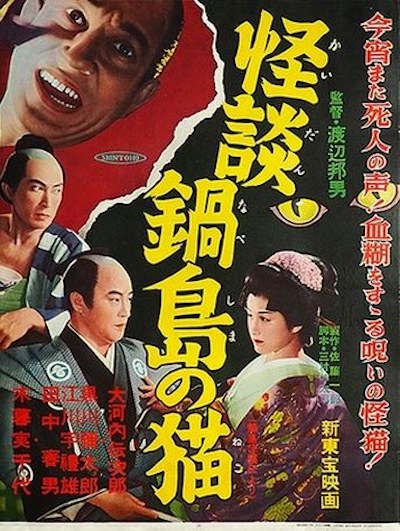
  • Kunio Watanabe – Nabeshima kaibyô-den AKA The Legend of Big Cat on Nabe Island (1949)

    1941-1950HorrorJapanKunio WatanabeMystery

    Quote:
    Tanuma Kandayuu is a high class samurai of the house of Nabeshima. He finds a lavish board of Go at Kinbei’s store. He recommend Kinbei to offer it to his lord. Kinbei hesitates at first, since he knows the board has some weird history. It is believed that one game played on the board requires one death.Read More »

  • Akira Kurosawa – Ichiban utsukushiku AKA The Most Beautiful (1944)

    1941-1950Akira KurosawaDramaJapan

    29f7c043f76a2bde437fd0d52a185152

    The Most Beautiful is a wartime propaganda film depicting the efforts of female factory workers in a precision-lens manufacturing plant. It is episodic and anecdotal and very documentary-like. Donald Richie records specific instances of documentary techniques borrowed principally from Russian filmmakers such as the austere and static composition of its scenes. This need not be entertained to any considerable degree: the point is, holistically, the overwhelming impression is one of a document. We see many shots of the lens-making equipment, and through these learn the process of lens manufacture itself. Nearly every scene is segmented with shots of a parade (a military band, a marching platoon of young soldiers, etc.) and the film itself was shot in a real factory, a length to which Kurosawa would rarely go in later work.Read More »

Back to top button