

The story follow Japan’s surrendering in WWII. On August 14-15 the surrendering declaration had already been prepared for broadcasting; however, a group of rebel soldiers attempted a coup d’état by invading the emperor’s palace.Read More »
The story follow Japan’s surrendering in WWII. On August 14-15 the surrendering declaration had already been prepared for broadcasting; however, a group of rebel soldiers attempted a coup d’état by invading the emperor’s palace.Read More »

There are two gangsters. The one who is planning to rob the 500 million yen from the large factory. and The another one who is planning to take that money over….Read More »

Quote:
Sabu and his pals hold a pauper’s funeral for Sabu’s mother. His brother Jiro arrives home, fresh out of jail, and Sabu pointedly states that Jiro is not invited. Jiro meanwhile is planning a big job – steal 40 million in cash and drugs, and he invites Sabu and gang to act as decoys, for 50,000 each. The sting is a success, but the double-crossing starts almost immediately. Sabu discovers how little of the take they were promised and hides the stash. Jiro and his slimy partner pressure the kids to fess up. Meanwhile, their respectable elder brother Ichiro is being leaned on by the town’s big boss, whose money it was.Read More »

Twenty six years after the execution of her soldier husband on the dying days of World War II the widow is still searching for the truth by meeting with, questioning and interviewing the dead man’s comrades, companions and executioner. The stories retold are one part of the reason why war is as bad as has been said. The state and existence of the survivors is another witness to the dangers of war and warmongers.Read More »
Quote:
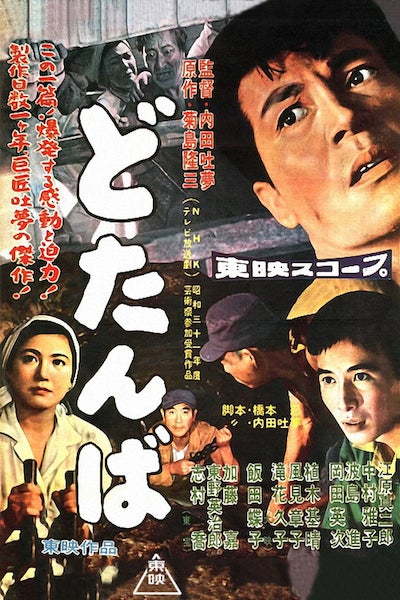
Based on a 1956 television feature on Japan’s national network, NHK, this is one of Uchida’s rarest films. A socially conscious drama with a contemporary backdrop, Dotanba focuses on the attempts to rescue a group of trapped miners. The title is a figure of speech — (essentially “last minute” or “eleventh hour”) — that refers to a situation of peril. The film boasts a script co-written by Uchida and Akira Kurosawa’s frequent screenwriter, Shinobu Hashimoto, and stars Kurosawa’s frequent star Takashi Shimura.Read More »

Quote:
Everyday, 12 April 2006
Author: sharptongue from Sydney, Australia
The style is equivalent to the kitchen sink dramas which came to prominence in the 1950s. No kitchen sinks here, but plenty of the gritty (or, more accurately, muddy) details of everyday life on rice farms and fishing boats, where the only labour-saving device is a cow to pull a rotary hoe – and the cow is only on hire. Much screen time is devoted to planting and harvesting the rice, and catching fish and eels on the lake. Punishing work, liked by no-one.Read More »